Native Landscapes, Exotic Plant – a Harvest Report
Matthias Plath · 6 July 2026
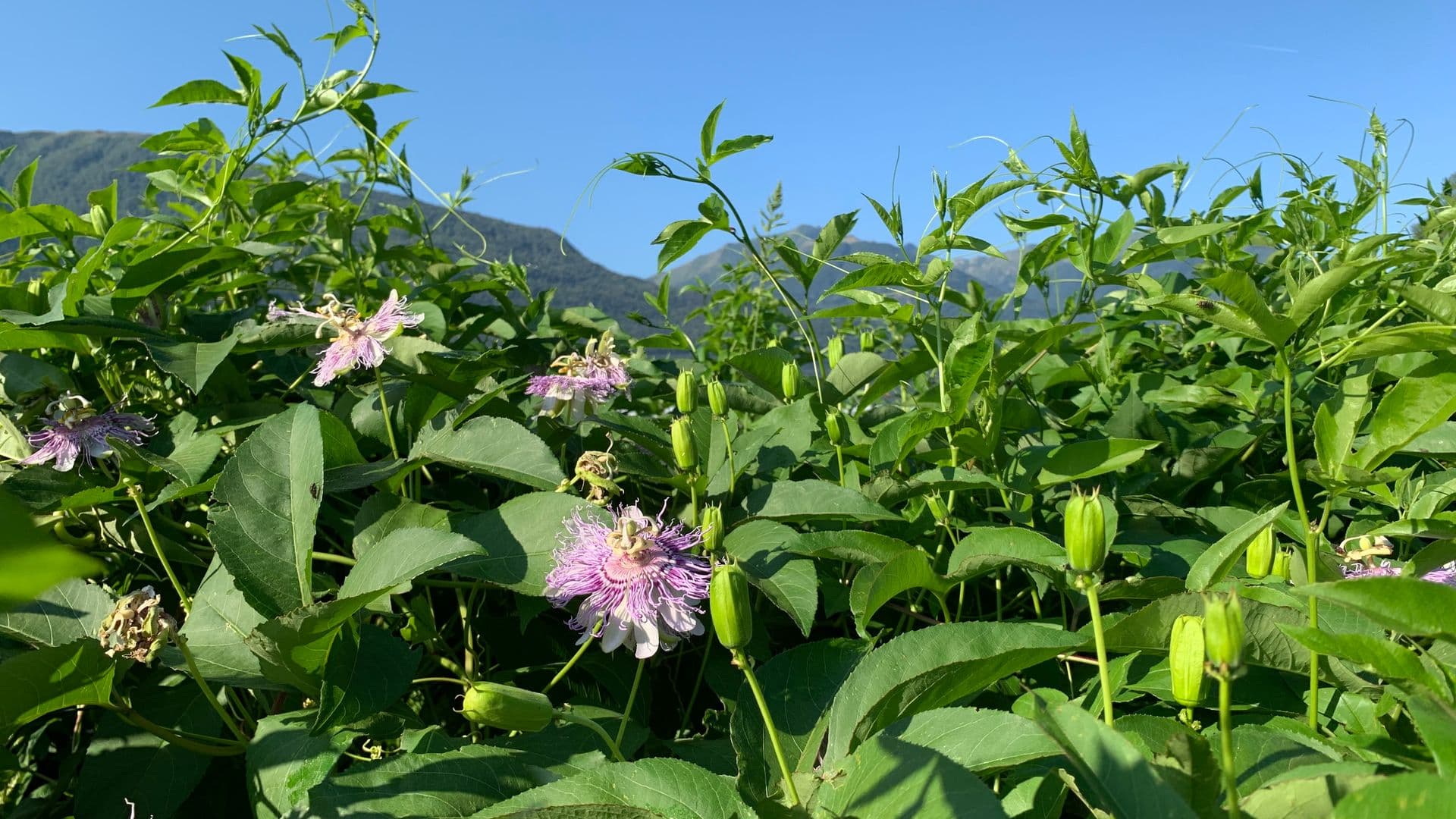
Even before sunrise, the journey to Ticino begins for the harvest of Passiflora incarnata. Production manager Matthias Plath takes us along for a day when care, experience, and the right timing determine the quality of the fresh plant material.
Early in the morning it begins. The sun is just rising over the horizon as I get into the small van in Kesswil. The vehicle was already loaded the day before with everything I need. Now the load space is filled right up to the roof with our proven green harvest crates. This July morning, the journey takes me southwards to Ticino, to our passionflower (Passiflora incarnata).
Our local cultivation partner and I have been in close contact for two weeks and, based on pictures, we jointly decided yesterday that the plants are now ready for harvest. The optimal harvest time is an important criterion for the high quality of our raw materials. Passiflora is one of those few plants that we cannot personally accompany intensively during the growth phase. It could not be cultivated locally at Lake Constance in the desired quality. Hence, it is grown further south, in the canton of Ticino, where it clearly feels much more at ease.
Fundamentally, many medicinal plants can also be cultivated outside their natural distribution area. However, it depends on the effort involved and how the location affects their quality. For Ceres, it is clear: the plants should develop outdoors and contend with sun, wind, rain, and the changing conditions of their location. Only in this way can they together with their environment “grow up”. Passiflora originally comes from southern North America and is among the few cold-resistant species of its genus. In the warm climate of Ticino, it finds conditions under which it can develop optimally in the open field.
“Our plants should confront all environmental factors at their growing site and grow up together with them.”
Matthias Plath, Production Manager Kesswil
The latest pictures I have received are promising. The plants are blooming luxuriantly and have thrived magnificently over the past three weeks. Initially, they grew a little slower, then gained strength with the warm July days. Now they show themselves in full vitality and bloom.
At just the right time, Passiflora has received sufficient rainfall. Subsequently, many sunny and warm days provided optimal conditions. It rewards the good weather and the care of the grower with many flowers. These spectacular, exceptionally beautiful flowers with their intricate structure immediately catch the eye.
The Flower of Passiflora
Those who take time to look more closely at the flower discover an astonishing architecture of concentric circles. White corolla and green calyx petals, the violet-white striped corona, as well as the prominently protruding stamens give it its distinctive appearance. Particularly fascinating: each single flower shows its full beauty for only about one day.
With these images in mind, my journey continues. It leads me through the Rhine Valley heading south, then steadily higher into the mountains until I finally reach the San Bernardino Tunnel. From here, it goes down again into Ticino, towards Lake Maggiore, to the fields of our cultivation partner. No one would expect a plant with such an extraordinary appearance in our latitudes in the open field. After all, it is better known from gardens in sheltered locations by house walls or in pots that are cared for and protected from frost during winter.
A Plant with History
The first contact Central Europeans had with specimens of the genus Passiflora was through Spanish missionaries. When they came to the “New World”, they saw in this plant a sign from God. The unusual flower was supposed to give an indication of the mystery and the suffering story of their saviour. They believed they recognised countless Christian symbols that symbolised Christ’s path of suffering from arrest to crucifixion. It is due to this circumstance that the plant owes its name: Passiflora.
Species of Passiflora were already used by the indigenous native population as a food source, but also as a calming and medicinal product. As early as around 1570, a description of Central American medicinal plants referred to its use for insomnia and melancholy. A Spanish Jesuit later considered it an equivalent substitute for hops and included the plant in his “Materia medica misionera” in 1710. Botanists and collectors then ensured wide distribution of various species in the 18th and 19th centuries so that today the genus Passiflora can be found throughout all tropical and subtropical areas. In Europe, it is mainly cultivated in botanical gardens and as an ornamental plant.
The fruits of Passiflora incarnata are decidedly less aromatic than the fruits of other Passiflora species, which we know as passion fruits. For us, it is not the fruit that is central, but the flowering herb, which we process fresh immediately after harvest.
The Quiet Magic of Harvesting: From Cutting to Further Processing
Looking forward eagerly to a lovely day’s work, I arrive early in the morning at my destination. The plants come out of the night vital and fresh. We immediately begin harvesting. Carefully, we detach the plants from their climbing aids and lay them individually and carefully into the harvest crates.
Already at the first cut, an intense scent fills the air. The aroma of the herb is surprisingly strong and heavy – almost somewhat “charred” – while the delicate flowers seem light and almost floating. It is precisely this contrast that fascinates me anew every year. While cutting, the large flowers keep appearing between the leaves and accompany the entire harvesting process.
I enjoy these hours: the awakening of the day, the vitality and freshness of the plants and their scent.
Matthias Plath, Production Manager Kesswil
Despite the considerable quantity of plants, the harvest every year proceeds astonishingly calmly. Without haste, one work step follows another. A workflow emerges that almost carries itself – from the first cut to loading the last crate.
After about two hours, this pleasure is already over. The green crates are now well filled with around 200 kg of flowering herb; they are loaded, and I immediately set off back towards Lake Constance. Because it is precisely this vitality that we want to “capture” in our mother tinctures. A brief call from me after the harvest is complete with the estimated time of arrival in Kesswil already lets me feel the anticipation of those who stayed behind for this exciting plant. Shortly thereafter, its fresh processing begins in Kesswil – exactly why the early departure was worth it.
Literature
- Dörken & Jagel (2012): Passiflora spp. – Passionflowers (Passifloraceae). Yearbook Bochum Botanical Association, Volume 3, pp. 251–262.
- Schneider (2013): Passiflora incarnata. Profile of a medicinal plant. Deutsche Apotheker Zeitung, No. 50, p. 86. Online: https://www.deutsche-apotheker-zeitung.de/daz-az/2013/daz-50-2013/passiflora-incarnata (accessed 03.07.2026).
Matthias Plath
Ceres Production Manager, Head of Plant Quality, Specialist Author
For over two decades at Ceres, he has shaped the development and manufacture of medicinal products. As an expert in plant quality, he ensures the highest pharmaceutical and herbal medicine standards.
Continue on Ceres channels
These links open the respective platforms directly. They are intended as a supplement to the article, not as a native in-page interaction.