Salvia officinalis — Medicinal Plant of the Year 2023
Margret Rupprecht · 1 June 2023
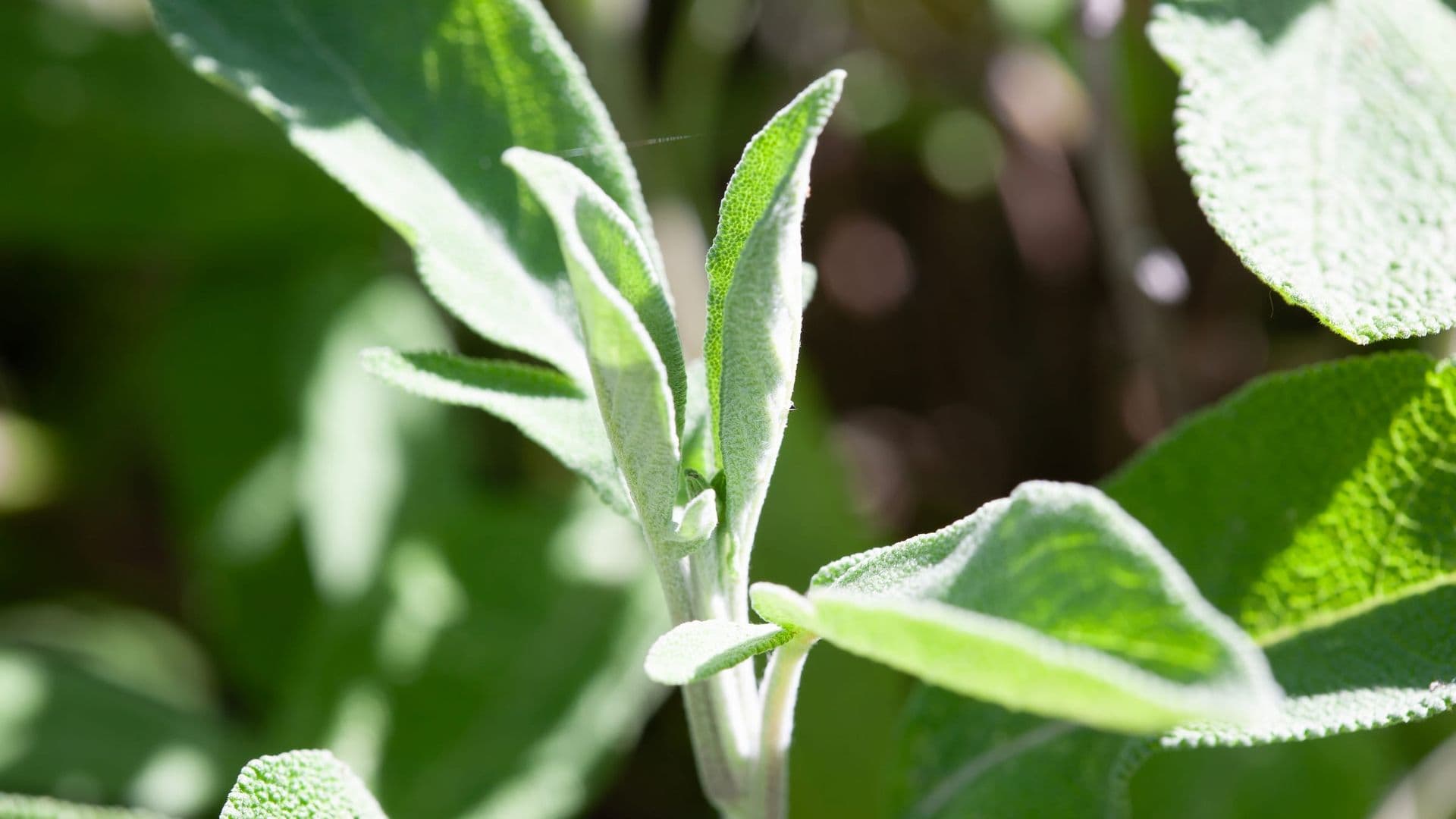
Garden sage is primarily known for its beneficial effects on throat inflammations. However, it can do much more and is now considered one of the most important medicinal products in phytotherapy for women during menopause.
"Sage shines foremost, sweet in scent, potent in strength, and useful as a drink; it is found helpful in most human ailments and deserves to always enjoy a youthful freshness," wrote the monk Walafridus Strabo in the 9th century about Salvia officinalis, the garden sage. The high esteem for this plant in the Middle Ages is also revealed by the saying "Cur moritur homo, cui Salvia crescit in horto? Contra vim mortis non est medicamen in hortis. – Why does a person die, in whose garden sage grows? There is no remedy in gardens against the power of death." In other words: no herb grows against death – not even sage can prevent it, although it can do so much otherwise. Salvia officinalis was attributed such healing power that it was given the "most healing" of all names: the botanical name Salvia derives from the Latin salvare, which means "to heal". From this not only the official German name Salbei has developed, but also many popular names such as Selbe, Salbine, Sälvli, Salverer or Selb. The Latin word salvus – healthy, intact, sound and whole – related to salvare, corresponds in Ancient Greek to the word holos – whole. According to the understanding of the ancient physicians, sage has the ability in this sense to make a person whole again, that is, complete. The concept of health in salvus – holos is identical with the concept of wholeness.
As a classic Mediterranean plant, sage was already known in Hippocratic medicine and was thus used medicinally as early as the 5th century BC, particularly for diarrhoea and treatment of the uterus. Little is known about the plant from the so-called Dark Ages of the first millennium AD. The fathers of botany in the 16th and 17th centuries – the physicians Adamus Lonicerus, Hieronymus Bock and Petrus Matthiolus – again praised sage to the skies and recommended it to soothe coughs, stimulate urination, promote menstruation, stop bleeding, heal wounds, treat colds and inflammations of the throat and larynx, and care for teeth. In the 17th and 18th centuries, the beneficial effects of Salvia officinalis on sweating were described for the first time, especially in convalescence after acute illness. It was also mentioned for the first time during this period as a remedy to stop lactation, since it not only acts suppressive and balancing on sweat glands but also on other glands, for example the milk glands of the female breast. The intense aroma of garden sage, which is still fondly woven into church bouquets by old women in the countryside, is reflected in names such as Altweiberschmecken or Geschmackblätter.
Medicinal plant for the "intake organs"
The semi-shrub originating from Southern Europe, which can grow up to one metre high, forms bushes with robust, evergreen, stalked leaves that are elongated and finely serrated. The young leaves are white-grey and felted, the corollas violet and two-lipped. Sage blooms from May to July. Sage leaves acquire their characteristic scent and flavour from numerous glands that secrete essential oil. The character of the sage aroma is hard to describe. It is unclear whether it has a warming or cooling effect. The aroma behaves similarly to the effect. It goes in two directions: sage preparations can suppress sweating and hot flushes, but at high dosages can also stimulate sweat production. The leaves of garden sage have an extraordinary blue-green hue. Typically blue is a cold colour, but the grey-greenish blue shimmer of Salvia officinalis contains many warm components.
Sage thus demonstrates an balancing quality in its signature, uniting aspects of two different poles. A newly formed sage leaf always appears at the top of the stem and initially is completely rolled up. Later, it unfurls but remains partly tubular and slightly open upwards, like a receptive gesture. The plant has an essential relationship to organs that are involved with intake and reception: to the throat and the female reproductive organs. This corresponds to the two most common areas of application: throat inflammations and hot flushes during menopause.
Pharmacologically active ingredients and proven indications
Sage contains up to 2.5 per cent essential oil, which mainly consists of monoterpenes and is composed of thujone, camphor, cineole and others. It also contains sesquiterpenes, labiatae tannins, diterpenoid bitters, flavonoids and triterpenes. Medicinal sage preparations have anti-inflammatory and astringent effects and additionally inhibit the growth of viruses, bacteria and fungi. Externally, sage is used for inflammations of the oral and pharyngeal mucosa, such as gingivitis, stomatitis and pharyngitis, primarily as a gargle. Sage leaf tea is excellent for digestive disorders, flatulence, inflammation of the intestinal mucosa and diarrhoea. This has not changed since Hippocrates' time, as modern pharmacological and clinical studies often confirm what empirical medicine has known for millennia.
Internally, sage is used as an antiperspirant, to inhibit sweating during night sweats after infections, hot flushes and sweating episodes in the climacteric, as well as for psychosomatically induced sweating. Sage also inhibits "milk gland sweating," the secretion of milk, making it a popular ingredient in teas that facilitate weaning.
Throat Inflammation
Tonsillitis or lateral pharyngeal angina always entails difficulty swallowing. They often develop especially when a person is under severe psychological stress: when the pharyngeal mucosa becomes inflamed, one can literally and figuratively "swallow nothing." One becomes a poor wretch burdened with too much on the neck: the exhaustion of the mental capacity to take in somatises as an inflamed throat. Sage can restore both the internal and external capacity to receive by transferring the refusal to accept certain things from the throat to the outside. Those who can ward off unpleasantness already at the relationship and communication level and defend their own access combatively do not need to fight this battle in their throat. This requires a process of awareness that sage supports. To achieve this therapeutic goal, not only the inflamed throat but also the overwhelmed soul needs treatment. A holistic therapy that brings the external inflammation and internal overwhelmed state to a close equally is the use of a phytodynamically active sage mother tincture, in which not only the pharmacological, anti-inflammatory substances of the plant are effective. The essence and life energy of sage also act healing on the overwhelmed person in the sense that the patient undergoes an inner process that culminates in learning to open up again flexibly. A sage mother tincture has a cooling effect in throat inflammations and supports the patient in becoming more receptive on a psychological level.
Hot Flushes in Menopause
"During the reproductive phase of life, the balance of Yin and Yang is maintained by hormone production. In the climacteric, due to slowed hormone production, the Yin-Yang balance changes. This leads temporarily to an excess of heat (Yang)," explain Swiss medicinal plant researchers Roger and Hildegard Kalbermatten regarding the balancing healing power of sage for women in menopause. In the climacteric, a new life phase begins for the woman, in which her fertility shifts from the physical to the spiritual level. If she struggles with this transition and fights against it "in the sweat of her brow," which may manifest as several hot flushes daily, sage supports the process of expanding personality and opening up for the second half of life and new interests and tasks.
In Indian, the word "menopause" translates as "finally no more children." Many women who have successfully managed the transition from physical to spiritual and practical fertility have made a real fresh start at the beginning of menopause, among them politicians such as Golda Meir and Indira Gandhi, as well as writers like children's author Astrid Lindgren and Nobel laureate Toni Morrison.
Hot flushes can be an indicator in the psychosomatic understanding that one is stuck in the "old programme" of menstruation, ovulation, pregnancy and childbirth. Sage, whose leaf shape forms a gesture open upwards toward the sky and thus towards the spiritual, can physically bring hot flushes to an end because it promotes the woman's receptivity for spiritual tasks on a deeper level and thereby stimulates an inner developmental process that can culminate in a new type of fertility – whether philosophical, political, social or otherwise.
Excessive Sweating: Hyperhidrosis
Common parlance includes the term "fear sweat" or also sweating in the sense of bleeding/hemorrhaging. People who sweat excessively constantly lose vital sap and life force. They may sweat from exertion because they perceive their life as very stressful. Or they are unconsciously yearning intensely for something but ultimately do not know what their desire relates to. Sage here again imparts the ability to open up and improve receptivity to new life contents. When people tend to cold sweat, there is often a fear issue underlying it. Awakening receptiveness to spiritual experiences can in such cases strengthen basic trust and help reduce anxiety and thus the fear sweat.
Those prone to hot sweat can, with the help of sage, become aware of the inner heat – learning to perceive moments of overexertion and open themselves to development and commitment on a higher level.
The tannins contained in sage are central to its sweat-inhibiting effect, as they generally act to tone the organism and reshape swollen, waterlogged tissue. Since the female mammary gland is also a type of sweat gland, sage supports weaning and reduces excessive milk secretion.
Humoral Pathology and Traditional Chinese Medicine
In humoral pathology, an ancient theory of disease based on bodily fluids, their proper or faulty mixture and composition, recognised until the 19th century, sage is considered a medicinal plant warm in the first degree and dry in the second. Therefore, it has the ability to "dry excessive moisture," which – translated from the language of the ancients into modern medicine – means this plant is capable of combating inflammation and suppressing excessive sweat production. Sage is also well known in Traditional Chinese Medicine (TCM) and remains highly valued there today for its drying, astringent, antiseptic, wound-healing and tonifying properties. It is used, among other things, for damp-phlegm that obstructs the lungs and mainly to tonify lung Qi and Wei Qi in respiratory infections, throat, tonsil and larynx inflammations, and lung catarrh, as well as against sweating on slight exertion, for weaning and for wound healing. In both cultural spheres, Chinese and European, practically the same indications have been discovered for Salvia officinalis and sage has been used successfully in the treatment of all the aforementioned ailments and complaints.
Sage is available in many dosage forms: from lozenges to tea to tincture. Those who wish to harness not only the pharmacological healing effects of this medicinal plant aimed at bodily symptoms but also its psychotropic potential to activate psychological developments work best with a plant mother tincture that is handmade avoiding high-speed industrial manufacturing processes. Only then is it ensured that the essence and life energy of the plant remain contained in the medicine and have the power to set inner processes in motion in the patient's psyche. This high medicinal quality is found, for example, in the plant mother tinctures of the Swiss manufacturer Ceres Heilmittel AG. Also holistic, though in a different manner, are the medicinal products of anthroposophic manufacturers such as Weleda or Wala.
Because of "its extensive use in history and present and its great potential for further research," the Study Group for the History of Development at the University of Würzburg in early 2023 declared garden sage, Salvia officinalis, the medicinal plant of the year 2023. In doing so, they drew attention to a plant that belongs to the oldest and most important medicinal products in phytotherapy – not only in Europe.
Literature
- Beuchert, M: Symbolik der Pflanzen. With watercolours by Maria-Therese Tietmeyer. Insel Verlag, Frankfurt and Leipzig 2004
- Dingermann, T, Loew, D: Phytopharmacology – Experimental and Clinical Pharmacology of Plant Medicinal Products. Wissenschaftliche Verlagsgesellschaft, Stuttgart 2003
- Garvelmann, F: Medicinal Plant Studies in Humoral Pathology – A Tabular Handbook of Phytotherapeutic Constitutional Remedies. Richard Pflaum Verlag, Munich 2000
- Kalbermatten, R, Kalbermatten, H: Plant Mother Tinctures – Essence and Application. AT Verlag, Baden and Munich 2005
- Kalbermatten, R, Kalbermatten, H: Psyche of Humans and the Signature of Medicinal Plants. AT Verlag, Aarau and Munich 2020
- Madaus, G: Textbook of Biological Remedies. Mediamed Verlag, Ravensburg 1990
- Roger Kalbermatten with collaboration from Hildegard Kalbermatten: Essence and Signature of Medicinal Plants – Form as Key to the Healing Power of Plants. AT Verlag, Aarau 2002
- Traversier, R, Staudinger, K, Friedrich, S: TCM with Western Plants – Phytotherapy, Acupuncture, Dietetics. Haug Verlag, Stuttgart 2012
- Wichtl, M: Tea Drugs and Phytopharmaceuticals – A Practical Handbook Based on Scientific Foundations. Wissenschaftliche Verlagsgesellschaft, Stuttgart 2008
About the Author
Margret Rupprecht
She studied Greek, Latin and German studies and subsequently worked for several years as a publishing editor for ancient languages. She completed her training as a Heilpraktiker at the Josef-Angerer School in Munich and opened her own practice in 1996. Since 1997, she has written as a medical journalist on natural medicine topics. Her focuses are complex homeopathy, herbal medicine, psychosomatics, nutritional counselling, orthomolecular medicine, balneotherapy and hydrotherapy.
Source: Naturheilpraxis – Journal for Natural Medicine, 76th year, June 2023, pp. 57–60.
Continue on Ceres channels
These links open the respective platforms directly. They are intended as a supplement to the article, not as a native in-page interaction.