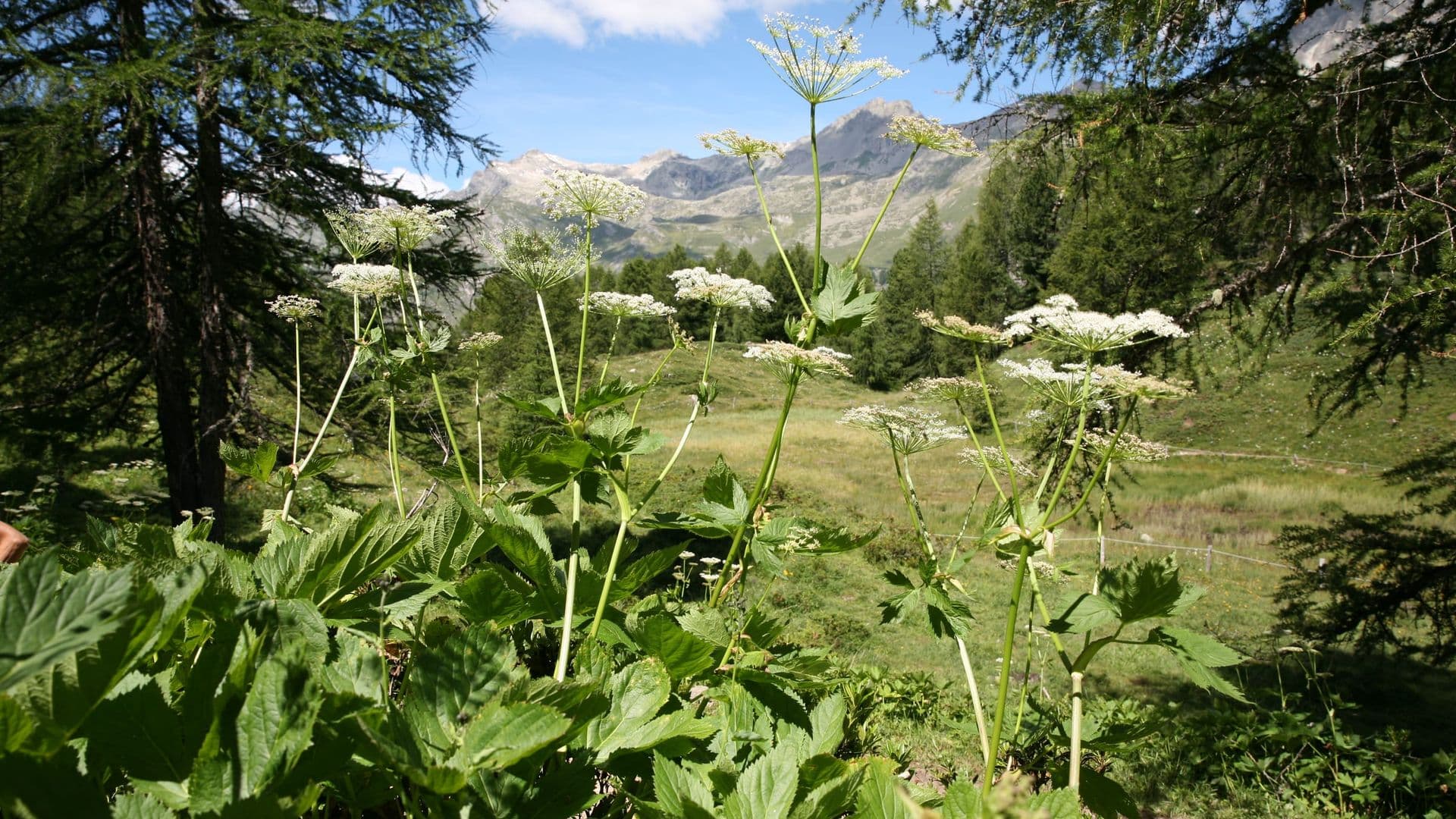
Summer
Meisterwurz
Imperatoria / Peucedanum ostruthium
Self-confidence, liberation from confinement and compulsion
familyApiaceae (umbellifers)
LocationTall herb vegetation, mountain meadows, stream banks; 600–2100 m
HarvestOctober
ProcessingMortar method
Botany and nature of the plant
Botany
Peucedanum ostruthium (L.) Koch, known as Meisterwurz, has received its name “Imperatoria” — the Imperial — due to its powerful medicinal properties. The plant belongs to the family Apiaceae (umbellifers) and grows in mountainous regions on moist mountain meadows, perennial plant communities, and by streams. Its transversely ringed, brown rhizomes are 2–3 cm thick and grow up to 10 cm long, with numerous side shoots and runners.
From the subterranean parts, stems develop which bear only a few upward-facing leaves — ternate with stalked leaflets, rather coarsely toothed at the edges. From July, Meisterwurz blooms with white or reddish flowers in umbels of 30–60 rays. The whole plant, especially the underground parts, is characterised by an aromatic, spicy scent.
Nature of the plant
Self-confidence, liberation from confinement and compulsion
Meisterwurz has a truly regal essence. It symbolises a self-confidence that does not override others and can also bring out the good qualities in those around it. The inner certainty of its right to exist allows it to act towards others in a benevolent and supportive manner. An aura of brilliance and naturalness surrounds it, causing threatening influences to bounce off.
People who are vulnerable due to a lack of inner security and who tend to open themselves to all kinds of harmful influences can become aware of their situation with the help of this plant essence. Imperatoria strengthens the inner power: a current of strength seizes the person's centre, rising from the stomach, expanding the chest cavity and straightening the shoulders. Imperatoria is also an extremely potent antidote against various toxic effects on body and soul.
Imperatoria / Peucedanum ostruthium
Meisterwurz
familyApiaceae (umbellifers)
Height30–100 cm
Flowering periodJuly–August
Harvest monthsOctober
LocationTall herb vegetation, mountain meadows, stream banks; 600–2100 m
DistributionMountain ranges of Central Europe; scattered in the Alps and Pre-Alps in Switzerland
Ceres procurementWild collection (Alps)
Plant partFresh underground parts
Common namesMeisterwurz, Kaiserwurz, Ostranz, Masterwort
Signature & impact
From shape to healing power
In an illustration by Paracelsus, we see the great physician and universal philosopher of the 16th century holding a Meisterwurz root in his hand. It is said that he always carried such a root with him. For Paracelsus, the Meisterwurz was one of the very great medicinal plants and it had a generally universal significance at that time and for a long while afterwards.
The superficial first impression is rather sobering. When we encounter the Meisterwurz in the mountains during summer, no special colours or shapes stand out. This is explained by its botanical family. The plant belongs to the family of umbellifers (Umbelliferae), with numerous representatives, which are often difficult for laypeople to distinguish.
All species of this family share the umbrella-shaped, mostly white inflorescence (e.g., meadow chervil). It is a plant family that does not produce spectacular external appearances.
Nevertheless, it includes some significant spice, medicinal, and poisonous plants as well as aromatic food plants (parsley, caraway, fennel, anise, celery, hemlock, etc.). Since the flowers, as mentioned, do not have remarkable features, one must learn to understand the essence of the umbellifers primarily through the leaves. Let us seek out the Meisterwurz at its natural habitat. We find this typical mountain plant in nutrient-rich, moist, and often rocky locations.
We quickly recognise the Meisterwurz by the gloss of its leaves. This is not particularly strong or conspicuous; it is noble and conveys an impression of compactness. The leaves radiate a powerful naturalness with their own sheen. Many other plant experts were fascinated from the first moment by the gloss of these leaves and sensed the power they emanate.
When one intuitively explores this plant, one recognises a force best described as "expanding upwards." It is an efficacy that has a distinct relation to the chest. The forces of the Meisterwurz seem — on an energetic level — to expand and simultaneously tighten the chest.
Previously, to express a posture conveying self-confidence, the phrase "with a swelling chest" was used. The analogous form is also found in the leaves. They are trifoliate with three stalked leaflets. The leaflets are upright and resemble a half-open hand reaching upward; they are deeply divided into three parts.
The individual parts (the divided ones) have the characteristic upward-spreading form inherent to the nature of the Meisterwurz. Whether examining the plant as a whole or the inflorescence shortly before blooming, one continually finds this characteristic upward expansion. The following incident illustrates the great power of this plant. Our medicinal plant collector, who investigates the effects of medicinal and poisonous plants through personal testing as every true plant expert does, once misjudged the dosage of a very poisonous mountain plant.
He ate a piece of root from Cyclamen europaea and shortly afterwards experienced dramatic effects; the windpipe rapidly began to swell and narrow, and breathing became dangerously difficult. In critical distress, remembering old reports about the fantastic effects of the highly valued Meisterwurz, at the last moment, nearly choking, he found a Meisterwurz, dug up its root, and dripped its juice into his throat. Within just one minute, the windpipe began to widen, and after ten minutes the poisonous effects had completely subsided, allowing him to breathe freely again.
Such events, which can still happen today, allow us to imagine why the Meisterwurz once had such great importance. We recognise in the signature of the Meisterwurz marks of power and self-confidence that do not need to impress through conspicuous external signs. True strength acts as a natural self-evidence from within. Such inner strength is the best guarantee for defence against harmful external influences such as poisonous effects on the physical or emotional level.
Harvest timeOctober
ProcurementWild collection (Alps)
Origin & harvest
Wild collection (Alps)
Meisterwurz is native to the mountains of Central and Southern Europe (Alps, Carpathians, Apennines) and grows on moist mountain meadows, in tall herb communities, and along stream banks between 600 and 2100 metres. In Switzerland, it is widespread in the Alps and Pre-Alps.
Ceres uses Meisterwurzel from wild collection in the Swiss Alps. The roots are harvested in autumn. At some locations the plant is rare — Ceres ensures sustainable gathering quantities.
Historical context
Traditional Use
Meisterwurz, Imperatoria, is frequently mentioned in the medical-botanical classics of the Middle Ages, including in the works of Paracelsus, Lonicerus and Hieronymus Bock.
The information gathered in the old herbal books often forms the basis for the medicinal plant knowledge passed down to the present day. For some medicinal plants, traditional knowledge has been validated by current scientific research. For others, the emphasis remains on experiences from folk medicine. The latter applies to Meisterwurz, which holds a very high status in traditional Alpine naturopathy. Imperatoria is primarily regarded as a strengthening and cleansing universal remedy. According to Madaus, this medicinal plant is attributed diuretic and diaphoretic effects. It was used as an adjunct remedy for the following indications: mucus and congestion, bronchial catarrh, and as a stomachic (for flatulence, diarrhoea and stomach cramps). Furthermore, it was used as an antidote in cases of poisoning symptoms.
Sources
1. Hänsel, R. & Steinegger, E. Hänsel / Sticher Pharmakognosie Phytopharmazie. (Wissenschaftliche Verlagsgesellschaft GmbH, Stuttgart, Deutschland, 2015).
2. Madaus, G. MADAUS LEHRBUCH DER BIOLOGISCHEN HEILMITTEL BAND 1-11. (mediamed Verlag, Ravensburg, 1990).
3. Kalbermatten, R. & Kalbermatten, H. Pflanzliche Urtinkturen. (AT Verlag, Aarau, Schweiz, 2014).
4. Kalbermatten, R. Wesen und Signatur der Heilpflanzen. (AT Verlag, Aarau, Schweiz, 2016).
IphaseDevelopment
Psychological signature
The natural justification for existence
R. & H. Kalbermatten — «Psyche des Menschen und Signatur der Heilpflanzen»
Manufacturing
Ceres mortar process — gentle, cold and complete.
Freshly harvested, hand-picked, ground at room temperature and aged for years. No heating, no pressure - the plant's full vitality is preserved.