SpringSummer
Viola tricolor
Viola tricolor
Vulnerability, Authenticity and Appearance
familyViolaceae (violet family)
LocationFields, roadside verges, poor meadows; sandy, nutrient-poor soils
HarvestMay–June
ProcessingMortar method
Botany and nature of the plant
Botany
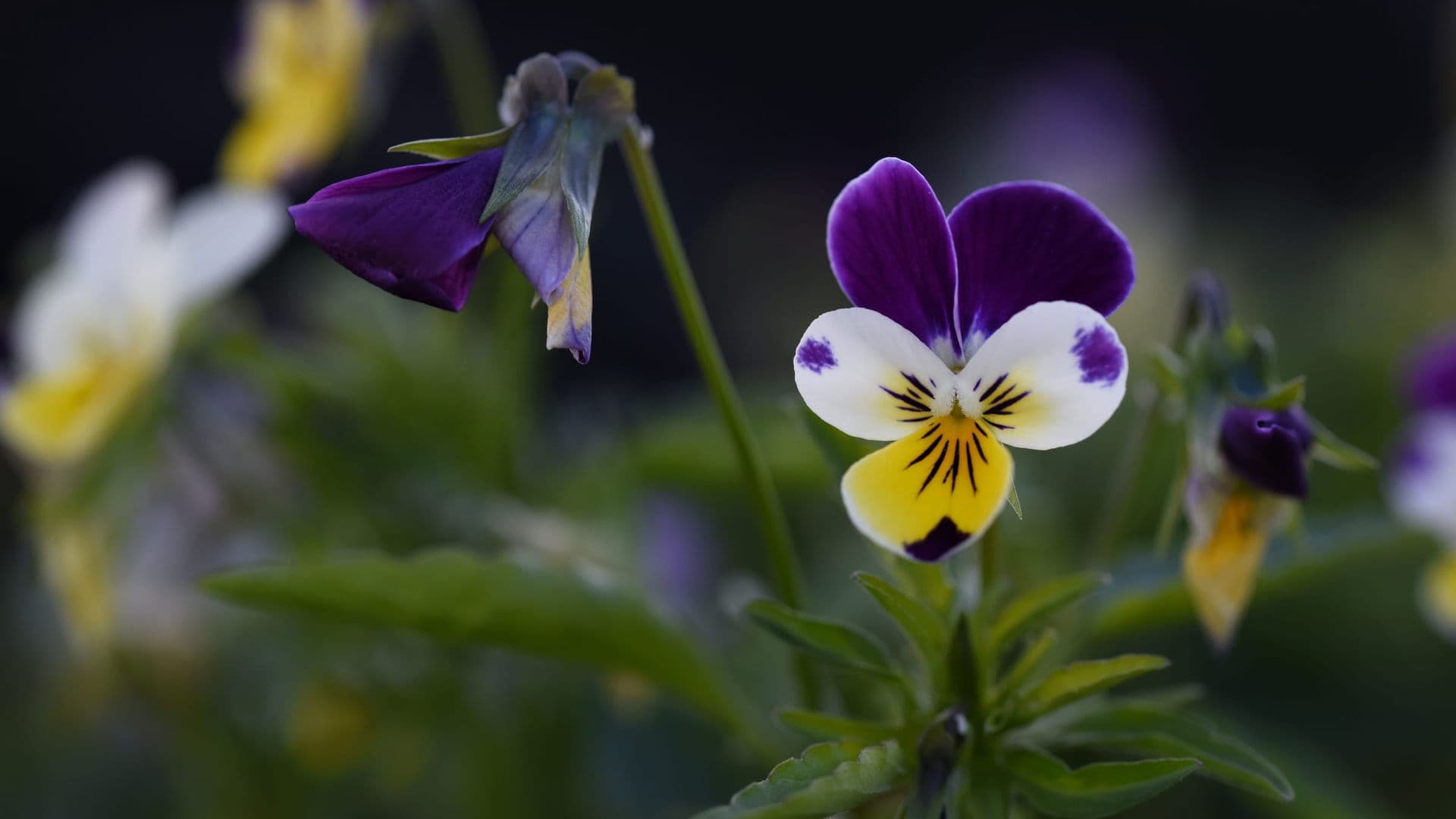
The wild pansy, Viola tricolor L., is an annual to perennial plant that grows 10 to 40 cm high. The ascending stems carry heart-ovate to oblong-ovate, notched leaves with lanceolate stipules. From April to September, the plant blooms with striking, colourful flowers that grow singly in the leaf axils and can reach up to 3 cm in length.
The five petals are noticeably longer than the sepals. The two upper petals are mostly blue or blue-violet, the three lower ones yellow or whitish, often only yellow towards the throat. The colour varies greatly; some bear intensely purple nectar guides — the name “tricolor” refers to this three-colour characteristic. The lowest petal is always spurred. The petals have a velvety-soft surface. The flowers emit a delicate fragrance, while the whole plant gives off a strong medicinal scent when crushed or cut.
Nature of the plant
Vulnerability, Authenticity and Appearance
The essence of the pansy reveals itself to us in its diverse shapes and colours. This plant species can appear in numerous different varieties through cultivation. There is no immediate correspondence between inside and outside, between essence and form.
Being and appearance exist in a field of tension. The stability and authenticity that other plants have through the correspondence of essence and form are lacking in the pansy. The pansy symbolises the very sensitive, vulnerable, complex human type who seeks to conceal their vulnerability by all means – including cosmetic ones.
It is important to them to preserve the appearance, the face. The skin, as the boundary between inside and outside, as the visible surface, should remain intact and beautiful.
Yet, as an excretory organ and mirror of the soul, the skin can also express a physiological or psychological imbalance, making it visible. Viola tricolor L. is highly sociable. Its essence is specifically focused on preserving the beauty of the skin. Psychologically, the pansy draws attention to the discrepancy between inner vulnerability and the outwardly displayed artificial superficiality.
Viola tricolor
Viola tricolor, Wildes Stiefmütterchen
familyViolaceae (violet family)
Height10–40 cm
Flowering periodApril–September
Harvest monthsMay–June
LocationFields, roadside verges, poor meadows; sandy, nutrient-poor soils
DistributionEurope; scattered in Switzerland
Ceres procurementOrganic cultivation
Plant partFresh flowering herb
Common namesWildes Stiefmütterchen, Ackerveilchen, Dreifaltigkeitskraut, Heartsease
Signature & impact
From shape to healing power
The essence of the Stiefmütterchen was the most difficult of all the plant essences described in this book to research. For many years, I continuously engaged with this little plant in order to uncover its secret. The difficulty lies within the essence itself, which concerns the inner being and the outer appearance. Precisely because the Stiefmütterchen presents an outward image that is meant to conceal the inner state, this plant is so enigmatic.
Intuitively, it was clear to me from the beginning that the essence of the Stiefmütterchen relates to the interaction between inside and outside. An inner image developed, in which the inner is always turned outward and the outer inward, a phenomenon I would describe with the term inversion. Yet I could not properly classify this phenomenon, as from my previous experience with essence and signature, I had always assumed that every plant reflects its innate essence in its external form. Certainly, nature is full of deception and illusion.
Humans are very ingenious and continually devise new deceptions in the struggle for existence. Animals also have species-specific behaviours designed to deceive prey or predators, or they adopt a form to create an appearance of defiance that differs from their true condition. The flower shows a diversity of colours. However, there is a difference between the deceptions of humans and animals, which are aimed at survival or self-assertion, and the deception of the Stiefmütterchen.
Its essence lies in concealing an inner vulnerability and imperfection. The Stiefmütterchen is one of the few plants where a physical effect can be recognized relatively simply in the signature. The flowers have a very soft structure, a gentle sheen, and yet convey something incredibly delicate. Their structure most closely resembles that of healthy children's skin – peach skin.
Let us now leave the simple physical reference and try to understand the essence. The genus Viola (violet), to which the Stiefmütterchen belongs, has some remarkable properties. From a distance, all violets appear like modest little flowers, and in poetic literature they are attributed the character traits of humility and modesty. However, if we approach closer and truly examine a modest violet under the microscope, we find some astonishing facts.
The little plant is adorned with many appendages. When we examine the flower from both inside and outside, we keep discovering new forms that are actually superfluous. Starting from the appendages on the sepals, the spur of the lower petal, the ring of hairs inside the main corolla, the stamens with their unfolded structure, and the club-shaped extensions to the stigma with its strange cup – additions to an extent uncommon in other plants. One might say the plant has adorned itself with some charming accessories. Such floral accessories are also carried by the Stiefmütterchen.
In the case of its leaves, however, something new, aiming in the same direction, is added. The leaf forms of other violet species are relatively simple, often heart-shaped, sometimes divided, but always very clearly structured. The leaf of the Stiefmütterchen, on the other hand, plays a true game of confusion with us. We struggle to discern its structure because it is so complicated and segmented.
The most confusing aspect is that a very large part of the leaf surface does not come from the main leaves, but from secondary leaves. There is no regular pattern, no transparent system in the leaves, but rather an attempt to implement various structural approaches that are then discarded. Most notably, it is the appendages, the secondary leaves, that are made principal, while the actual leaves recede into the background. In the same way, the flower colour can also be seen.
The Stiefmütterchen is the only violet species whose flower is not uniformly coloured – mostly blue – but presents itself in three different colours: violet, white, and yellow. This emphasises its complexity, which the genus already expresses in the many appendages, albeit discreetly and not conspicuously. Through the striking, atypical colouring for violets, the Stiefmütterchen specifically expresses what is typical of the genus and which in other species has not yet emerged as an essential characteristic. The scent of the Stiefmütterchen is very delicate, perfume-like.
If the plant is injured, an entirely different character of scent immediately emerges. The plant contains abundant salicylic acid, which then dominates the smell of the cut plant. Salicylic acid has a strong medicinal character; many ointments for rheumatic pains contain this substance. Although this compound is also found in other plants (willow bark, meadowsweet), no other plant exhibits such a strong scent of this active ingredient as the Stiefmütterchen.
Harvest timeMay–June
ProcurementOrganic cultivation
Origin & harvest
Organic cultivation
Wild pansy is widespread in Europe and Western Asia and grows on fields, pathsides, meadows, and in light forests on nutrient-poor to moderately nutrient-rich soils.
Ceres uses wild pansy from organic cultivation. The fresh flowering herb is harvested from spring to early summer.
Historical context
Traditional Use
The traditional use of Stiefmütterchen, Viola tricolor L., dates back to antiquity. Already in the Middle Ages, Stiefmütterchen was used for various skin diseases. Furthermore, respiratory complaints such as cough and bronchitis, as well as urinary tract complaints, were known areas of application. The use for skin conditions – especially for increased sebum production (oily skin, cradle cap in children, often associated with acne and itching) and eczema – remains established in herbal medicine and homeopathy to this day. The latter also recognises its use for inflamed urinary tracts. For this medicinal plant, both internal and external applications are very common.
Sources
1. Hänsel, R. & Steinegger, E. Hänsel / Sticher Pharmakognosie Phytopharmazie. (Wissenschaftliche Verlagsgesellschaft GmbH, Stuttgart, Deutschland, 2015).
2. BGA/BfArM (Kommission E). Violae tricoloris herba (Stiefmütterchenkraut). Bundesanzeiger 50, (1986).
3. Madaus, G. MADAUS LEHRBUCH DER BIOLOGISCHEN HEILMITTEL BAND 1-11. (mediamed Verlag, Ravensburg, 1990).
4. BGA/BfArM (Kommission D). Viola tricolor. Bundesanzeiger 29 a, (1986).
5. Committee on Herbal Medicinal Products (HMPC). Assessment report on Viola tricolor L. and/or subspecies Viola arvensis Murray (Gaud) and Viola vulgaris Koch (Oborny), herba cum flore. EMA/HMPC/131735/2009 (2010).
6. Kalbermatten, R. & Kalbermatten, H. Pflanzliche Urtinkturen. (AT Verlag, Aarau, Schweiz, 2018).
7. Kalbermatten, R. Wesen und Signatur der Heilpflanzen. (AT Verlag, Aarau, Schweiz, 2016).
Manufacturing
Ceres mortar process — gentle, cold and complete.
Freshly harvested, hand-picked, ground at room temperature and aged for years. No heating, no pressure - the plant's full vitality is preserved.