Wild Carrot
Daucus carota
Botany
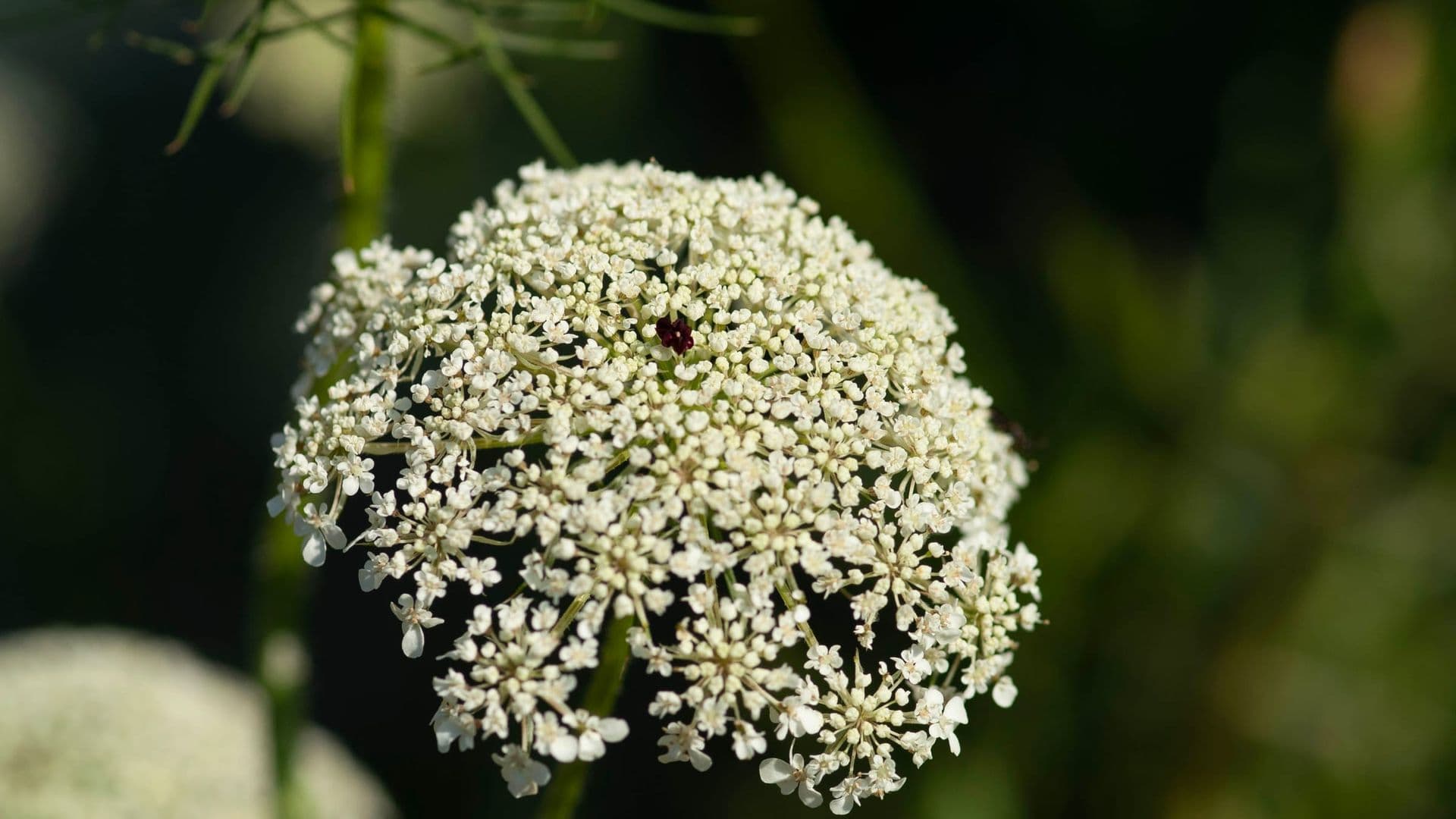
The wild carrot grows on poor meadows, roadside verges, and dry slopes — everywhere the soil is barren and nutrient-poor. In the first year, it produces only a basal rosette with delicately feathered leaves and a slender, pale root. In the second year, the bristly stem shoots up to 120 cm high. The umbel is the true marvel of this plant: hundreds of small white individual flowers arrange themselves in a precise, centred formation. In the middle of the umbel there is almost always a single dark violet to black flower — the so-called attraction flower. After flowering, all the rays of the umbel bend inwards and form a closed nest. This movement from outside to inside, from the periphery to the centre, is the strongest signature of this plant.
Essence of the plant
Back to the centre
"Daucus centres. Daucus gathers scattered forces and brings us to the centre. One becomes aware of its essence when looking at the umbels. Such a pronounced, centre-focused signature is unique among the plants of the Central European flora." (Dr Roger Kalbermatten, Ceres Heilmittel AG). When attention is scattered in all directions, when external influences weaken the inner centre, when concentration is lacking and the mind seems empty — then Wild Carrot reveals its quality. It supports the gathering of conscious forces and the return to one's own centre.
Daucus carota
Wild Carrot
From shape to healing power
The spiral movement of the umbel from outside to inside is the most distinct central signature of the Central European plant world. The single dark lock bud in the centre — a point that inevitably draws attention — symbolises the power of the centre. The biennial development (Year 1: gathering and rooting; Year 2: rising and flowering) corresponds to the path from dispersion to concentrated unfolding.
Wild collection
Wild Carrot is native to Europe, North Africa and Western Asia and grows on poor meadows, roadsides, embankments and dry slopes. It prefers calcareous, well-drained soils and sunny locations.
Ceres uses fresh Wild Carrot from wild collection in Switzerland. The flowering herb is harvested in summer. The plants must have already formed the first typical "bird’s nests" but must still be richly in flower.
Traditional Use of Wild Carrot
Wild Carrot is the ancestral form of all cultivated carrots and has been known in the folk medicine of many cultures since antiquity. Dioscorides and Galen described its diuretic and digestive-promoting properties. In European folk medicine, the herb was especially valued as a cleansing and nourishing agent.
Traditionally, Wild Carrot was used for urinary tract complaints, kidney weakness, and as a diuretic. In folk medicine, it was employed for digestive ailments, flatulence, and gastrointestinal irritations. Carrot mash made from cooked fruits was a classic remedy for diarrhoea, particularly in children. Externally, grated carrots were used for skin diseases and burns.
In Ceres signature doctrine, Wild Carrot is the plant of centring par excellence. Roger Kalbermatten wrote: “Daucus centres. Daucus gathers scattered forces and brings us to the core. Its essence becomes apparent when looking at the flower heads. Such a pronounced, centre-oriented signature is unique among the plants of the Central European flora.”
Sources
Kalbermatten R. & H., Pflanzliche Urtinkturen – Wesen und Anwendung
AT Verlag
Kalbermatten R., Wesen und Signatur der Heilpflanzen
AT Verlag
Wichtl M., Teedrogen und Phytopharmaka
Wissenschaftliche Verlagsgesellschaft
Ceres mortar process — gentle, cold and complete.
Freshly harvested, hand-picked, ground at room temperature and aged for years. No heating, no pressure - the plant's full vitality is preserved.