Copper Chloride Crystallisation at Ceres
Greta Guglielmetti · 21 April 2026
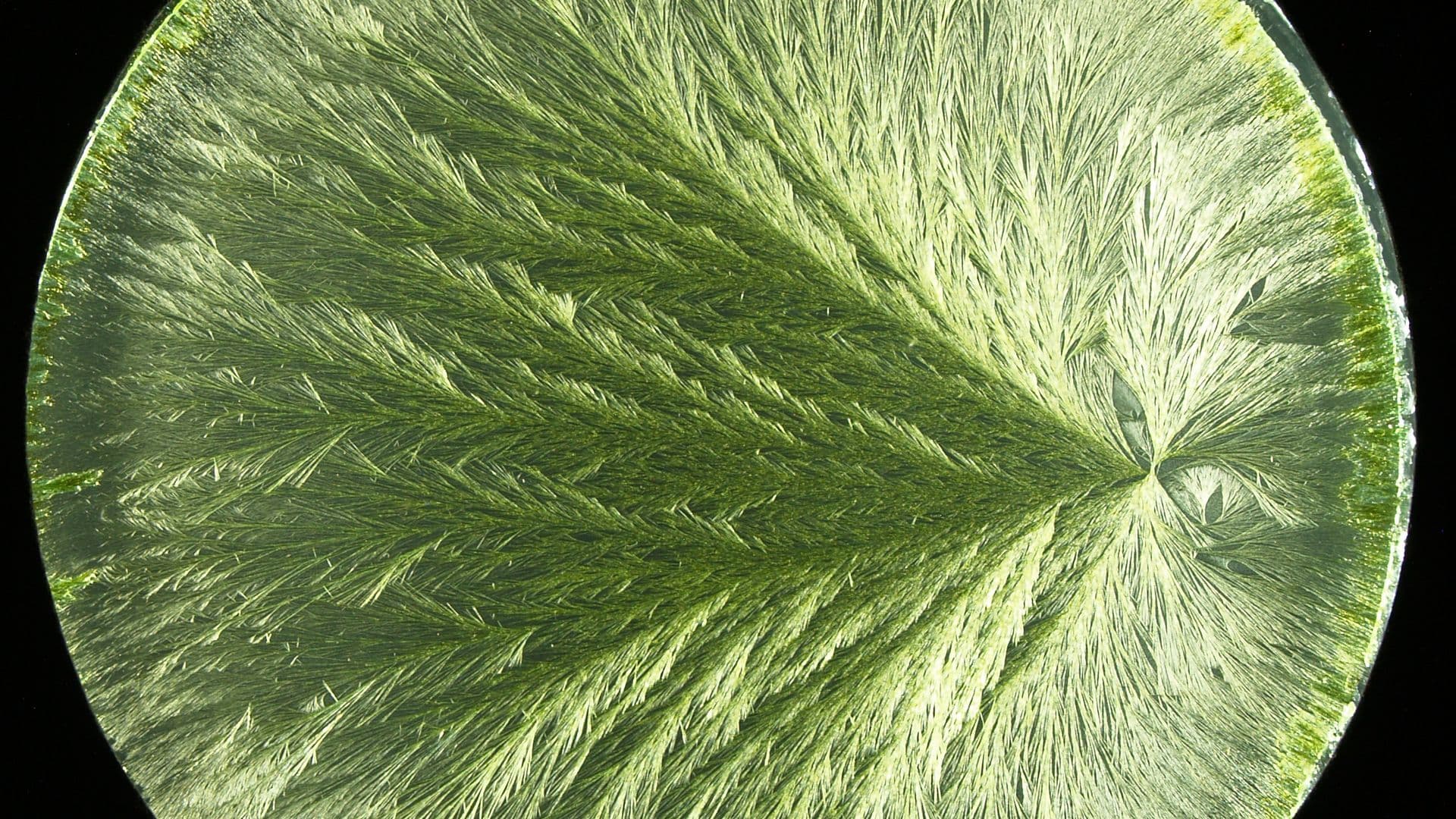
A newly established laboratory in Ceres Research and Development is dedicated to a method nearly one hundred years old: copper chloride crystallisation. It aims to visualise qualities of our mother tinctures that elude purely chemical analysis — vitality, freshness, inner coherence.
Producing high-quality mother tinctures is at the core of our work at Ceres. For us, quality means more than just the chemical and physical profile of a product. Quality also reflects the attention, care, and passion with which we accompany our tinctures — and the preservation of those subtle properties that characterise medicinal plants as living organisms: their vitality.
Making the Living Visible
Investigating such qualities scientifically is demanding. Most available methods focus purely on chemical-physical aspects — on what is measurable, countable, isolatable. However, one method has proven promising in recent years precisely because it seeks a holistic approach: copper chloride crystallisation.
A Method with a History of Over One Hundred Years
The method was developed in 1922 by Ehrenfried Pfeiffer — then under the name “Sensitive Crystallisation Method”. Pfeiffer wrote about his original intention:
Our research work began with the attempt to find reagents for the etheric forces and to demonstrate ways to prove their existence.
— Ehrenfried Pfeiffer, 1931
Today, research is focused on better understanding what Pfeiffer meant by “etheric forces” — and which sample characteristics the method actually responds to. Studies in agriculture have shown that crystallisation is sensitive to qualities such as freshness and resilience — precisely those properties which, according to our understanding, also distinguish our mother tinctures.
A New Laboratory at Ceres
Against this background, we have established our own laboratory for copper chloride crystallisation within our Research and Development department. Accompanied by a team of scientific advisors, we carry out crystallisation experiments there and explore the potential of the method for characterising our products.
How Does the Method Work?
The principle is as simple as it is precise:
- A small amount of a biological extract — in our case a mother tincture — is mixed with a copper chloride solution in a Petri dish.
- The dish is placed in a crystallisation chamber — with carefully controlled temperature, humidity, and air circulation. Each of these conditions is crucial.
- As the water evaporates, crystallisation begins. Usually, it starts at a single central point and branches outwards into fine, tree-like formations spreading across the entire dish.
Every Image Tells a Story
Crystallisation images arising from different plant samples, under various cultivation conditions or at different stages of freshness and ageing, differ from each other. Each image reflects, in a way, the character of the substance that shaped it.
Fresh samples form rich, coherent, finely differentiated crystal patterns. Aged or degraded samples often show simpler, less structured images.
A More Comprehensive Picture of Quality
By evaluating these images alongside our other quality analyses, a more comprehensive understanding of our products emerges. The crystallisation does not replace existing methods — it complements them with a dimension that is otherwise difficult to access.
Our concern is to better understand what we produce — and to continuously improve what we offer to the people who trust our medicinal products.
References
- Guglielmetti, G. et al. Evaluation of copper chloride crystallisation as a method for systems-level characterisation of phytopharmaceuticals — a pilot investigation. Sci. Rep. 16 (2026). doi:10.1038/s41598-026-41081-6
- Pfeiffer, E. Studium von Formkräften an Kristallisationen. Naturwissenschaftliche Sektion der Freien Hochschule für Geisteswissenschaften am Goetheanum (1931).
- Steiner, R. Geisteswissenschaftliche Grundlagen zum Gedeihen der Landwirtschaft — Landwirtschaftlicher Kurs. Rudolf Steiner Verlag (1999).
- Athmann, M. et al. An update on image forming methods: structure analysis and Gestalt evaluation of images from rocket lettuce with shading, N supply, organic or mineral fertilization, and biodynamic preparations. Org. Agric. 12, 307-323 (2022). doi:10.1007/s13165-021-00347-1
- Fritz, J. et al. Advanced panel training on visual Gestalt evaluation of biocrystallization images: ranking wheat samples from different extract decomposition stages and different production systems. Biol. Agric. Hortic. 35, 21-32 (2018). doi:10.1080/01448765.2018.1492457
Continue on Ceres channels
These links open the respective platforms directly. They are intended as a supplement to the article, not as a native in-page interaction.