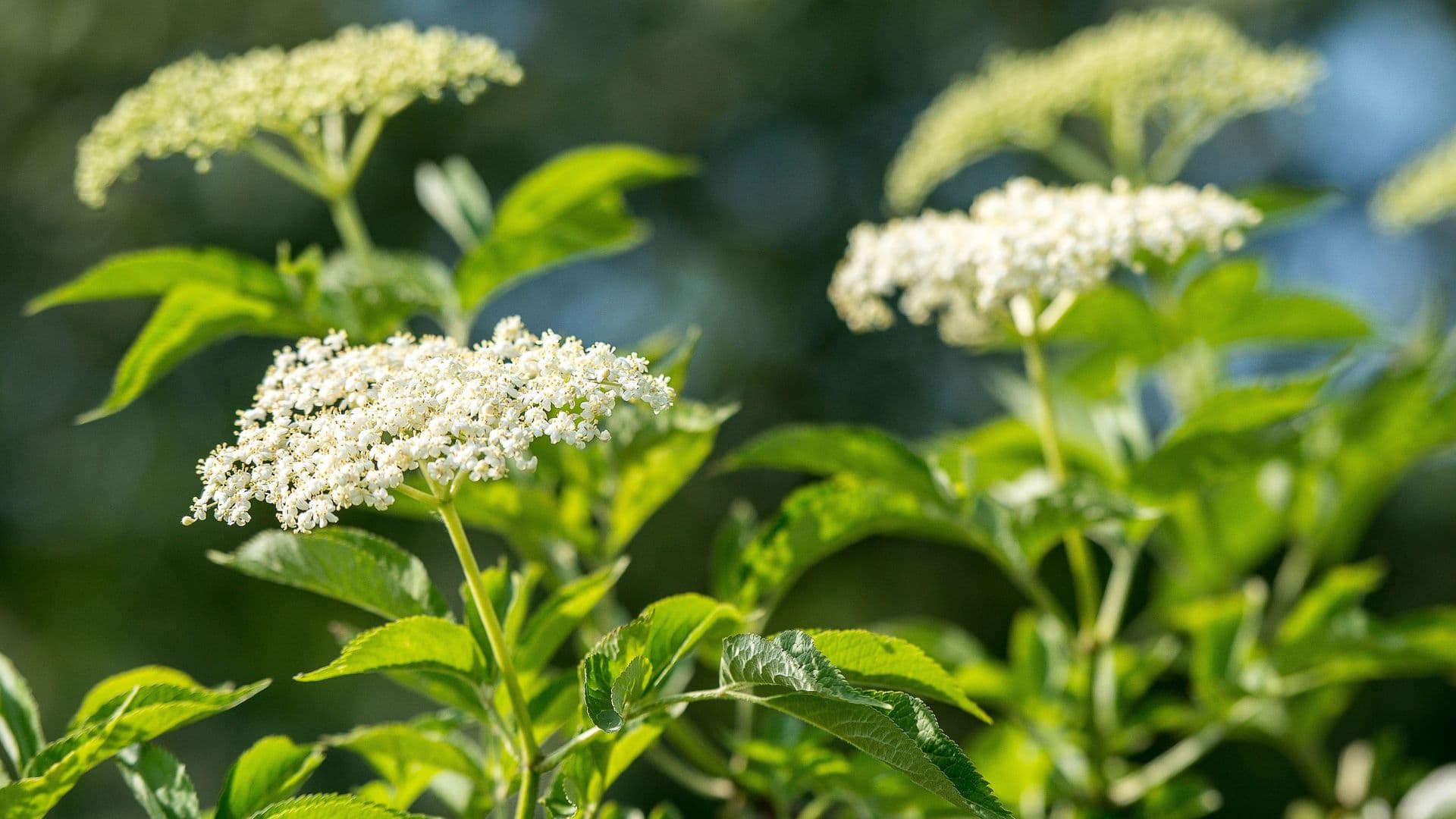
Elderberry
Sambucus nigra
Maturation, completion of thermal processes, growing up, responsibility, protection
Botany
The black elder (Sambucus nigra L.) is a richly branched, shrub- or tree-like woody plant and is widespread throughout Europe. It colonises moist forests and roadside edges, grows up to 7 m high, and prefers nutrient-rich locations. Young shoots are green and covered with wart-like dots for gas exchange; they can grow more than a metre in the first year and quickly grow upwards. The bark of older shoots is grey-brown and deeply fissured, the inside of the shoot is filled with white, airy pith. The odd-pinnate leaves grow up to 30 cm long; leaves and bark emit an unpleasant smell when crushed. From mid-May onwards, yellowish-white, intensely sweetly scented flowers form in umbrella-shaped umbels, releasing abundant yellowish pollen. The black berries ripen from these until autumn.
Essence of the plant
Maturation, completion of thermal processes, growing up, responsibility, protection
Elder represents the protective essence for the works of refinement and perfection of nature and mankind. The essential element bestowed upon humans for cultural and intellectual advancement is fire. Every refinement process is ultimately one of warmth and the awakening of consciousness.
For this, the element of fire must be applied in the correct measure, with the element of air properly dosed and regulated. The Elder essence represents the force that enables the correct use, the proper handling of air (breath) and fire. It is the spiritual principle that allows the right tonal warmth, so that human works – both external and internal consciousness works – can reach their fulfilment.
The power of Elder compels the human being towards what they are meant to become, towards perfection, and towards soul and intellectual advancement. Elder ripens things and permits their harvest at the right time; it allows one to ascend to the next level without skipping any stage. Elder is a symbol of the human life task.
Its branches grow straight upwards towards the sky, only to bend back towards the earth after some time. It does not forget its roots, its ancestry; it inclines towards all who are journeying with it. In its full bloom, it is open upwards in a receptive gesture.
Elder offers itself, for example, to people who are not yet aware of their task or who have a limited concept of their existence, a idiosyncratic worldview. They judge their surroundings according to their values and are not easily dissuaded from their judgement.
What is lacking is the gesture of opening upwards, the opening for higher knowledge and broader connections. From this, respiratory illnesses can arise, since breath is the symbol of spiritual connection with the world and humanity. Through breath, humans are intimately connected with each other – "we breathe each other in"
Sambucus nigra
Elderberry
From shape to healing power
The elder begins to stir in spring as one of the first shrubs in our forests. New shoots burst vertically upwards from the trunk and branches and stretch to a considerable length in a short time. Their growth is so exuberant that bark formation cannot keep pace; the young shoots are initially only poorly protected by a leaf-like green, thin bark coat. The scent of this young, impetuously growing life is, like that of the leaves, peculiarly acrid, unfinished.
It resembles smouldering fire, lacking sufficient airflow and oxygen. A year later, the young wood has externally solidified, the bark has formed, and the branches begin to bend gently downwards. When we examine the inside of the branches by peeling layer after layer of wood with a knife, we find a spongy, porous, light pith. The comparison with polystyrene is obvious.
The elder branch is thus richly permeated with air in its pith. Are these not peculiar connections? Air pockets are present in the pith, while the smell of the leaves and young shoots suggests a combustion process with insufficient air supply. As it grows further, the branches bend ever further downwards.
In older shrubs, the branches are sometimes shaped into beautiful archways. At the apex of such arches, younger branches rise, which later also form arches, so that often several curved branches lie on top of one another. Thus, in elder we find the expression of green, ascending life force, which is seized by earthly heaviness, reshapes itself, reaches upwards, only to be drawn downwards again. Older elder branches form rounded arches.
The bark of an old, mature elder looks worn and wizened. It is hard to imagine a greater contrast between the green skin of the young shoots and the torn grey bark of the old trunk. Yet the elder is not ill; new shoots sprout as before, it only looks very old. In spring, elder produces a rich display of blossoms.
The white umbels (which are compound umbels) are often slightly concave, like receptive, upwards-directed parabolic mirrors, which is quite unusual for umbels. The small individual flowers are like twinkling, white little stars that enclose the overabundant yellow-golden anthers. Hardly any other plant produces such large quantities of flower pollen. For example, if you dry elder flowers on a white cloth or paper, it is covered with a layer of yellow pollen powder, reminiscent of fiery sulphur powder. The flower scent is mysteriously sweet, carrying our soul to other worlds.
If we wish to fathom the depth of the elder’s scent, it must be in the evening hours of a fine early summer’s day. Then the scent is at its strongest. In autumn, the fruits hang heavily on the shrub. Their colour is as black as night, the taste tart and bitter.
What does all this tell us? The main theme, which runs like a red thread through the signature of elder, is the theme of life energy, which is placed at the service of a spiritual maturation process, a process of warmth. It is the nature of life: to grow up, take responsibility, and above all achieve spiritual maturity is only possible to the extent that life energy can transform and no longer be lived out in the full exuberance of youth. This necessarily leads to the waning of youthful vitality and the setting-in of aging and maturing in every respect.
A spiritual-soul developmental process always requires reorientation, a leaving behind of concepts and goals. Because every development on a certain path, however good it may be at the beginning, after some time loses strength and becomes negative — it bends downwards to the earth. Therefore, at the peak of a development, the old path must be left and a new path taken. Only then can one speak of true inner progress.
The elder impressively shows us this. The fairy tale “Frau Holle” by the Brothers Grimm gives us a perfect image of the essence of elder (Holler). After the main characters have descended through the well shaft to a deeper level (level of soul transformation), they must first complete a maturation process (taking baked rolls from the oven, picking ripe apples). Then they must place their life force at the service of Frau Holle so that their spirit may gain clarity (snow on the earth).
Those who fulfil this life task selflessly and with devotion are gifted with spiritual gold; those who perform it reluctantly and only for the reward are doused with the sticky pitch of entanglement in fate. Elder belongs to the great mystery plants. It is the external symbol of a truly spiritual development. In earlier initiation schools, the plant was also an important symbol for the path to the highest goal a human being can ever reach.
Wild collection
Black elder is native throughout Europe, North Africa, and Western Asia, and grows at woodland edges, hedgerows, in floodplains, and gardens on nutrient-rich, moist soils. It is one of the most common shrub plants in Central Europe.
Ceres uses leaves and flowers of elder sourced from wild collection. The flowers are carefully hand-harvested together with the leaves during full bloom from May to June.
Traditional Use
Elder is a firm pillar of Traditional European Medicine. The medicinal tradition dates back to Hippocrates and Paracelsus. One of the best-known properties of elderflowers is their diaphoretic (sweat-inducing) effect. Its use as a sweat-inducing, diuretic, and bronchial secretory agent in cold-related illnesses has proven effective in herbal medicine. Elder is also successfully employed in homeopathy for inflammations of the respiratory tract. Hence, typical areas of application for elder include colds, mild febrile conditions, diseases of the respiratory organs, laryngitis, bronchitis, coughs, and colds.
Sources
1. Hänsel, R. & Steinegger, E. Hänsel / Sticher Pharmakognosie Phytopharmazie. (Wissenschaftliche Verlagsgesellschaft GmbH, Stuttgart, Deutschland, 2015).
2. Wichtl, M. et al. Teedrogen und Phytopharmaka. (Wissenschaftliche Verlagsgesellschaft GmbH, Stuttgart, Deutschland, 1997).
3. Hänsel, R., Keller, K., Rimpler, H. & Schneider, G. Hagers Handbuch der Pharmazeutischen Praxis Band 5 Drogen P-Z. (Springer Verlag Berlin Heidelberg, 1994).
4. Madaus, G. MADAUS LEHRBUCH DER BIOLOGISCHEN HEILMITTEL BAND 1-11. (mediamed Verlag, Ravensburg, 1990).
5. Committee on Herbal Medicinal Products (HMPC). Assessment report on Sambucus nigra L ., flos. EMA/HMPC/611504/2016 (2018).
6. BGA/BfArM (Kommission E). Sambuci flos (Holunderblüten). Bundesanzeiger 50, (1986).
7. BGA/BfArM (Kommission D). Sambucus nigra. Bundesanzeiger 54a, (1989).
8. Kalbermatten, R. & Kalbermatten, H. Pflanzliche Urtinkturen. (AT Verlag, Aarau, Schweiz, 2014).
9. Kalbermatten, R. Wesen und Signatur der Heilpflanzen. (AT Verlag, Aarau, Schweiz, 2016).
The Path to Spiritual Gold
R. & H. Kalbermatten — «Psyche des Menschen und Signatur der Heilpflanzen»
Ceres mortar process — gentle, cold and complete.
Freshly harvested, hand-picked, ground at room temperature and aged for years. No heating, no pressure - the plant's full vitality is preserved.