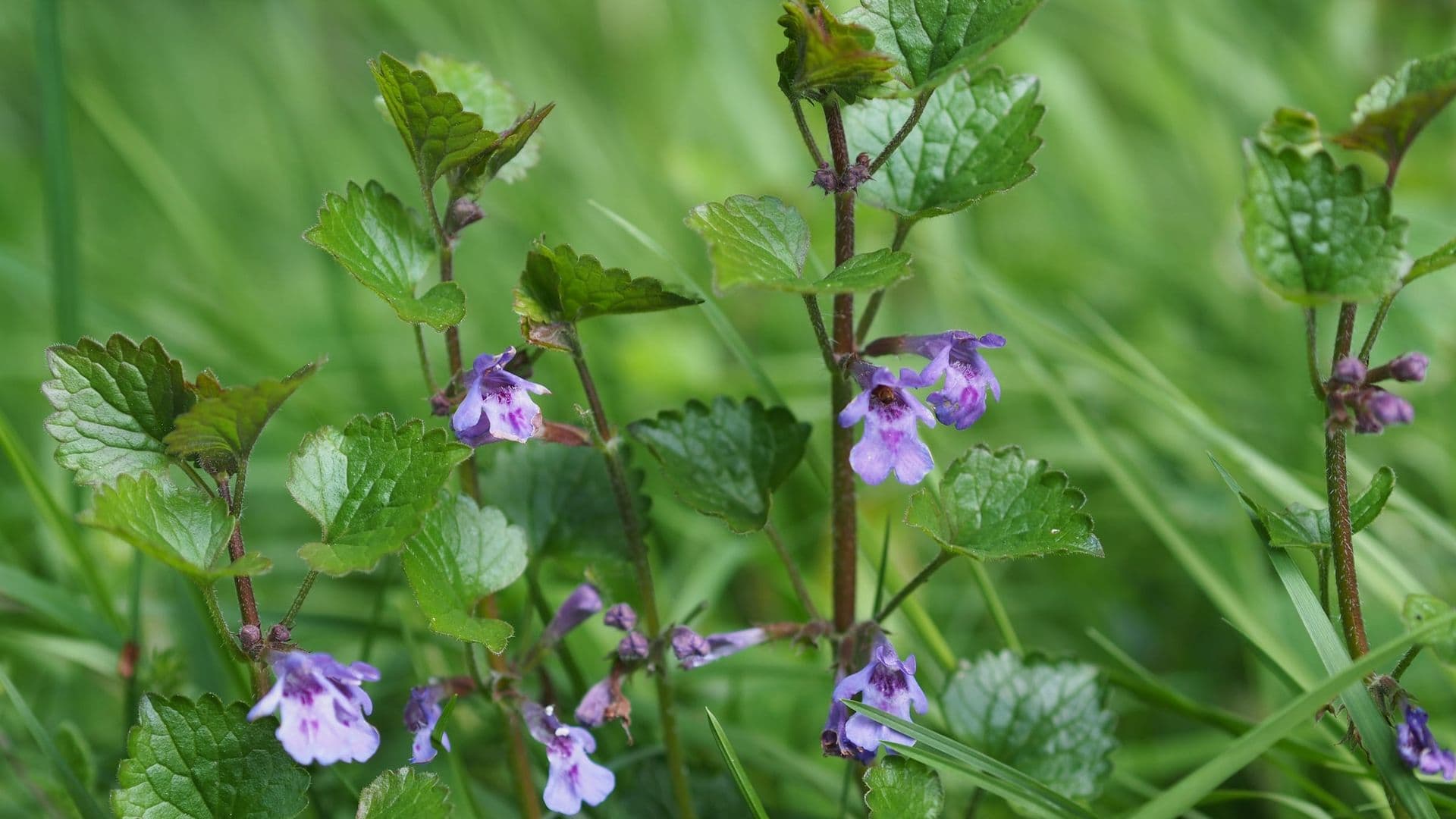
Ground ivy
Glechoma hederacea
Releasing and renewal, composure, revitalizing warmth
Botany
Ground-ivy (Glechoma hederacea L.) belongs to the family of Lamiaceae (mint family), whose members are mostly characterised by an intense scent. Its aroma differs from the light fragrances of other Lamiaceae — earthy, warm and spicy. Glechoma hederacea grows to 10 to 40 cm tall and is a typical spring plant. The quadrangular stem bears opposite leaves that are kidney-shaped to heart-ovate. From March to May, large blue-violet flowers up to 3 cm long appear in the leaf axils. After flowering, ground-ivy sends out long runners that gradually conquer the surroundings, covering bare ground like a living skin.
Essence of the plant
Releasing and renewal, composure, revitalizing warmth
Ground ivy is intrinsically connected to the helping forces and beings of nature. It resonates with these beings and thereby acts as their amplifier. In the presence of a Ground ivy stand, we perceive the highest vitality.
Ground ivy awakens trust in the self-healing powers, in the inner doctor within us. It opens the eyes to the insight that we do not have to do everything ourselves, that – if we open ourselves to it – the help is already there. The essence of Ground ivy never intervenes forcibly.
It embodies composure, patience, inner calm and trust in the helping forces of nature. Ground ivy strengthens a person’s belief in the miraculous, in life itself. The inconspicuous, dwarf-like form of Ground ivy carries within it a highly lively being of light and warmth, capable of warmly penetrating and revitalising processes that have become stagnant and frozen through inner coldness.
Ground ivy mediates the power to resolve and renew conditions that have been consciously or unconsciously held onto, and which thereby no longer participate in the living process of continuous change. Thus, long-frozen processes can once again be incorporated into the flow of life. Ground ivy ends winter rigidity and darkness through dissolving forces of warmth and light, allowing new life energy to flow through the veins.
Glechoma hederacea
Ground ivy
From shape to healing power
Glechoma hederacea is so lively and communicative that its essence reveals itself to the empathetic observer after only a short time. It is more difficult to verify the inner perception of the signature. With few plants have I spent so many hours of intensive study without discovering their key characteristics. I made the mistake of focusing primarily on the individual plant, studying its shapes and colours in detail, and thus was unable to do justice to its essence.
Glechoma hederacea is not a loner. It only comes into its own true to its nature when it is part of a larger whole, a stand of identical plants. Glechoma hederacea does not seek self-assertion. It never stands out against the background but seeks together with others to spread horizontally.
Its essence is to resonate with the rhythms and forces of nature. Glechoma hederacea can enter into resonance with the life forces and thus acts as their amplifier. At a Glechoma hederacea site, we feel the highest vitality and the presence of elemental beings, the so-called earth spirits, which are responsible for plant growth. When we observe the stand and look somewhat unfocused, we perceive it as a whole and not just its parts.
We now see a rich number of round shapes that seem to communicate with each other. The image is held together by the rounded leaves with their scalloped leaf margins. The many semicircles are like elements of wave lines, of vibration patterns that resonate throughout the entire stand and unite it as one.
This reveals the ability to resonate with the surrounding life forces. What kind of forces does the plant resonate with? They are the solar forces aimed at enlivening the earth. Thus, the young leaves at the growth point are always paired, lying flat against each other like two folded, upward-facing hands.
The plant is distinctly warm and earthy. Its aroma is spicy warm and strongly earthy in character; its leaves in the juvenile stage are covered with a violet-brown hue and often match the reddish-brown earth in colour. Glechoma hederacea belongs to the family Lamiaceae, a family that produces many spice and medicinal plants which have predominantly assimilated the element of solar warmth in a substantial form in their typical aromas. Glechoma hederacea is the first species of this family to overcome winter rigidity in early spring with its warm, earthy aroma.
The flowers are expansive, they extend far horizontally, often beyond the leaves; the upper lip is flattened, so the flowers appear as a gesture of letting go and receiving. In summary: Glechoma hederacea frees from lone fighting. It helps to release the rigid idea of having to accomplish everything by one’s own strength. It trusts and surrenders to the creative and wondrous forces of nature and gratefully accepts their help.
Demeter cultivation
Glechoma hederacea is widespread across Europe and North Asia and grows as a creeping plant in moist, semi-shaded locations such as forests, hedges, gardens, and roadside verges. In Switzerland, it is a common, evergreen wild herb throughout the year.
Ceres uses ground ivy from Demeter cultivation in Switzerland. The fresh, flowering herb is harvested in spring when the plant is in bloom and its characteristic aroma is fully developed.
Traditional Use
The use of ground ivy, Glechoma hederacea L., is particularly widespread in traditional folk medicine. Ground ivy is attributed with anti-inflammatory properties, which are utilised in the treatment of gastrointestinal catarrh, diarrhoea, diseases of the upper bronchi (also symptomatically for cough), as well as bladder and kidney stones. Saint Hildegard of Bingen wrote that a person lacking strength should bathe in warm water with the addition of ground ivy, or add it to meals. Furthermore, she used it for tinnitus, chest pain, and lung complaints. Ground ivy is also suitable for conducting spring cures to cleanse and detoxify the body by stimulating overall metabolism after the cold winter months. Hieronymus Bock, one of the fathers of botany, describes ground ivy as a diuretic and a remedy that opens the liver and spleen. The herbal pastor Sebastian Kneipp recommends it for mucus congestion of the lungs, stomach, and kidneys.
Sources
1. Madaus, G. MADAUS LEHRBUCH DER BIOLOGISCHEN HEILMITTEL BAND 1-11. (mediamed Verlag, Ravensburg, 1990).
2. Hänsel, R., Keller, K., Rimpler, H. & Schneider, G. Hagers Handbuch der pharmazeutischen Praxis Band 5 Drogen E-O. (Springer-Verlag Berlin Heidelberg 1993, 1993).
3. BGA/BfArM (Kommission D). Glechoma hederacea. Bundesanzeiger 109 a, (1987).
4. Riha, O. Hildegard von Bingen - Werke- Band V- Heilsame Schöpfung - Die natürliche Wirkkraft der Dinge - Physica - Vollständig neu übersetzt und ein geleitet. (Beuroner Kunstverlag (Abtei St. Hildegard, Rüdesheim/Eibingen), 2016).
5. Kalbermatten, R. & Kalbermatten, H. Pflanzliche Urtinkturen. (AT Verlag, Aarau, Schweiz, 2014).
6. Kalbermatten, R. Wesen und Signatur der Heilpflanzen. (AT Verlag, Aarau, Schweiz, 2016).
Trust and Letting Go
R. & H. Kalbermatten — «Psyche des Menschen und Signatur der Heilpflanzen»
Ceres mortar process — gentle, cold and complete.
Freshly harvested, hand-picked, ground at room temperature and aged for years. No heating, no pressure - the plant's full vitality is preserved.