Ivy
Hedera helix
Self-knowledge, overcoming fear, clinging and freedom, connection of the subconscious and consciousness, bringing shadows to awareness, breaking up hardened structures
Botany
Ivy (Hedera helix L.) with its evergreen clinging roots is familiar to almost every child. It belongs to the family Araliaceae, which is mainly native to the tropics. Even the young ivy shoots on the ground show a special feature: they grow deliberately towards the shade — unlike most plants, which are attracted to light. Only when the shoots have reached an object to climb do they begin to grow upwards towards the light with their clinging roots.
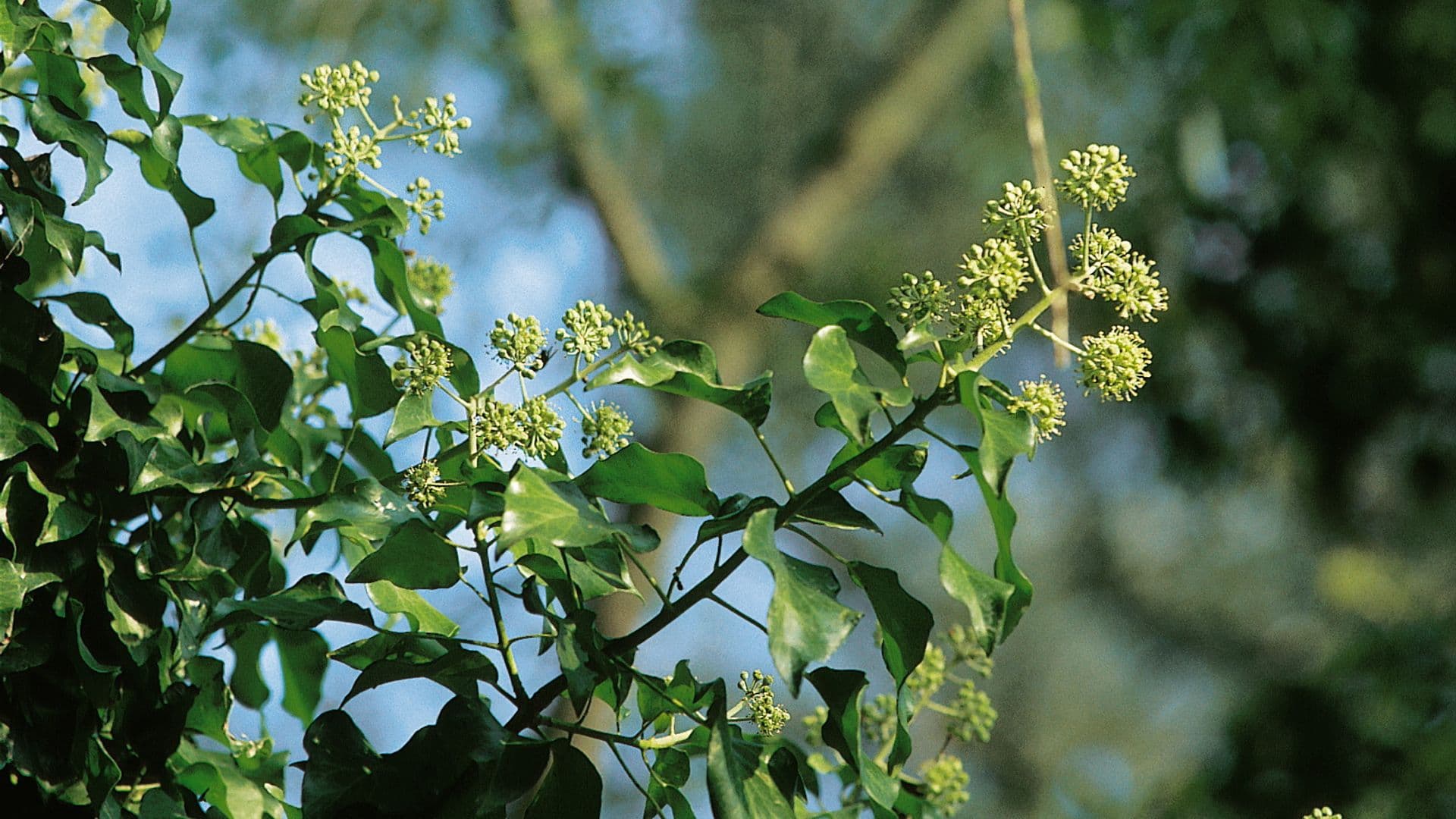
The leaves are leathery, evergreen in winter, dark green and glossy on the upper side. There are two forms: the leaves of the climbing juvenile stage are five-lobed. Only when the plant reaches the light do the leaves become ovate (“adult stage”) and it begins to flower with hemispherical umbels and inconspicuous yellow-green flowers. Flowering occurs in autumn; as a lot of nectar is produced, there is abundant insect visitation. The dark fruits only ripen in winter. Ivy is not a “parasite” — it does not penetrate other plants with roots — but it can damage its host through its weight or shading.
Essence of the plant
Self-knowledge, overcoming fear, clinging and freedom, connection of the subconscious and consciousness, bringing shadows to awareness, breaking up hardened structures
The perception of the inner images, forces and qualities that rise from the depths of the subconscious into consciousness plays a key role in the soul development of human beings. These images hidden in the darkness of the soul’s depths, often appearing as threatening shadows, are just as much a part of our wholeness as the qualities of which we are aware and accept. The process of becoming conscious is often associated with existential problems, as people usually fear the shadows and therefore reject and repress them.
Unconscious fear leads to constriction in soul and body. Just as fear limits the "free breathing" of the soul, on a physical level it causes impaired breathing manifesting in symptoms such as spasmodic cough, bronchitis or asthma.
The essence of Ivy lies in connecting the unconscious pole hidden in darkness with the conscious pole exposed to light. The key organ for this connection is the thyroid gland, the function of which is stimulated by Ivy. Ivy dissolves psychologically induced spasms of the respiratory organs and frees the breath.
Hedera helix
Ivy
From shape to healing power
Ivy is one of the greatest mystery plants. The shoots of young ivy with their typical five-lobed leaves creep through damp, shady places and sometimes cover large areas of the forest floor. When faced with a tree or a wall, the shoot clings to it with its aerial roots and climbs upwards towards the light. After many years – the lower part of the trunk is now densely covered with ivy leaves – the side shoots branch out.
These grow away from the supporting trunk and no longer need aerial roots. Now comes the remarkable part: The leaves of the side shoots are shaped differently from the leaves that lie against the tree. Many laypeople fail to recognise them as ivy leaves, although they form the majority on a mighty ivy embracing a tree. They are not lobed but entire and ovate.
The lobed leaves are called juvenile, the ovate leaves adult leaves. This means the ivy has juvenile and adult leaves of different shapes. Both leaf types are leathery, tough, and survive the winter. Sometimes it seems that a tree has leaves in winter; however, it is an ivy that clings to the trunk and branches up to the crown. At the adult side shoots, umbel-like inflorescences begin to develop, which flower in October and offer a last nectar to the bees.
During the winter, the fruits slowly develop, maturing into black berries by spring. One important constituent should also be mentioned: Ivy is very rich in iodine, which is unusual for terrestrial plants and only found in marine plants. Ivy belongs to the family Araliaceae, a plant family whose species mainly colonise the Southern Hemisphere of the Earth. Let us start again from the beginning: First, we identify the juvenile shoots with their leaves that look like five-pointed stars.
Now let us perform an experiment. We take a young ivy shoot and the shoot of any other plant and plant them side by side in the soil at a shaded location. What happens? The shoot of any other plant grows towards the light, but the ivy grows in the opposite direction, into the shade.
Ivy strives into the darkness of the forest. If an obstacle stands in its way and it must climb it, the five-pointed leaf stars all point their tips downwards. What a telling symbol of the shadow world! When the ivy finally reaches the highest treetops after years on its path under the sign of shadow, it carries the essence of shadow into the light.
It is the orientation into darkness that characterises ivy, and it is the light that it reaches. This is not contradictory to spiritual laws. Only those who can connect the two worlds fully are whole. Those who flee the shadow will never be able to rise to the light, for the shadow will always pursue and overtake them.
The deep grounds of the shadow, of the subconscious, must be permeated with the light of self-knowledge. And here we see the profound significance of ivy’s high iodine content. Iodine is the essential element for thyroid function. This important organ determines our growth and intelligence. Without a thyroid we would be dull, unconscious beings without any capacity for spiritual awareness.
Severe hypothyroidism leads to so-called cretinism (dwarfism and retarded intellectual development). The consciousness-enabling warmth of iodine must blossom at the gate to the shadow world (as ivy flowers in autumn, at the gateway to winter) and ripen its spiritual fruits in the cold and darkness of winter. Ivy is not about tending the shadows, nor giving free rein to the lower impulses, but about consciously observing and recognising them as part of oneself. This is quite different from what most people do spontaneously, which is to retreat from the shadows and repress them.
Ivy symbolises the connection of two worlds; it is a plant with two leaf forms, the downward-pointing leaves of the underworld and the entire, ovate leaves of the sphere of light. Thus, ivy climbs from the south or the water (symbols of the subconscious) up to the north or the land (symbols of the conscious), laden with the fruits of self-knowledge. Those who do not take this path – and this applies to all of us repeatedly at various phases of our lives – those who want to go the path to light without penetrating the shadows will be caught by the phantoms of fear that strangle them like ivy strangles its host tree. An essential medicinal product made from ivy leaves is one of the greatest medicinal products for transitional situations in the psychological and spiritual development of humans.
Wild collection
Ivy is native to Europe, Western Asia and North Africa and grows as a climbing or creeping plant in forests, parks and on buildings. It is one of the few evergreen climbing plants in Central Europe. In Switzerland, it is widespread.
Ceres uses ivy leaves from wild collection. The fresh leaves and flowers are harvested in autumn, at the time when the aroma of the flowers has optimally developed.
Traditional Use
Ivy, Hedera helix L., played a cultic role in the form of wreaths already in classical antiquity and was also frequently used for ornamental representations. Ivy is mentioned in many passages in the writings of Hippocrates. Hedera helix L. is regarded as a classic cough and respiratory remedy with antispasmodic, antitussive, and expectorant effects. Ivy was particularly used as a cleansing and resolving agent in chronic catarrhs, especially in cases with heavy mucus production. Today, ivy is used in herbal medicine and homeopathy as a helpful remedy for productive coughs and acute respiratory inflammations. Ivy can be found in various medicinal products in the form of tea, syrup, concentrated special extract in various dosage forms, or as a mother tincture.
Sources
1. Hänsel, R. & Steinegger, E. Hänsel / Sticher Pharmakognosie Phytopharmazie. (Wissenschaftliche Verlagsgesellschaft GmbH, Stuttgart, Deutschland, 2015).
2. BGA/BfArM (Kommission E). Hederae helicis folium (Efeublätter). Bundesanzeiger 122, 2020 (1988).
3. Hänsel, R., Keller, K., Rimpler, H. & Schneider, G. Hagers Handbuch der pharmazeutischen Praxis Band 5 Drogen E-O. (Springer-Verlag Berlin Heidelberg 1993, 1993).
4. Madaus, G. MADAUS LEHRBUCH DER BIOLOGISCHEN HEILMITTEL BAND 1-11. (mediamed Verlag, Ravensburg, 1990).
5. Committee on Herbal Medicinal Products (HMPC). European Union herbal monograph on Hedera helix L., folium. EMA/HMPC/325716/2017 (2017).
6. BGA/BfArM (Kommission D). Hedera Helix. Bundesanzeiger 29a, (1986).
7. Kalbermatten, R. & Kalbermatten, H. Pflanzliche Urtinkturen. (AT Verlag, Aarau, Schweiz, 2014).
8. Kalbermatten, R. Wesen und Signatur der Heilpflanzen. (AT Verlag, Aarau, Schweiz, 2016).
Insight into the shadow
R. & H. Kalbermatten — «Psyche des Menschen und Signatur der Heilpflanzen»
Ceres mortar process — gentle, cold and complete.
Freshly harvested, hand-picked, ground at room temperature and aged for years. No heating, no pressure - the plant's full vitality is preserved.