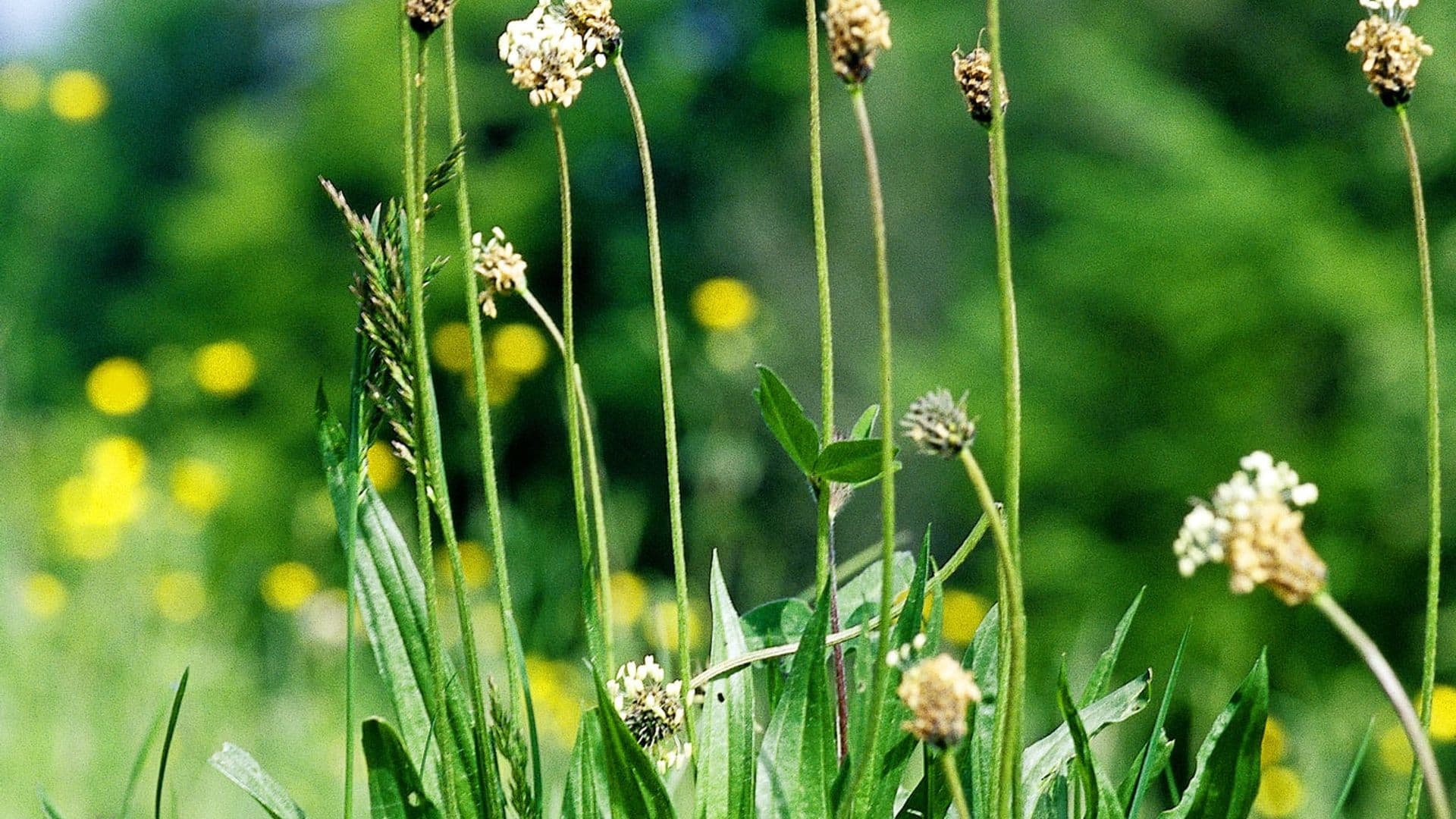
English plantain
Plantago lanceolata
Extinguishing, moisturising, cooling
Botany
Plantago lanceolata L., the ribwort plantain, is a plant found worldwide. From the taproot, it produces a basal rosette of lance-shaped leaves up to 30 cm long with parallel-running veins — a special feature among dicotyledonous plants, which are usually reticulate-veined. From the rosette rises an angular spike stem up to 50 cm high, elevating the inflorescence well above the leaves. The spike blooms continuously from bottom to top; the inconspicuous flowers are only visible by the whitish, prominently hanging anthers. Above all, the seeds, but also the leaves, are mucilaginous. When crushed, the leaves emit a characteristic fungal odour.
Essence of the plant
Extinguishing, moisturising, cooling
Crushed leaves of Plantago between the fingers have a mucilaginous consistency, indicating a moist, cool character. However, the plant prefers rather dry locations. Thus, Plantago carries the principle of moisture into dryness.
In its nature, Plantago is—figuratively speaking—a plant “fire extinguisher.” It is drawn to overheated, flaring processes, which it is able to extinguish and cool. One could say it covers the sites of inflammation with a cooling, mucilaginous layer that moistens and protects the affected surfaces.
Of course, this does not refer to literal fire but to inflammatory processes. Plantago has a cooling and healing influence on inflammatory diseases of the respiratory mucous membranes. The plant has an essential connection to amphibians, whose skin must always remain moist. Just as these animals live at the boundary between water and air, Plantago mediates between the watery life forces and the airy breath of life.
Here, the lung is the mediating organ, whose function Plantago is able to support. Flaring processes can also be seen in the soul as eruptive emotionality. The constitution type corresponding to Plantago experiences intense feelings.
This person is quick-tempered and feels easily attacked. Even the smallest spark can ignite an uncontrollable fire. They explode and lose control, later struggling to catch their breath, exhausted.
Such individuals may be prone to inflammations of the skin and mucous membranes, breathing difficulties, and chronic bronchitis. Plantago works on both the emotional and physical level by cooling the excessive fiery emotionality and covering the inflamed mucous membrane with a protective, antiseptic layer. This alleviates irritation and promotes healing.
Plantago lanceolata
English plantain
From shape to healing power
Plantain has – as the botanical species name lanceolata indicates – lance-shaped leaves, which are longitudinally divided by five to seven parallel veins that stand out strongly on the underside. The leaves form a basal rosette. The veins are tough and can be partly pulled out like threads from a torn leaf. When you look at the leaf with its longitudinal ribs, the resemblance to an exposed muscle fibre is striking.
On the surface, one might infer an effect on muscles, but this is not the case. The true meaning of this sign can only be understood if one connects Plantain not with the muscle itself but with its essence. Muscles enable animals and humans to move about and elevate them above the immobility of plants. They allow active movements within the body such as breathing, heartbeat, and intestinal peristalsis.
Muscles are the instruments of a higher level of existence through which humans and animals differ from plants. This is the realm of drives and emotions. The latter term contains the Latin motio, meaning movement. Emotions are the forces that move us, and muscles are their instruments.
With the help of muscles, emotions can be expressed within our bodies. Plantain, through the muscle-like character of its leaves, has an essential relationship to strongly moving emotionality. The leaves rise very dynamically, like flames from the basal rosette, among other reasons, indicating intense movement. It is evident that there is a close interplay between the emotional level and the vital forces. A harmonious emotional life characterised by calm rhythms without extreme outbursts is the best guarantee for promoting vital forces and thus health, whereas impulsive, intense emotionality escaping the measured control of reason depletes the vital forces and damages health.
Plantain is now a medicinal product for states of weakness caused by the intense emotionality mentioned. Such states are characterised by the moving force of emotions being unable to be directed towards purposeful activity and instead exhausting itself. There is, so to speak, a lack of permeability for information transfer at the interface between emotions – the element of air – and the vital forces – the element of water. Plantain restores this missing permeability with the help of its mucilaginous substances.
Mucilaginous substances are compounds that perform a protective and mediating function at the interfaces of organisms. Plantain is thoroughly permeated by mucilage. The leaves, roots, and seeds of the plant contain mucilaginous substances. On the physical level, they are responsible for the irritation-soothing effect in bronchial catarrh.
There are further signs indicating a weakening of the vital forces. The leaves contain aucubin, which transforms under the influence of an enzyme from the plant into a substance with antimicrobial activity. Freshly pressed plantain juice contains a high concentration of preserving substances; by killing the natural germination of microorganisms, the plantain juice is temporarily withdrawn from the life cycle. The fungus-like smell of the juice or of the essential mother tincture points in the same direction, as fungi owe their existence to the decomposition of other living organisms.
Applied to the essence of Plantain, this means that decomposing forces from the emotional level of existence have pushed back the vital forces. This finding becomes clear from another observation, which requires some background to understand. Every researcher who has examined many plants and animals with a stereomicroscope or possibly a highly magnifying botanical lens notes that there is a fundamental difference in aesthetics between plant and animal microstructures. Plant parts are structured in meticulous detail and harmoniously designed.
Every observer experiences the microstructures of plants (at 10- to 100-fold magnification) as wonderfully designed and very beautiful. Every plant particle reveals itself as a harmony in miniature, filling our soul with enthusiasm and joy. The inflorescence has an animal-like microstructure. How different are the microstructures of animal organisms.
These generally lack, with few exceptions (e.g. butterfly wings and bird feathers), harmonious structuring down to the smallest detail, and their appearance at medium magnification often causes the observer, who approaches the subject not only from a purely scientific stance, to experience more or less considerable discomfort – in many cases even disgust. Where does this great difference between plant and animal structures come from? Why are animal organisms not harmoniously designed even in the smallest structures?
Which forces shape the smallest structures? It is primarily the vital forces, those powers that act most strongly in plants. The transition from plant to animal life is possible only because part of the vital forces is pushed back by the newly added emotional forces. Thus, the microstructuring vital forces must be weakened to enable animal mobility; therefore, animal structures appear unfinished to us and often provoke feelings of rejection. Animal forces only exert harmonious shaping effects in larger structures.
Only the shapes of animals and humans recognisable to the naked eye do we perceive as beautiful. When I first viewed the inflorescence of Plantain at 20-fold magnification under the stereomicroscope, I was startled and very unsettled. What revealed itself to me was not the harmonious structure of a plant organism but that of an animal. In particular, the strongly hairy styles, as well as the dry-skinned calyx and corolla petals, have an insect-like rather than a plant-like character.
This is another sign that forces are at work in Plantain that weaken the harmoniously designing vital forces. Lastly, the strong association of Plantain with the lung needs to be explained. The lung is the organ through which we connect with the air. The element air is assigned to the level of emotions, just as water is the carrier of vital forces.
This is evident not least in the fact that emotional states are often expressed with terms from meteorology, whereas in connection with vital forces one speaks of, for example, the source of life in water. The lungs and heart are the organs with the strongest emotional connection, with the lung having direct, physical access as it inhales and exhales the air, the carrier of emotional forces. The lung is the organ that only gains significance at birth (with the first cry), through which we enter the air of the world and become an emotionally autonomous being. It is the essential relationship of Plantain to emotionality itself that simultaneously establishes an organic connection to the lung, which is why this medicinal plant can be regarded as a specific lung remedy.
Demeter cultivation
Plantain is native to Europe and Western Asia and is now widespread worldwide — especially in meadows, along paths, droves, and compacted soils. It is one of the most common plants in Europe.
Ceres uses plantain from Demeter cultivation in Switzerland. The fresh leaves are hand-harvested at the beginning of the flowering season in spring.
Traditional Use
The widespread Plantago lanceolata has a long tradition in herbal medicine for the treatment of colds, coughs, lung and bronchial conditions. The anti-inflammatory and soothing effects of Plantago lanceolata are utilised for both internal and external inflammatory complaints of the mucous membranes and skin, as well as for chronic lung diseases.
Sources
1. Hänsel, R. & Steinegger, E. Hänsel / Sticher Pharmakognosie Phytopharmazie. (Wissenschaftliche Verlagsgesellschaft GmbH, Stuttgart, Deutschland, 2015).
2. Wichtl, M. et al. Teedrogen und Phytopharmaka. (Wissenschaftliche Verlagsgesellschaft GmbH, Stuttgart, Deutschland, 1997).
3. Madaus, G. MADAUS LEHRBUCH DER BIOLOGISCHEN HEILMITTEL BAND 1-11. (mediamed Verlag, Ravensburg, 1990).
4. Committee on Herbal Medicinal Products (HMPC). Community herbal monograph on Plantago lanceolata L ., folium. EMA/HMPC/437858/2010 Corr. (2014).
5. BGA/BfArM (Kommission E). Plantaginis lanceolatae herba (Spitzwegerichkraut). Bundesanzeiger 223, (1985).
6. Kalbermatten, R. & Kalbermatten, H. Pflanzliche Urtinkturen. (AT Verlag, Aarau, Schweiz, 2014).
7. Kalbermatten, R. Wesen und Signatur der Heilpflanzen. (AT Verlag, Aarau, Schweiz, 2016).
Ceres mortar process — gentle, cold and complete.
Freshly harvested, hand-picked, ground at room temperature and aged for years. No heating, no pressure - the plant's full vitality is preserved.