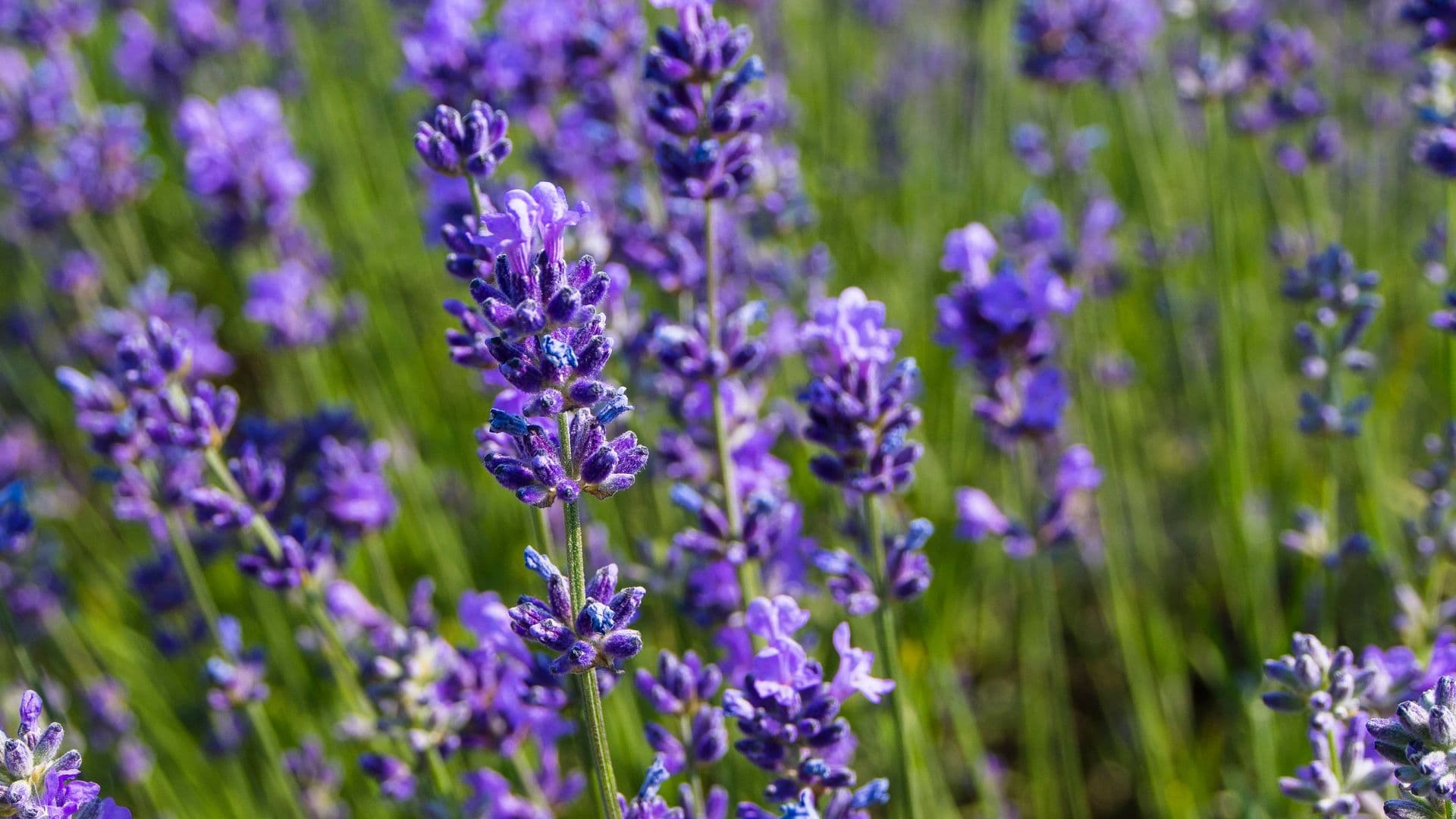
Lavender
Lavandula angustifolia
Clarification, purification; transcendence
Botany
Lavandula angustifolia MILL., true lavender, belongs to the family of Lamiaceae and originates from the Mediterranean region. Today, it is widespread throughout much of Europe. This aromatic-smelling shrub grows up to 60 cm high and develops a deep taproot of 3 to 4 metres. The ascending, square stems become woody at the base, are heavily branched, and richly leafed. The leaves are linear, entire, and slightly rolled downwards at the edges.
The leaves and stems have only a mild scent — the intense lavender fragrance comes from the flowering horizon. Unlike other family members, the blue-violet flowers are not arranged in leaf axils, but in false spikes, which appear separate from the leaf area. The flowers occur in single whorls, with the lowest whorl set far apart. They have an aromatic scent and a bitter taste. Full bloom lasts only a few days. For bees, lavender is an excellent source of nourishment.
Essence of the plant
Clarification, purification; transcendence
Lavender is a great »plant of the soul«, whose significance has been intuitively understood for centuries. This is reflected in the botanical name, which derives from the Latin lavare, meaning to wash. This cleansing, however, is not only physical but understood primarily on a spiritual level.
Lavender acts to clarify and soothe the soul. It cleanses the vessel of the soul and creates space for subtler and higher values. This clarification brings calmness and nervous strength.
This facilitates, on the one hand, the acceptance of one’s personal destiny path and, on the other, promotes the readiness to embrace the demands of the next stage. Lavender has the power to uplift the person and open the soul. It brings spiritual clarity, inner peace, and directs consciousness to life areas or relationships that need to be cleansed or clarified. For people who repeatedly experience spiritual crises—that is, those temporarily weakened in strength, courage and zest for life—lavender provides the impetus and the possibility to form a protective shell.
A correct assessment of oneself and others becomes possible. Lavender supports during life crises and transitional situations; as a maternal being, it lovingly takes the person by the hand and guides them over obstacles and through difficulties. The trust in this prudent guidance makes it possible to endure difficult situations and to open oneself to new tasks and challenges.
Lavandula angustifolia
Lavender
From shape to healing power
Lavender, a Mediterranean mountain plant, belongs to the family of Labiatae (mint family), which also includes many other fragrant and aromatic plants. The vast, blue-violet lavender fields in the mountain regions of Provence possess a magical allure. Has a piece of heaven here connected with the earth? In a fragrant lavender field, we feel suffused with a quiet, pure energy.
The inflorescence of lavender is entirely elevated above the realm of the leaves. Closely packed, the flowers surround the ends of the upright branches and, when many plants stand together, the narrow leaves are hidden from view. This leads to a situation where, shortly before and at the time of flowering, the sunlight only weakly penetrates the vegetative sphere of the leaves; the plant has fully become flower and offers itself to the air of the heavens. How are the individual flower whorls arranged within the inflorescence?
After the branch already slightly surpasses the leaves, the inflorescence begins to announce itself with a small flower whorl surrounding the stem. After a gap, a second whorl appears, and after another, shorter gap, the full inflorescence is revealed. The flowering effect announces itself in stages – in a kind of flower ladder with progressively shorter steps. Have you ever closely examined lavender flowers from the pharmacy?
Anyone with basic botanical knowledge will recognise that these are mostly calyces. The oval calyces have the same deep colour as the flowers, which is why the “inconsistency” does not immediately stand out. It is a peculiarity of lavender that it is harvested shortly before or at the beginning of flowering, so that most of the “lavender flowers” are still in the bud stage. There is a reason for this: contrary to the rule that the fragrance and active ingredient content of floral drugs is highest at full bloom, we find the greatest healing power in lavender at the beginning of flowering.
The oval flower calyx is like a vessel. The five calyx leaves are completely fused, and four of the five calyx leaf teeth are barely present. The fifth calyx leaf tooth, however, is expanded and forms a heart-shaped lip that lays over the opening of the calyx vessel (visible with a magnifying glass). This lip opens immediately when the corolla pushes out of the calyx.
A beautiful signature: an egg-shaped calyx with a small little lid. In the development of life, the germination of the seed is followed by unfolding and growth, then flowering and reproduction, later the wilting, fruit ripening and finally withering and dying to make room for a new cycle. The peak of natural life is seen in full bloom. But only when it has wilted can a fruit, a seed for new life, develop from it.
Lavender reaches its peak not, as usual, at the time of full bloom but somewhat before. It seems as if lavender wants to point to another developmental possibility beyond the natural, biological cycle. A spiritual higher development – which is to grow into true wisdom in old age – must begin at a time when the person still possesses full vitality. Transcendence is also expressed in the violet colour of the flower.
Organic and Demeter cultivation
True lavender (Lavandula angustifolia) is native to the western Mediterranean region, especially in the mountainous areas of Provence, the Pyrenees and the Apennines at 600–1500 m altitude. In Switzerland, it is cultivated in Valais and in warmer regions.
Ceres uses lavender flowers from organic or Demeter cultivation. The flowers are harvested painstakingly by hand at the beginning of flowering, after summer days, when the content of essential oils is at its highest.
Traditional Use
Sources
1. Wichtl M, Czygan F-C, Frohne D, et al. Teedrogen Und Phytopharmaka. 3rd ed. Wissenschaftliche Verlagsgesellschaft GmbH, Stuttgart, Deutschland; 1997.
2. Committee on Herbal Medicinal Products (HMPC). Assessment report on Lavandula angustifolia Miller , aetheroleum and Lavandula angustifolia Miller , flos. EMA/HMPC/143183/2010. EMA/HMPC/143183/2010. Published online 2012.
3. Madaus G. MADAUS LEHRBUCH DER BIOLOGISCHEN HEILMITTEL BAND 1-11. Nachdruck. mediamed Verlag, Ravensburg; 1990.
4. BGA/BfArM (Kommission E). Lavandulae flos ( Lavendelblüten ). Bundesanzeiger. 1984;228.
5. Kalbermatten R, Kalbermatten H. Pflanzliche Urtinkturen. 9th ed. AT Verlag, Aarau, Schweiz; 2018.
6. Kalbermatten R. Wesen Und Signatur Der Heilpflanzen. 9th ed. AT Verlag, Aarau, Schweiz; 2016.
Transcendence
R. & H. Kalbermatten — «Psyche des Menschen und Signatur der Heilpflanzen»
Ceres mortar process — gentle, cold and complete.
Freshly harvested, hand-picked, ground at room temperature and aged for years. No heating, no pressure - the plant's full vitality is preserved.