Chamomile
Chamomilla / Matricaria recutita
Security, patience, gentleness, motherliness
Botany
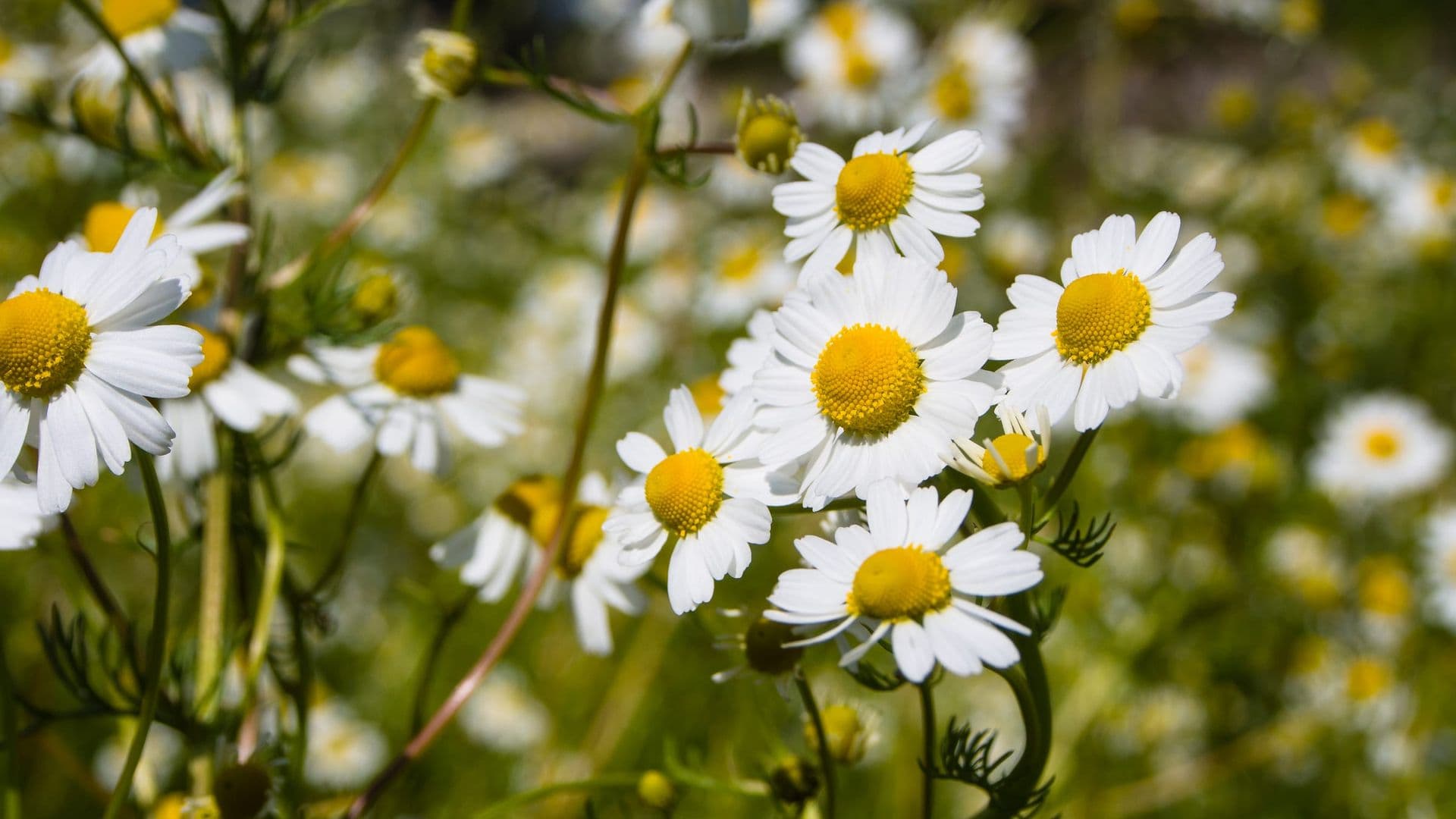
Chamomile (Matricaria chamomilla L., family Asteraceae) grows between 15 and 60 cm tall. Very fine, deeply pinnatisect leaves, reduced almost to the veins, grow on the sturdy stem — the leaf therefore has practically no flat surface. From May to August, the flower heads appear singly at the stem tips, measuring 1.5 to 2.5 cm in diameter. The inflorescence consists of white ray florets and yellow disc florets. The flower receptacle is initially flat, later becoming strongly domed with a cavity forming in the centre. When crushed, the flowers develop their characteristic pleasantly aromatic scent.
Essence of the plant
Security, patience, gentleness, motherliness
Chamomile conveys a feeling of motherly protection by dampening an excessive internal or external sensory sensitivity and relieving spasmodic conditions through gentle warmth. With heightened sensory sensitivity, other people, situations, the environment, and one's own body appear in a sharp, exaggerated image.
One then feels vulnerable and insecure, is very sensitive to pain, irritable, and reacts irritably and impatiently at the slightest provocation. In these situations, chamomile conveys a peaceful gentleness and alleviates inflammatory and cramp-like processes.
Chamomilla / Matricaria recutita
Chamomile
From shape to healing power
In the chamomile flowers, we see the dazzling light of high summer. Above the dry, warm arable land, the forces of light have found their expression within them. The crown of petals is dazzling white, the domed flower disc shining pale yellow. The flower centre feels delicate and has a smooth surface, radiating a strong gleam in the sunlight.
The leaves are very fine, twice pinnate. The individual segments are indicated only as lines. Like antennas or highly sensitive sensory organs, the chamomile plant directs its leaf tips in all directions. Everything about it is focused on receiving and absorbing.
A high sensitivity speaks through its form. And yet chamomile is not hypernervous because of this. On the contrary, the damping principle, the cushioning, is at work everywhere. Thus, the leaves are very soft, like feathers. The principle of cushioning is most clearly expressed in the domed yellow flower base.
During development, it curves strongly upwards. When cut longitudinally, the cylindrical flower base reveals an air-filled cavity. Like an air cushion, the flower dampens any harshness. The dazzling, glaring light is softened by the gently cushioning, air-padded flower base.
Chamomile contains a deep blue essential oil, which is an exception; essential oils are usually colourless or yellowish. However, the oil is not blue in the fresh plant but acquires this colour only after extraction by steam distillation. During this process, a blue substance is formed which colours the oil. The colourless, undifferentiated essential oil of chamomile transforms in combination with water and heat into the blue oil, radiating gentleness, calm and maternal security.
Blue is the colour of the ocean, which brings forth life, and also of the primal mother. Colourless, undifferentiated water in bright sunlight assumes the deep blue colour of the ocean. The Latin terms mare, mater and materia are closely related in essence – and connected to this is Matricaria, the chamomile. The typical scent of chamomile oil has a pleasantly warm but not fiery character. Chamomile is surely the epitome of a medicinal plant.
A child troubled by stomach pain, the caring mother, the warm chamomile tea – these simply belong together. It is not only the antispasmodic active ingredients that do the child good, the chamomile essence also intensifies maternal care. At birth, the child is pushed out from the soft, warm, dark security of the maternal womb into a hard, cold and bright world. The newborn experiences the light at first as a dazzling pain, but gradually learns to orient itself by the light, using its eyes to take the world into itself.
The mother surrounds the child with the softness and warmth of her security and accompanies it in its first discoveries in the light of the world, but she must continually protect it from the extreme, dazzling sensory impressions. The need for warmth and softness remains, but the light slowly ceases to be threatening for the infant. The child awakens more and more to a desire for the soft glow of the light. Light, softness and warmth are encountered in the wonderful chamomile.
Demeter cultivation
Originally probably native to the Mediterranean region, chamomile is now widespread throughout Central Europe on fields, fallow land, and roadside verges. Pharmaceutical chamomile is primarily cultivated in Germany, Hungary, Egypt, and Argentina.
Ceres uses the fresh chamomile plant from Demeter cultivation. The plant is harvested at midday – at this time the essential oil content is at its highest.
Traditional Use
Chamomile, widespread throughout Europe, possesses a very broad spectrum of applications, particularly in the field of paediatrics. The variety of preparation forms is extensive: tea, extraction of the essential oil, fluid extraction with aqueous-alcoholic solvents, and medicinal-cosmetic products. Chamomile has antibacterial and wound-healing promoting properties. For this reason, rinsing and gargling the mouth and throat with chamomile preparations has proven effective for soothing inflamed mucous membranes. The anti-inflammatory properties, combined with the antispasmodic mode of action, explain why Matricaria chamomilla L. is among the principal remedies for irritations, spasms, and colics of the digestive organs. Inflammations of the respiratory organs can also be treated. In gynaecology, spasmodic and painful complaints of the female genital organs constitute the main areas of application. In children, chamomile preparations are indicated for irritable moods, restlessness, sleep disorders, and teething discomfort.
Sources
1. Hänsel, R. & Steinegger, E. Hänsel / Sticher Pharmakognosie Phytopharmazie. (Wissenschaftliche Verlagsgesellschaft GmbH, Stuttgart, Deutschland, 2015).
2. Madaus, G. MADAUS LEHRBUCH DER BIOLOGISCHEN HEILMITTEL BAND 1-11. (mediamed Verlag, Ravensburg, 1990).
3. Committee on Herbal Medicinal Products (HMPC). European Union herbal monograph on Matricaria recutita L., flos. EMA/HMPC/55843/2011 44, (2015).
4. BGA/BfArM (Kommission D). Chamomilla Recutita (Chamomilla). Bundesanzeiger 217a, (1985).
5. Kalbermatten, R. & Kalbermatten, H. Pflanzliche Urtinkturen. (AT Verlag, Aarau, Schweiz, 2014).
6. Kalbermatten, R. Wesen und Signatur der Heilpflanzen. (AT Verlag, Aarau, Schweiz, 2016).
The Damping of Pain Sensations
R. & H. Kalbermatten — «Psyche des Menschen und Signatur der Heilpflanzen»
Ceres mortar process — gentle, cold and complete.
Freshly harvested, hand-picked, ground at room temperature and aged for years. No heating, no pressure - the plant's full vitality is preserved.