Nettle
Urtica dioica
Aggression, willpower, self-discipline, blood purification; iron
Botany
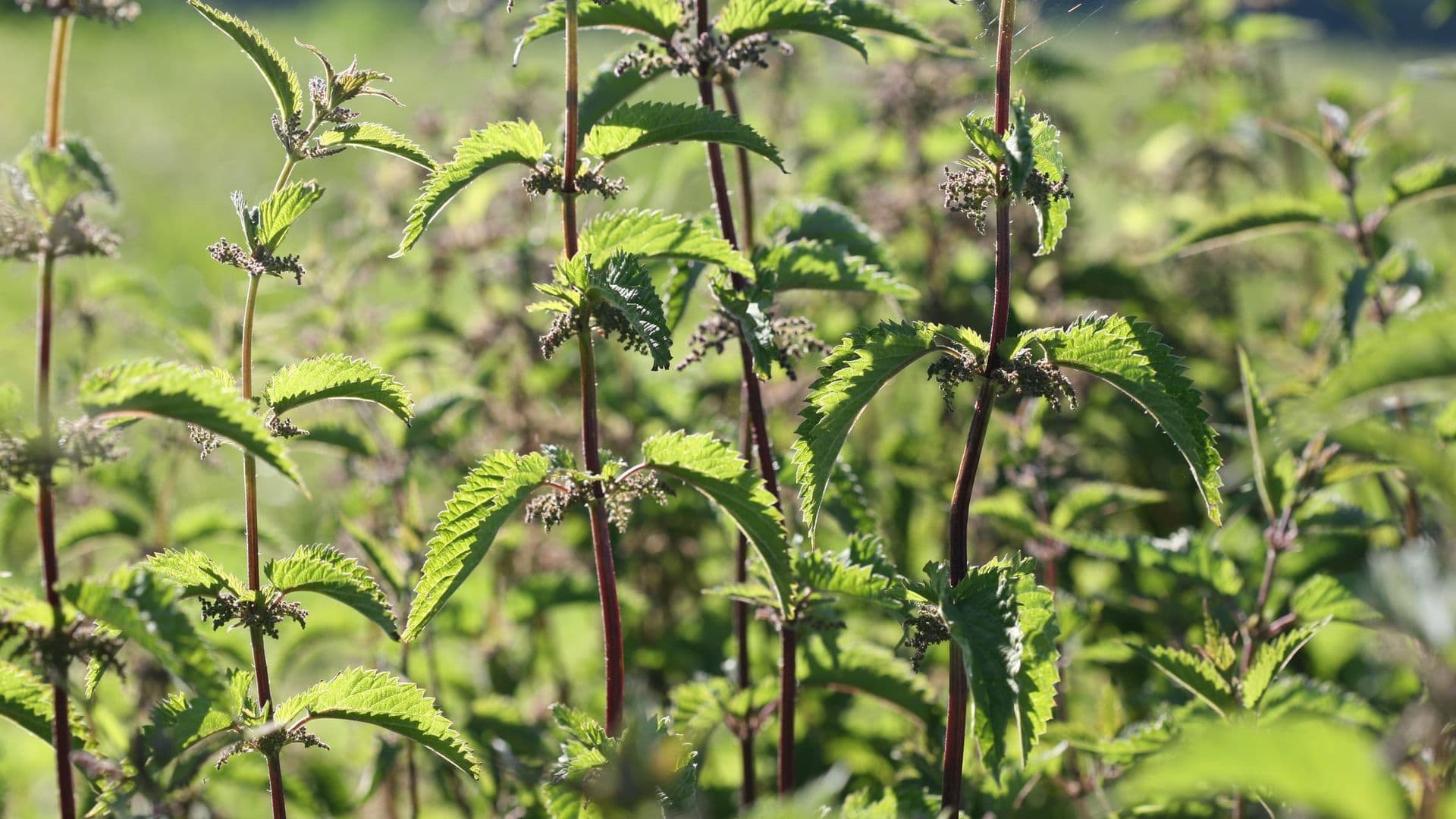
Who does not know the nettle (Urtica dioica L.)? It grows up to 1.50 m tall and colonises nitrogen-rich sites: banks, ditches, paths, cultivated land. On the stems, the pointed, coarsely serrated leaves grow opposite each other. Both stems and leaves are covered with stinging hairs shaped like cannulas, which inject their juice into the skin of the unwary toucher. The nettle knows how to defend itself! With underground runners, it conquers the space around it.
From June, the plants begin to flower. There are female and male nettles, which are often difficult to distinguish due to their small, inconspicuous flowers. In the male flowers, something fascinating occurs: their stamens are tensed like a catapult. As the pollen ripens, tension increases—especially in warm, dry weather—until it is released in an explosive shower of pollen. Those who take the time can see small pollen clouds travelling on the wind.
Essence of the plant
Aggression, willpower, self-discipline, blood purification; iron
Aggression is usually associated with a negative, destructive activity. Yet aggression, understood in its original, positive sense, removes obstacles so that new activity can unfold (Latin aggredi, to approach something). It eliminates the old, worn-out, powerless, overdue, thereby creating space for the new.
Aggression and creative activity are inseparably connected. For personal development and freedom, it is important to develop a positive aggression that addresses one’s own essence in the form of self-overcoming and willpower, in order to take charge of one’s own life and not be controlled by drives. Without restraining willpower, hindering tendencies and attachments cannot be released, leading to an accumulation of mental and physical "slags".
At the physical level, due to poor nutrition (luxurious, protein-rich), slags (nitrogenous breakdown products, uric acid) accumulate in the blood, resulting in restricted mobility (rheumatic and gout-like complaints). Here, the nettle helps with its aggression by creating the possibility to dynamically break up rigid structures in soul and body. Due to its iron content, it has a specific relationship to the blood.
It is the aggression carried into the blood that frees the organism from old, useless substances. For no other plant is the old concept of "blood cleansing" as fitting as for the nettle. Nettle is an outstanding basic therapeutic medicinal product for the treatment of allergies.
Allergies are excessive immune reactions to substances that are inherently harmless. They represent a defence aimed at a supposed enemy, a sign of misdirected aggression. The essence of the nettle can help re-establish the defence in its correct relationship.
Urtica dioica
Nettle
From shape to healing power
On walks or in the garden, we are occasionally surprised by the nettle and experience its sharply burning effect. A plant that burns is an unusual phenomenon, and the nettle is an exception in this respect. The painfully tangible main characteristic of the plant is the typical stinging hairs, whose spherical tip breaks off at the slightest touch. This creates a sharp-edged needle from which the poison flows into the scratched skin, causing burning, itching, wheals and redness.
The poison consists of substances mainly found in the animal kingdom (acetylcholine, serotonin, formic acid). Nettles colonise acidified, nitrogen-fertilised soils, and are therefore often found around alpine huts, at forest edges and on scree slopes. They fulfil an important function for these soils by removing excess nitrogen and thus restoring the biological balance. The nitrogen absorbed from the soil is converted into protein compounds within the plant.
The high protein content makes the nettle an attractive forage plant for caterpillars and other insects. The caterpillars of many colourful butterflies (peacock butterfly, small tortoiseshell, red admiral) depend on this forage plant. Nettles are sometimes so densely populated with caterpillars that they are stripped bare to the stem. Unadorned flower spikes like caterpillars. Another consequence of the protein richness is the rapid decomposition and putrefaction process when nettles are soaked in water to prepare a liquid manure.
Nettle liquid manure is an effective and popular liquid fertiliser in organic gardening. A dense nettle stand develops a strong, herbaceous spicy scent on hot, sunny summer days, which undeniably has an affinity with animal odour. No other plant has such a pronounced relationship with iron. The nettle has a high selectivity for the metal and thus regulates soils with excessively high iron content.
Landfills and scree slopes with scrap iron are popular nettle habitats. While a high iron content is found in only a few plants, because iron does not serve specific functions in the biochemistry of plants, it plays an important role in humans and animals. As the central atom of haem, the red blood pigment, iron enables the binding of oxygen in the blood, so that it can be transported to its destination in the cells. Thus, iron is responsible for one of the blood's most important tasks, oxygen transport.
Iron can therefore be described as a central functional carrier in respiration, and it forms the basis for the combustion of nutrients. In a way, as a counterbalance to the untypically high iron content in the plant kingdom, the nettle has a high chlorophyll content. Chlorophyll, the green plant pigment, is the chemical, optical and functional counterpart to haem. Both compounds have a very similar chemical structure, differing only in that haem has an iron ion and chlorophyll a magnesium ion as the central atom.
Furthermore, it is worth mentioning that the two colours green and red behave as mirror images. They are complementary colours. The function of chlorophyll is to assimilate light energy and convert it into chemical energy required to synthesise glucose from water and carbon dioxide, releasing oxygen. Glucose is the starting material for the formation of all other energy-rich organic compounds.
Chlorophyll thus provides the basic prerequisite for the absorption of solar energy, its storage in biomass and the release of oxygen. In contrast, haemoglobin enables the uptake of oxygen as a prerequisite for the combustion of nutrients (biomass) to carbon dioxide and water, releasing stored energy. This energy is used for muscle power or countless physiological reactions, with heat released as an essential by-product. It can therefore be said that iron lies at the beginning of the long chain of reactions that enables our blood warmth. The shape of the plant's leaves contains no striking features.
The leaves are sharply serrated, arranged oppositely in pairs and very regularly rhythmical along the square stem. Many other plants, such as species of Lamium (dead-nettles), have similar leaves although they belong to a completely different family. Only the flowers give the nettle an unmistakable external character. The flowers – male and female, which grow separately on different plants – are colourless and very small, but their great number shapes the appearance of the nettle from midsummer until autumn.
Like bright, narrow sausages or caterpillars, they stand out from the stem and thus give the inflorescence an animal-like character. In the nettle, we can thus recognise several features untypical for plants, which otherwise only occur in the animal kingdom. This means that its essence expresses exactly those elements that distinguish the animal kingdom from the plant kingdom, namely the inner driving force for movement and change in the broadest sense. When related to humans, these are willpower and assertiveness.
Organic and Demeter cultivation, wild collection
Nettle is native to Europe, Northern Asia and North America and grows on nutrient-rich, nitrogen-rich soils at pathsides, fences, in floodplains and gardens. It is considered an indicator plant for nitrogen enrichment.
Ceres harvests the plants from organic and Demeter cultivation as well as wild collection. The plants are harvested when they show explosive dusting.
Traditional Use
Nettle is one of the medicinal plants that has been used in phytotherapy for a particularly long time. It was already known in the time of Hippocrates and is also recommended by Saint Hildegard and Paracelsus. From a medicinal plant perspective, diuresis in inflammatory diseases of the urinary tract is one of the main areas of application. The kidney-excreting effect of nettle can also be used to prevent kidney gravel. Another traditional use is the supportive treatment of rheumatic complaints and mild joint pains, which from a naturopathic viewpoint can usually be attributed to the presence of uric acid diathesis. Preparations from nettle are also traditionally used for seborrhoeic skin conditions. Moreover, it is not surprising that at least the species closely related to Urtica dioica L., Urtica urens is used according to the classical homeopathy principle “Similia similibus curentur” for nettle-rash-type skin conditions, as well as for kidney ailments and gout. An important folk medicinal use of Urtica dioica L. is blood cleansing and strengthening.
Sources
1. BGA/BfArM (Kommission E). Monographie: Urticae herba (Brennnesselkraut); Urticae folium (Brennnesselblätter). Bundesanzeiger 76, (1987).
2. Wichtl, M. et al. Teedrogen und Phytopharmaka. (Wissenschaftliche Verlagsgesellschaft GmbH, Stuttgart, Deutschland, 1997).
3. Madaus, G. MADAUS LEHRBUCH DER BIOLOGISCHEN HEILMITTEL BAND 1-11. (mediamed Verlag, Ravensburg, 1990).
4. Committee on Herbal Medicinal Products (HMPC). Community herbal monograph on Urtica dioica L. and Urtica urens L., herba. EMEA/ HMPC/170261/2006 (2008).
5. BGA/BfArM (Kommission D). Urtica dioica. Bundesanzeiger 199a, (1989).
6. Kalbermatten, R. & Kalbermatten, H. Pflanzliche Urtinkturen. (AT Verlag, Aarau, Schweiz, 2014).
7. Kalbermatten, R. Wesen und Signatur der Heilpflanzen. (AT Verlag, Aarau, Schweiz, 2016).
Willpower
R. & H. Kalbermatten — «Psyche des Menschen und Signatur der Heilpflanzen»
Ceres mortar process — gentle, cold and complete.
Freshly harvested, hand-picked, ground at room temperature and aged for years. No heating, no pressure - the plant's full vitality is preserved.