Birch
Betula pendula
Quality, aesthetics, polarity of life and death
Botany
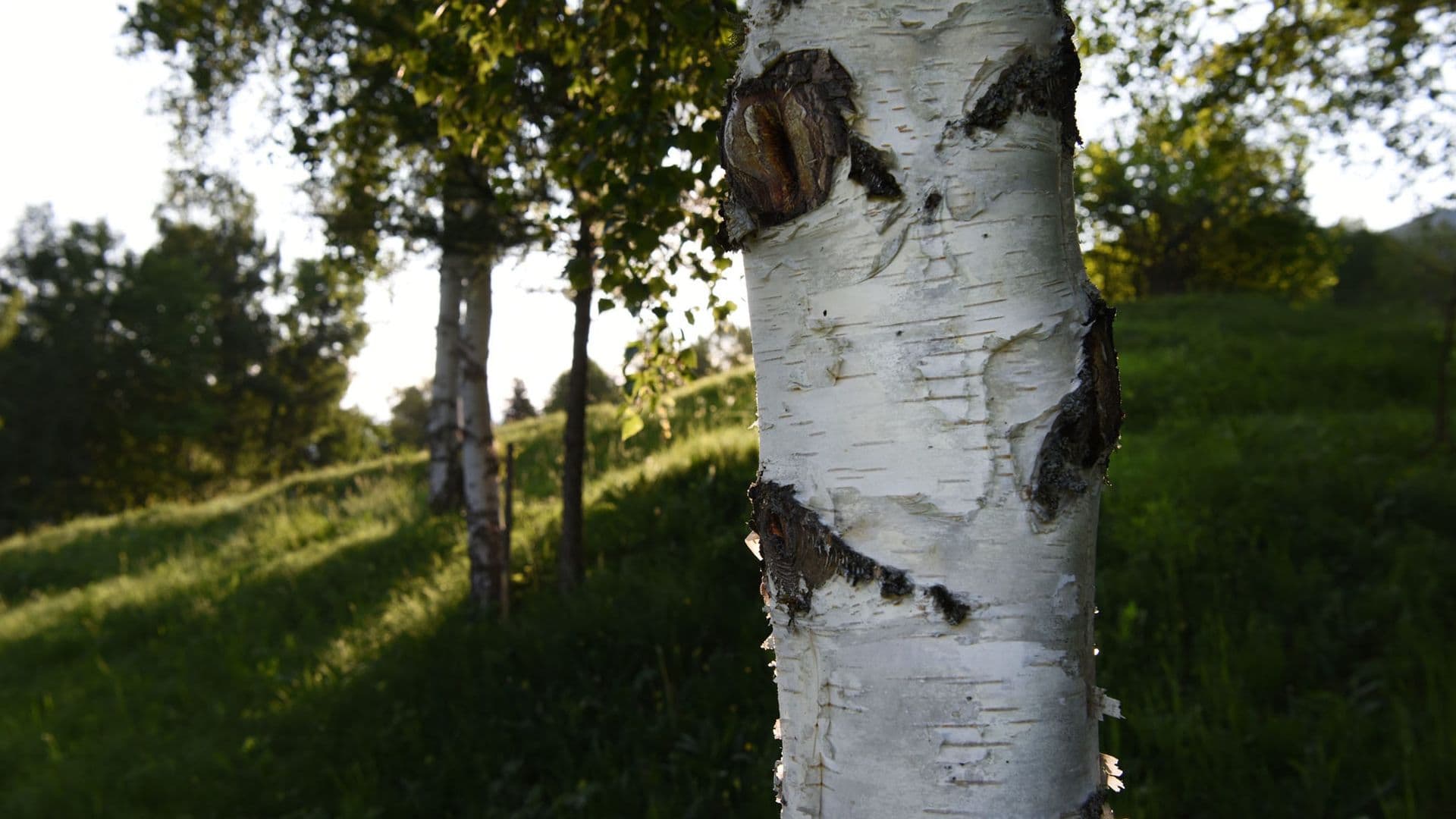
The silver birch (Betula pendula Roth, family Betulaceae) is a tree that can grow up to 30 m tall. Birches are fast-growing and often the first trees to colonise an area — after the ice ages, the birch was one of the first trees to return to Central Europe. Today, it is primarily found on riverbanks, in marshes, and in damp forests. Its trunk is intensely permeated by sap in spring. The bark of young trees is snow-white and peels off in horizontal strips; on older trees, the lower trunk is fissured and knobbly, while higher up it is smooth and white.
The branches grow at sharp angles and hang heavily. The youngest shoots often bear resin glands. The leaves are triangular with a long pointed tip, initially very soft, gland-dotted and sticky. Birches bloom from April to May with catkin-like inflorescences; each catkin can produce several million pollen grains. An old birch also produces several million seeds, but these are very short-lived. The birch combines exuberant life and death.
Essence of the plant
Quality, aesthetics, polarity of life and death
The birch unites the opposites of life and death within itself. It bears signs of youthful flowing life as well as those of decay and mineralisation. How is it possible for the birch to encompass such a vast range?
In myths, it was often depicted as a gracefully dancing maiden with golden hair (Betula means young girl in Hebrew). In the supple movement of the branches in the wind, in the golden-yellow spring and autumn foliage, and in the pure white bark, we can imagine this comparison. Dance is rhythm, oscillation, vibration.
Graceful dance, aesthetic form, radiance is an image of pure quality, of soul power that unites all opposites. It is the soul principle that connects the spiritual with the material, that brings the dead to life and mediates between the greatest polarities. The essence of the birch is quality.
Under the influence of this tree, the soul perceives colours more vividly, tones more resonantly, scents more aromatically. In its sphere of influence, forms appear more alive, and our senses are enabled to behold aesthetics and harmony. Birch leaf mother tincture is the indicated remedy when the world feels dull and grey, when one is gripped too tightly by forces of stagnation and cold.
When youthful vigour in thoughts and feelings wanes, when the joy of physical movement is lost, the birch serves as a richly flowing source of new energy. However, the birch also reaches the opposite human type, who moves through life too lightly and too dancer-like. The person for whom life is a stage for self-presentation, who avoids deep bonds, who chases after the sweetness of life like a butterfly and who suppresses their harsh sides.
Through their non-committal behaviour, they have no deep share in the communal bond of friendship and interest that connects people. Connection and friendship are represented in the organ system by the kidneys. By activating kidney function through Betula, such people are given the opportunity to connect more deeply with life and with others.
Betula pendula
Birch
From shape to healing power
Which child does not know the birch, the only tree with white bark? White is the colour of purity, of untouchedness, of the bridal gown. It is the colour of promise, for white light can be split into the fundamental colours of the rainbow. White is not a rare colour in the plant kingdom; there are numerous beautiful white flowers.
The term "blossom white" is used as a synonym for the highest purity. In the white blossom, we encounter an image of promising young life. Otherwise, we find the colour white mainly in the inanimate natural world, such as in snow. The sight of a freshly snow-covered landscape moves us solemnly.
We sense the purity, freshness and renewal that emanate from the gentle, sunlit, sparkling snow cover. Yet it would be a premature conclusion to describe the essence of the birch – because of its white bark – as purity. Before we can interpret the meaning of the white birch bark, we must understand the nature of the usually brown bark.
If we cut open an apple and leave it exposed to the air, it turns brown; the life-decomposing oxidation processes affect the injured cells at the cut surface of the apple. Brown always accompanies decomposition in the plant kingdom. The bark is brown like the soil, the humus, and consists of decomposed plant material no longer permeated by life juices. Thus, the bark has an essential kinship with the earth.
Both are on the path from living substance to mineral substance. Does this now mean that the white birch bark is still blossomy and not earthy or decomposed? No, on the contrary. Because as the decomposition process advances, the last stage that emerges is the mineral, the pure white ash.
In the birch, we see a tree whose bark symbolises the complete dissolution of the living, death. This brings us to the other meaning of white, as recognised especially in Eastern cultures, as the colour of mourning and death. Only now do we have a complete image of this colour, for within it lies the polarity of the beginning and the end of the life cycle, the promise of life and death.
Seemingly distant opposites are in reality close together, as they are closed by the ever-ongoing movement of life into a circle. Between these poles – both symbolised by white – stretches the life force that moves us. The essence of the living circular movement is therefore what symbolically meets us in the birch bark. Life means movement, change, flexibility.
The birch is an extremely mobile tree. Especially in the silver birch – which provides the medicinally used leaves – we see a dancing grace of movement when the wind passes through its branches. The branches are fine and elastic; for this reason, they are also used to make twig brooms and rods. In spring, the birches are richly permeated by an abundance of life-awakening sap, often drunk as part of a detoxification cure. (The tapping of birches required for this purpose should only be carried out by healthcare professionals to avoid damaging the tree.) The birch leaves emit a particularly lovely, sweetish scent that imbues our soul with rejuvenating forces.
Wild collection
Ceres uses birch leaves harvested from wild collection in Switzerland. The young, still sticky leaves are picked by hand individually in spring shortly after sprouting — this way no leaf is damaged during harvest and can be processed carefully immediately.
Traditional Use
The leaves of birch are used in pharmacy fresh or dried in the form of herbal teas, powdered, or for the preparation of dry or fluid extracts. The primary focus of the effect of birch leaves lies in increasing diuresis or aquaresis. Therefore, they are also suitable for washout therapy in bacterial and inflammatory diseases of the lower urinary tract. The enhancement of kidney function in combination with sufficient fluid intake can also help prevent the formation of kidney grit. In naturopathic specialist literature, medicinal preparations from silver birch "Folia Betulae" are also recommended as supportive treatment for rheumatic complaints and skin diseases. This is not surprising, as impaired kidney elimination is often a contributing factor in the aforementioned conditions.
Sources
1. Hänsel, R. & Steinegger, E. Hänsel / Sticher Pharmakognosie Phytopharmazie. (Wissenschaftliche Verlagsgesellschaft GmbH, Stuttgart, Deutschland, 2015).
2. Madaus, G. MADAUS LEHRBUCH DER BIOLOGISCHEN HEILMITTEL BAND 1-11. (mediamed Verlag, Ravensburg, 1990).
3. Committee on Herbal Medicinal Products (HMPC). European Union herbal monograph on Betula pendula Roth and/or Betula pubescens Ehrh. as well as hybrids of both species, folium. EMA/HMPC/5, (2014).
4. BGA/BfArM (Kommission E). Betulae folium ( Birkenblätter ). Bundesanzeiger 50, (1986).
5. Kalbermatten, R. & Kalbermatten, H. Pflanzliche Urtinkturen. (AT Verlag, Aarau, Schweiz, 2014).
6. Kalbermatten, R. Wesen und Signatur der Heilpflanzen. (AT Verlag, Aarau, Schweiz, 2016).
Mobility and Aesthetics
R. & H. Kalbermatten — «Psyche des Menschen und Signatur der Heilpflanzen»
Ceres mortar process — gentle, cold and complete.
Freshly harvested, hand-picked, ground at room temperature and aged for years. No heating, no pressure - the plant's full vitality is preserved.