Crataegus – Harvesting, Collection, Preservation
Miriam Moser
Hawthorn changes its appearance over the course of the year. From the many-jointed branches it opens towards the blossom, from the blossom the fruit ripens. Those who observe Crataegus through the seasons discover a special connection: reception, gathering and preservation become images for a plant whose form transforms while retaining something of its own essence.
There are plants whose essence only reveals itself if you do not fixate on a single moment in time.
Hawthorn is one of these. In spring, it is barely recognisable. Where just moments before there was a dark tangle of branches, a profusion of white blossoms opens up. A few months later, this sea of flowers is no longer visible. Instead, red fruits hang among the branches. Those who accompany hawthorn through the seasons do not always meet the same plant. Its form changes – and with it, what it reveals to us.
Branches of Change in Direction
Perhaps understanding hawthorn therefore does not begin with its flowering, but with what precedes it: its branching. There are plants that occupy space generously. Hawthorn does something different. Its branches follow no straight line. They divide, change direction, continue and branch out again. This creates not a simple framework, but a dense network.
This way of growing illustrates a thought: development does not always proceed in a straight line. A path can divide, change direction, and continue elsewhere. In spring, it is time for this many-segmented interior to emerge outward.
Uptake: Opening Towards the Sun
With the flowering, the appearance of the hawthorn changes completely: The plant, previously characterised by its many-branched twigs, opens outward. Between branches and leaves, a profusion of white blossoms appears for a brief time. It is a remarkable transition: from a segmented individual structure to a unified surface. From many small units emerges an overall image.
The blossom forms an interface between the inside of the plant and the world outside – and thus also to the sun. What previously appeared as a dense network now forms a new relationship to the external world. The blossom does not erase the previous form, but rather builds upon it.
The sea of blossoms does not arise despite the branched twigs, but out of them.
Gathering: From Blossom to Fruit
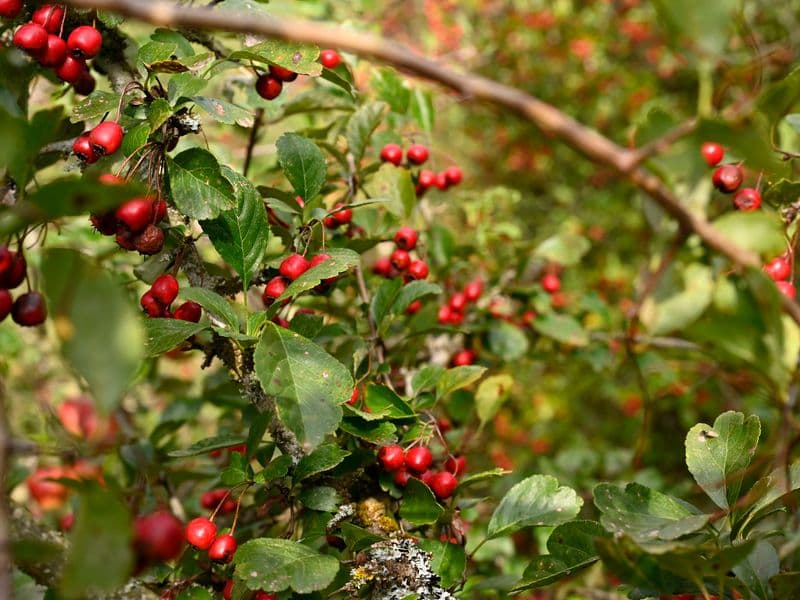
The blossoms do not remain. Their time is brief. But what develops from them ripens well into autumn. The fruit is more than a late splash of colour. It is another form of the same plant. What in spring was open and outward-facing is now gathered and preserved. In spring, hawthorn shows itself in the abundance of blossoms.
In autumn, it carries this development forward in its red fruits. Only in the alternation between blossom and fruit is hawthorn’s own rhythm visible: what opens in spring finds a new form in autumn.
What is Preserved in the Fruit
A closer botanical look at this final part of the year is also worthwhile: the fruits of Crataegus contain a characteristic mixture of phenolic compounds. Important groups for the fruits include oligomeric procyanidins. At the same time, the chemical composition of hawthorn is not uniform everywhere: it depends, among other things, on species, plant part, and stage of development.
Thus, the transformation is not only visible externally. The composition of the plant also changes during its development.
The fruit is therefore not simply an endpoint. In it, a development reaches maturity.
Why the Heart?
Perhaps part of the special position hawthorn holds in medicinal plant studies can be explained from here. The heart is an organ of rhythm: it collects and distributes, contracts and releases this tension. In the doctrine of signatures, hawthorn was therefore associated with the heart. Roger Kalbermatten describes this relationship as a tension between congestion and release.
Looking at the plant itself, a related rhythm can be recognised: condensation in the branches, opening in the blossom, gathering in the fruit.
This is not about deducing a medical effect from the plant’s form. More interesting is the observation that a plant makes a recurring motif visible throughout its annual cycle. With hawthorn, it is the alternation between gathering and opening.
At the End of Maturity: Ceres
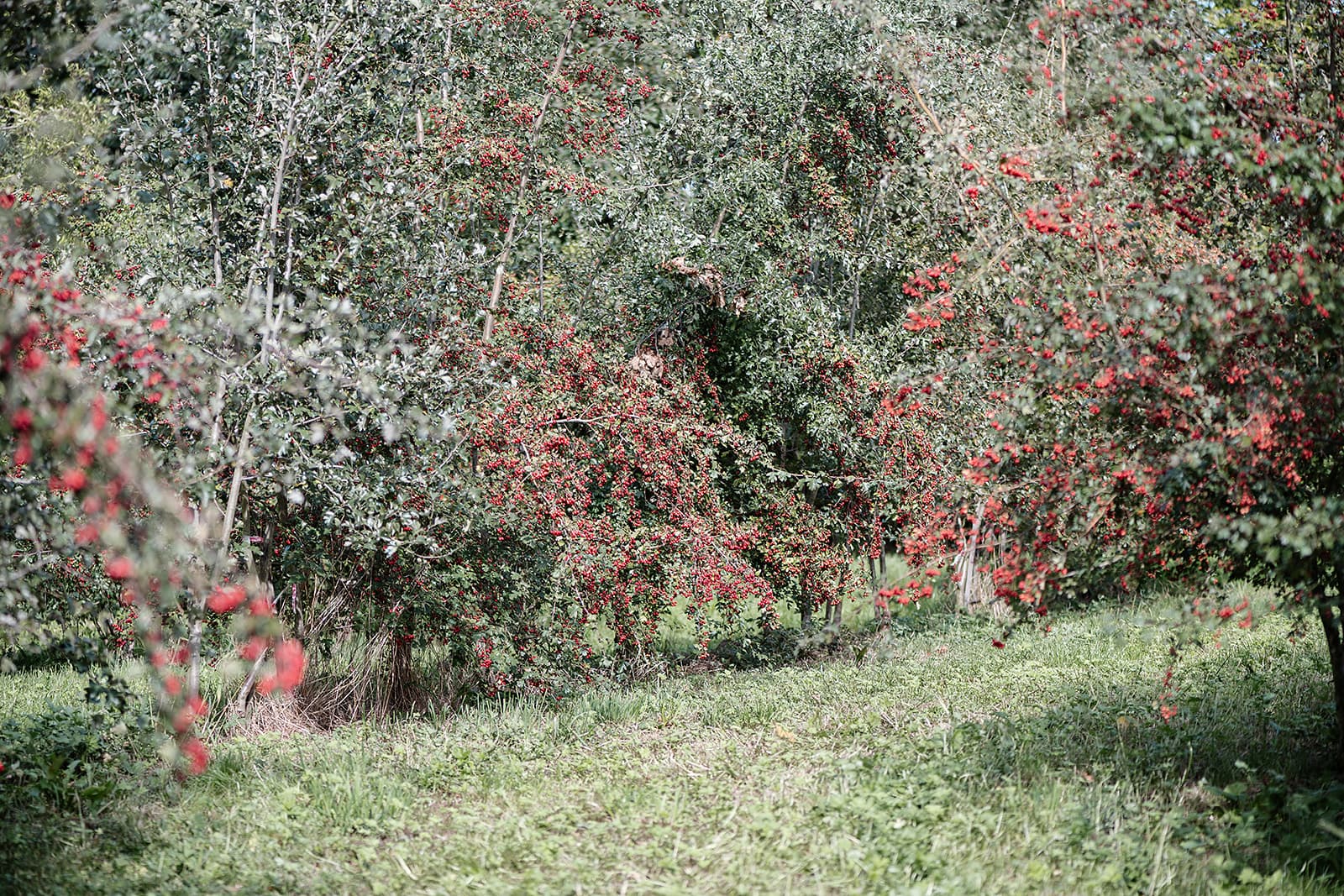
For Ceres, this development does not end with observing the plant. In autumn, when the fruits are ripe, the fruits are hand-harvested by wild collection and at our own research site and processed fresh. From what has ripened over months on the shrub outdoors, a mother tincture is made. The fruit is not simply any plant part. It stands at the end of a development – and it is precisely at this point that processing begins.
A Holistic View of Hawthorn
Those who see hawthorn only in spring know its blossoms. Those who look at it in autumn know its fruits. Those who observe Crataegus throughout the year recognise the connection: from the branches come the blossoms, from the blossoms the fruit. The form changes – and retains its own coherence.
Uptake. Gathering. Preservation.
Continue on Ceres channels
These links open the respective platforms directly. They are intended as a supplement to the article, not as a native in-page interaction.