Hawthorn
Crataegus laevigata / monogyna
Impetus through congestion and resolution
Botany
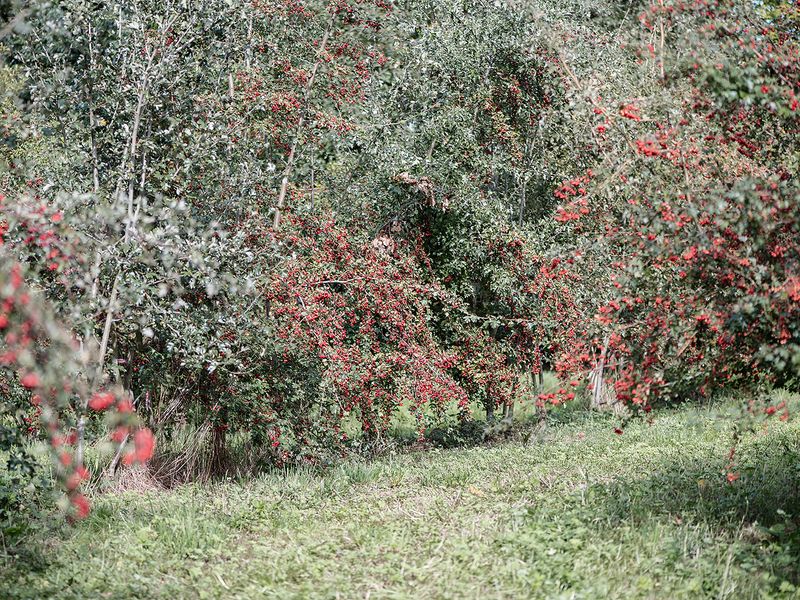
Crataegus monogyna JACQ. and Crataegus laevigata (POIR.) DC, the single-seeded and the two-seeded hawthorn, are deciduous shrubs or small trees up to 10 m tall from the rose family (Rosaceae). They produce very hard wood; the shoot system is divided into long and short shoots, which often end in thorns up to 10 mm long. These thorns represent transformed, condensed shoots of the plant. The result is an almost impenetrable, thorny framework that our ancestors early on used as a protective hedge.
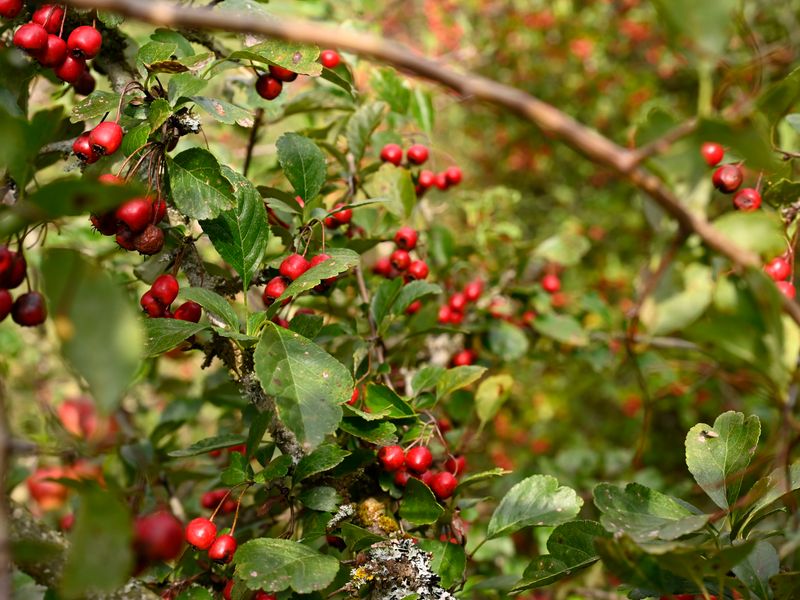
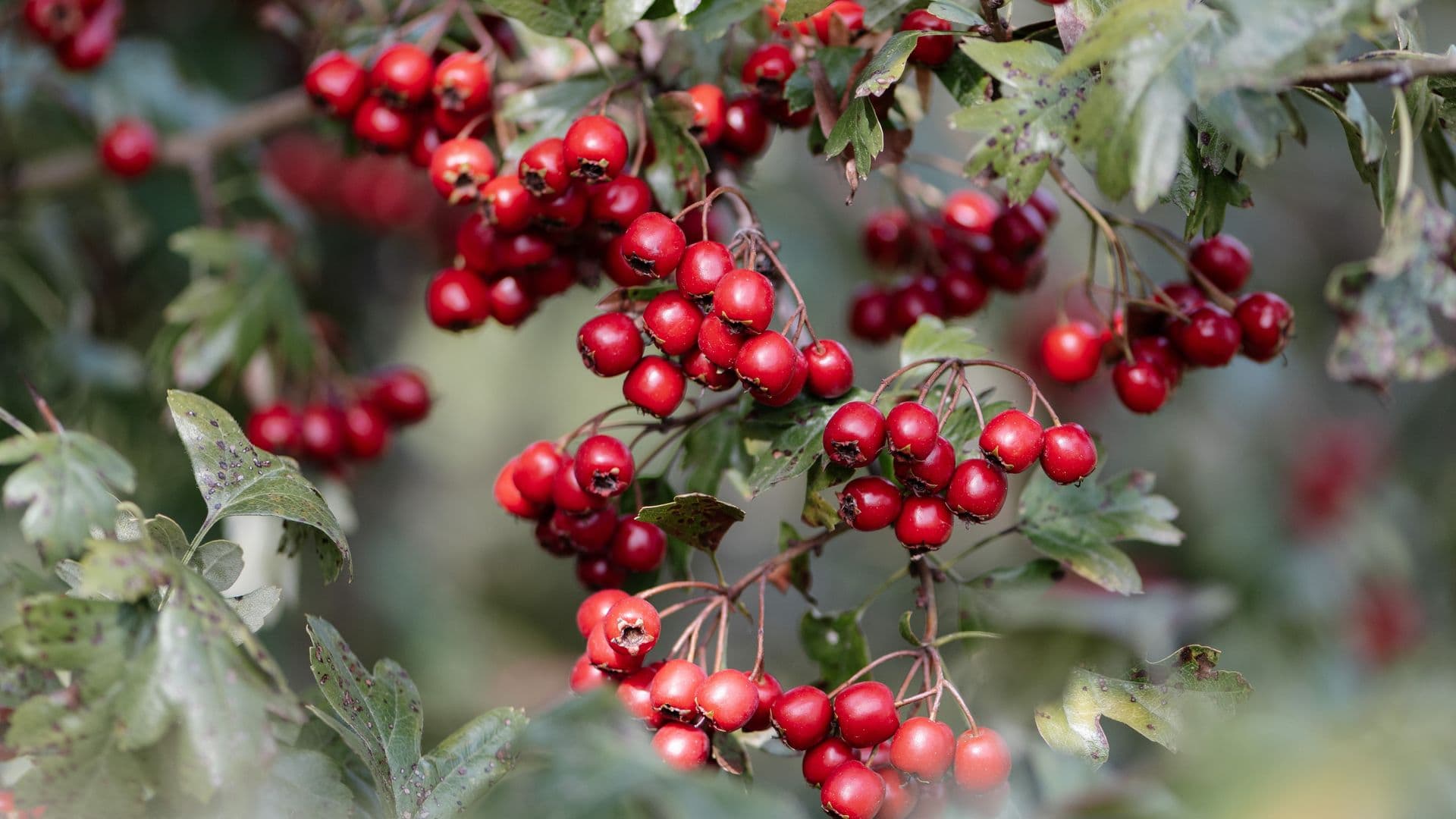
Both species flower explosively in May with white blossoms that develop an unpleasant scent and mainly attract flies and beetles. After pollination, red, egg-shaped fruits develop. In the single-seeded hawthorn, they have a diameter of 6–10 mm and one stone; in the two-seeded hawthorn, 8–20 mm diameter and two to three stones. These “meal barrels” were eaten or added to flour in times of hardship.
Essence of the plant
Impetus through congestion and resolution
"The essence of hawthorn manifests itself in the tension between pent-up power and impulsive discharge. Hawthorn shows us that many developments in life do not proceed in a straight line; they are obstructed and take a different course than planned. The moments of delay, the external stagnations, are prerequisites for the emergence of new impulses that elevate our lives to a higher level. Only when we do not attempt to break through stagnation by sheer willpower, but instead accept reflection in silence, do impulses develop in the heart that lead us to a higher spiritual quality. At declining heart performance, hawthorn is a proven long-term therapeutic."
Crataegus laevigata / monogyna
Hawthorn
From shape to healing power
"The key to understanding hawthorn lies in its structure, which is best examined without the enveloping leafy coat. On the one hand, it leads to hardening and densification, on the other to impulsive discharges — the extraordinary hardness of hawthorn wood and the density of the branches are visible expressions."
"Every congestion necessarily leads to an impulsive discharge. Thorns are the plant's “antennas,” through which vital forces are taken up or given off. Another expression of the discharge is the impulsive blossoming. In early summer, hawthorn is densely covered with flowers that, pushed outwards, almost completely encircle the tree's periphery in white. The scent of the flowers is unpleasant, foul and fishy, due to the high amine content. Nitrogen is the main component of air and is the chemical-material expression of the emotional level. Nitrogen-containing substances that smell foul indicate a decomposition process that has not yet been completed. On the emotional level, this corresponds to the impulsive discharge of pent-up feelings that cannot be fully matured."
"The fruits are a blood red colour. There are many red fruits in the plant world, but very few have a colour so similar to blood as that of hawthorn, which suggests an essential reference to blood. Moreover, the fine, net-like branching of the leaf nerves points to a connection with the vascular system. Through its essential trait of the accumulation of vital forces, hawthorn becomes the prototype of a heart plant. For it is the nature of the heart to accumulate blood in order to enable the rhythmic flow of blood."
Wild collection
Hawthorn is widespread throughout Europe, Western Asia, and North Africa, growing in hedges, thickets, forest edges, and on unimproved meadows. Both species (C. laevigata and C. monogyna ) occur naturally in Switzerland and are medicinally equivalent.
Ceres processes the ripe fruits in autumn, which are carefully hand-harvested in wild collection.
Traditional Use
Hawthorn is one of the best-known and most widely used natural medicinal products worldwide. Depending on the preparation method (tea, tincture or extract), the leaves, flowers or fruits are used in homeopathy and phytotherapy. Some medicinal products also use combinations of the different parts of this traditional medicinal plant. One of the main reasons for hawthorn's popularity in naturopathy is that it is very well tolerated compared to other common medicinal products for the cardiovascular system. The main focus of its use is the supportive and preventive treatment of heart weakness (so-called senile heart), the symptomatic treatment of temporary nervous heart complaints, but also for nervous-related sleep disorders and blood pressure disorders. Preparations from hawthorn are well suited for both prevention and long-term use in particular. Additionally, hawthorn is also a popular concomitant medication for functional cardiovascular diseases and arrhythmias. A positive effect on the coronary vessels of the heart and also the peripheral blood vessels is also described in the literature.
Sources
1. Hänsel, R. & Steinegger, E. Hänsel / Sticher Pharmakognosie Phytopharmazie. (Wissenschaftliche Verlagsgesellschaft GmbH, Stuttgart, Deutschland, 2015).
2. Madaus, G. MADAUS LEHRBUCH DER BIOLOGISCHEN HEILMITTEL BAND 1-11. (mediamed Verlag, Ravensburg, 1990).
3. BGA/BfArM (Kommission D). Crataegus. Bundesanzeiger 109 a, (1987).
4. Committee on Herbal Medicinal Products (HMPC). European Union herbal monograph on Crataegus spp . , folium cum flore. EMA/ HMPC/159075/2014 (2016).
5. Kalbermatten, R. & Kalbermatten, H. Pflanzliche Urtinkturen. (AT Verlag, Aarau, Schweiz, 2014).
6. Kalbermatten, R. Wesen und Signatur der Heilpflanzen. (AT Verlag, Aarau, Schweiz, 2016).
Ceres mortar process — gentle, cold and complete.
Freshly harvested, hand-picked, ground at room temperature and aged for years. No heating, no pressure - the plant's full vitality is preserved.