Hawthorn Harvest at Ceres
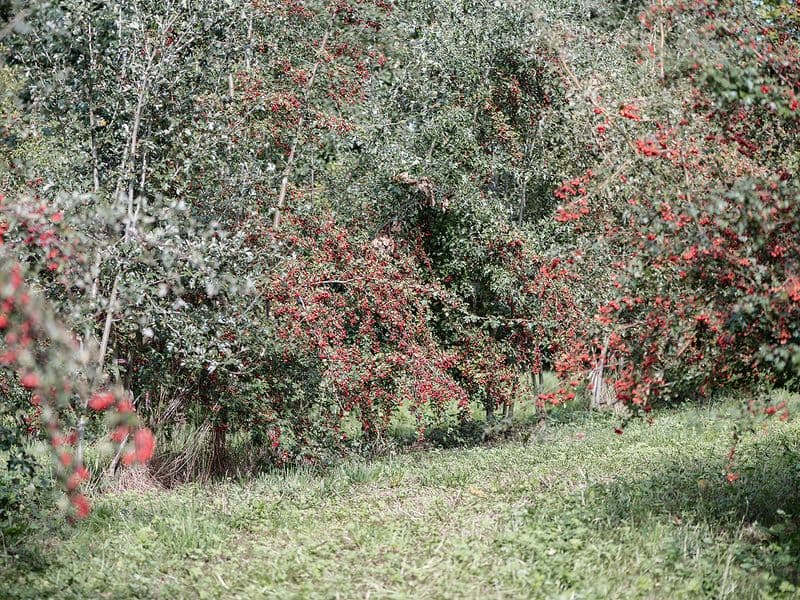
When long ladders are standing by the hawthorn* bushes with the red berries in autumn, it means: hawthorn harvesting time at Ceres. But before the red berries shine, the hawthorn – true to its name – appears in a dense white.
Already in spring, we visit the hawthorn bushes to see how they have withstood the winter and how many flowers they have set. According to the Ceres philosophy, hawthorn has so far been exclusively gathered wild. For three years now, we have also had our own hawthorn research facility at the headquarters in Kesswil. Here, we study how Crataegus can be cultivated and cared for in a nature-oriented and true-to-the-plant's nature manner in its wild form. At the same time, we examine which subspecies and varieties suit our soils and which are robust enough for increasingly challenging weather conditions – from long dry periods to continuous rain. An important point: we do not want to change the hawthorn. We want to learn to do it justice.
The amine-like, slightly fishy scent of the flowers primarily attracts insects. For us wild collectors, however, the special attraction lies in the impressive floral display. Already during flowering, the number of seeds the fruit will later develop can be recognised by the styles standing in the centre. One, two or three... Since the whole shrub begins to flower simultaneously, at the right time we can expect a veritable floral fireworks display.
Fresh, ripe fruits
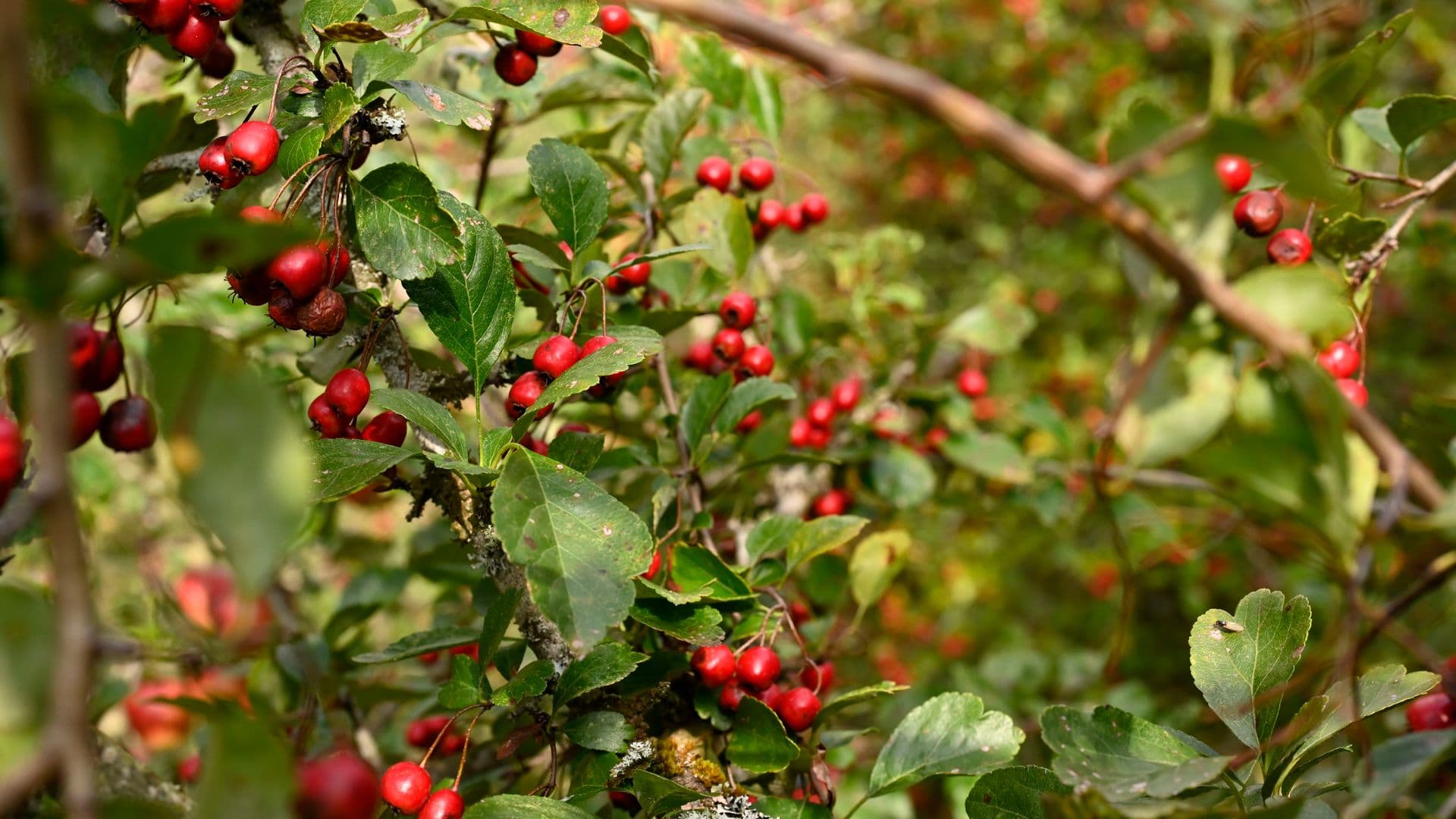
In early autumn, after a three to four-month ripening period, the time has come: the red fruits (commonly called berries) are ready for harvest. Between 500 and 1,300 kilograms of hawthorn are harvested every year.
The fruits exhibit a complete range of colours and forms: from orange-red through blood red to almost purple red, and shapes from small and spherical, through cherry- or cone-shaped to almost cylindrical, with pointed elevations at the end or suggested edges along the length. Due to the low weight of 0.33–1.2 grams per fruit, up to 2,000 fruits are needed for one kilogram of gathered material.
Ripeness of the fruit can be recognised by the fact that the fruit can be easily crushed and is no longer green around the seed. Furthermore, it tastes slightly sweetish when chewed.
This video is provided by Vimeo and requires your consent.
With climbing harness and safety glasses
While our own trees can (still) be harvested without ladders, we set off for a conventional wild harvest with a long ladder, climbing harness, harvest basket and safety glasses. In this way, we climb step by step towards the hawthorn canopy, as the shrubs are densely laden in the upper area. Although old shrubs at height carry almost no thorns with good handling, safety glasses are necessary because of the very sharp and long thorns. The tallest hawthorns we harvest are over eight metres high. It is almost a meditative atmosphere up there in the midst of the plant, surrounded by insects, birdsong and other natural sounds, eye to eye with the hawthorn.
Once we return to Ceres with our full baskets and boxes, the harvest immediately goes into production. On our wooden tables, the last leaves or stalks are picked out of the already pre-sorted harvest. The hawthorn berries are not as delicate as most of our other plants in processing. Kept well chilled, they can easily be stored overnight before being further processed in the mortar mill.
After careful sorting, the whole fruits are crushed and dynamised in the Ceres mortar mill together with the quantity of water and alcohol previously calculated in the laboratory. The grinding gap between the stones is kept wide enough to prevent fruit stones from being ground, as otherwise hydrocyanic acid from the seeds could pass into the grinding material.
As with every Ceres product, Crataegus mother tincture also undergoes a long resting and maturing period in the mother tincture storage. After 18–24 months, it is mature for bottling.
*Intermediate form of shrub and tree
Continue on Ceres channels
These links open the respective platforms directly. They are intended as a supplement to the article, not as a native in-page interaction.