Marigold
Calendula officinalis
Balm, closing wounds
Botany
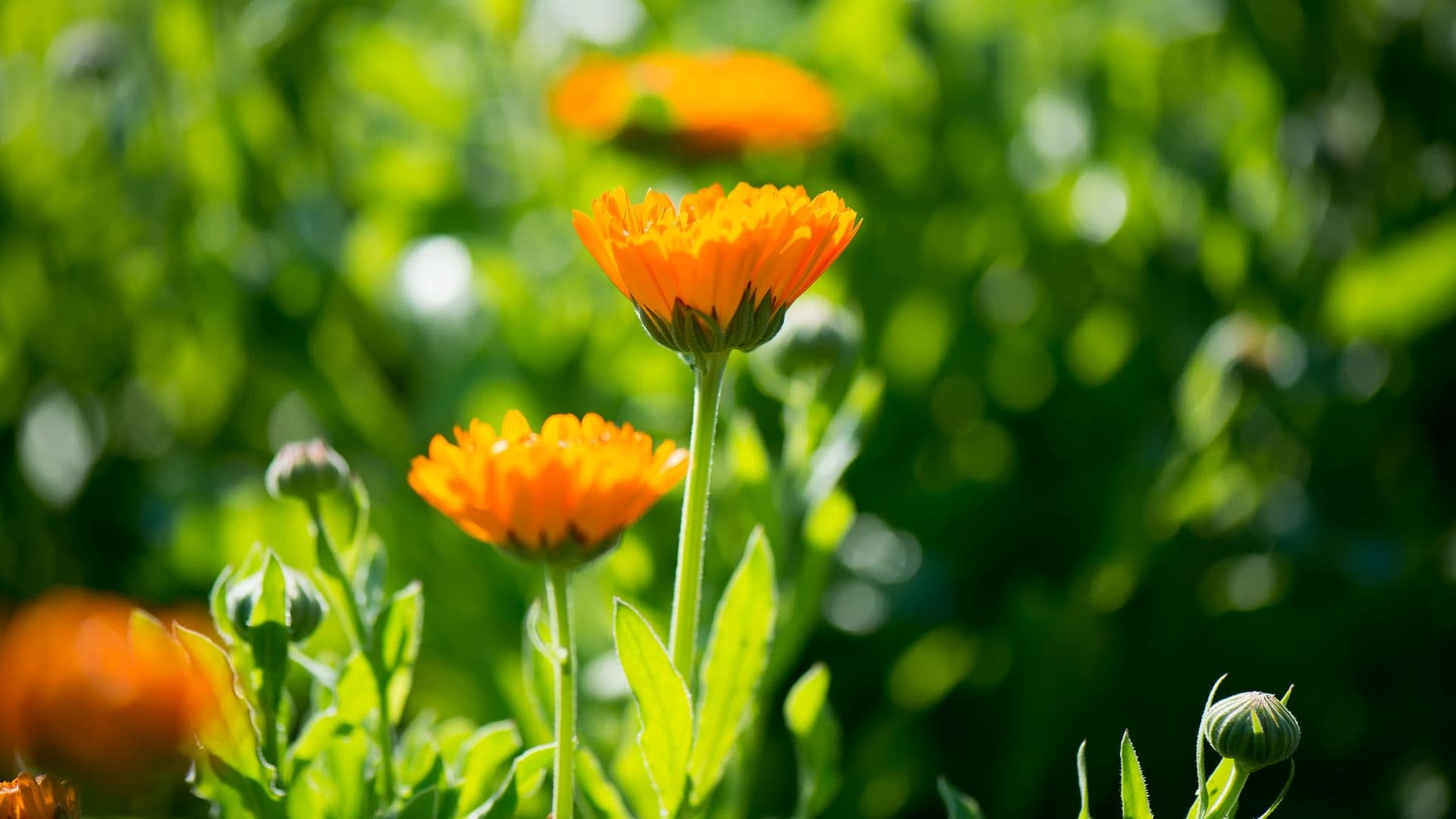
The marigold (Calendula officinalis L.) belongs to the family of Asteraceae. It is an annual plant with a distinctive scent reminiscent of resin. When the plant is touched or harvested, the skin is immediately coated with this balsamic-scented, sticky substance. The marigold grows 30 – 50 cm tall, with simple spatulate to lanceolate leaves arranged along an upright, hairy stem. The marigold blooms from June through October and delights us with its 2 – 5 cm large, radiant, yellow to orange flowers, which open from the outside inwards. It is such a resilient plant that it can continuously produce new flowers, provided the old flowers are regularly removed. Typical for a member of the Asteraceae family are the flowers, which are in fact not single flowers but flower heads composed of ray and disc florets. Unlike other species in the plant family, the actually fertile inner disc florets of the marigold are sterile, while the outer ray florets are fertile. Another special feature is that the plant produces differently shaped fruit types.
Essence
Essence of the plant
Balm, closing wounds
Hardly any other plant is by nature so excellently suited to be a wound herb. Its balsamic, warm essence is entirely focused on closing wounds. Like threads of light, the plant closes the disturbed energy field over the wound and supplies it with new strength to promote rapid healing.
The ringed fruits of Calendula cover the flower base from the outside inwards, sealing the open, “wounded” area within. When you hold a Calendula to pick it, it leaves a unique, sticky secretion on the skin. Its ability to "glue" wounds and close them is outstanding.
It possesses an intense inner warmth and thus acts anti-inflammatory and disinfecting. It contains the power of the sun, producing the most enduring blossoms in the herb garden, even withstanding the November cold. Calendula heals skin cracks, promotes wound healing, and with its comforting, balsamic power, influences even emotional processes.
Calendula officinalis
Marigold
From shape to healing power
Calendula is a very popular garden plant that demands little in terms of location and care. If left to its own devices, it takes care of itself and reseeds year after year. Thus, our eyes and hearts can delight in its radiant yellow and orange colours from early summer through to late autumn. The luminosity of the colours expresses pure zest for life and true warmth of the senses.
A larger area densely covered with calendula flowers radiates an unbroken vitality that is scarcely surpassed. One can almost see before the inner eye how the intense field of life energy above the surface of the flower weaves in broad movement. It is not only the flowers that have a special relationship to the periphery. When holding a bundle of cut plants and pressing them gently several times, one notices a slightly sticky, balsamic substance that covers all parts of the plant and spreads a wonderfully warm aroma.
Having spoken above of the unbroken vitality and fertility of calendula, we must also mention that the inner tubular florets of the flower head (Calendula belongs to the daisy family) are infertile. A contradiction? No, a wonderful sign of the signature, for here we learn the origin of the calendula’s name.
Its fruits curl and coil and vary greatly in size. The fruits of the fertile ray florets all curve more or less inward until they completely cover the entire infertile inner surface. If one does not examine this closely, one would never guess that the calendula fruits do not come from the entire flower disc. Another “sealing mechanism” is noticeable when collecting flowers and cutting them at the stem.
After a short time, a white, sealing coating forms at the cut surface. Plant sap oozing from the cut point solidifies into a compact layer. It goes without saying that a plant with such an impressive essence does not only excel in sealing physical wounds. Emotional wounds also find relief through this sun-like plant.
Demeter cultivation
Originally native to the Mediterranean region, Calendula is now cultivated worldwide. In Switzerland, it thrives in sunny gardens and fields up to moderate altitudes.
For Ceres, the cultivation of the plant takes place on a Demeter-certified farm, where the plants are always harvested by hand at their optimal harvest time.
Traditional Use
Calendula, which has been cultivated in herb gardens for centuries, is one of the best-known medicinal plants for promoting wound healing. Calendula is used as a dried herbal drug and, due to its beautiful yellow colour, also as an ornamental component in herbal tea blends. Other common preparations include fluid extracts and alcoholic tinctures. In addition, Calendula oil for external use is obtained by maceration with plant oils (e.g. olive oil) from the marigold flowers. Because of its anti-inflammatory properties, injuries and poorly healing wounds of the skin and mucous membranes are the main areas of application. Both internal and external use are suitable. For application in mucous membrane care in the mouth and throat area, tea preparations or gargle solutions can be easily made using just a few drops of the tincture. Externally, medicinal preparations containing Calendula officinalis are applied locally to the skin.
Sources
1. Hänsel, R. & Steinegger, E. Hänsel / Sticher Pharmakognosie Phytopharmazie. (Wissenschaftliche Verlagsgesellschaft GmbH, Stuttgart, Deutschland, 2015).
2. Madaus, G. MADAUS LEHRBUCH DER BIOLOGISCHEN HEILMITTEL BAND 1-11. (mediamed Verlag, Ravensburg, 1990).
3. BGA/BfArM (Kommission D). Calendula officinalis (Calendula). Bundesanzeiger 190a, (1985)..
4. European Medicines Agency. European Union herbal monograph on Calendula officinalis L., flos. Eur. Med. Agency 44, 0–7 (2018).
5. Kalbermatten, R. & Kalbermatten, H. Pflanzliche Urtinkturen. (AT Verlag, Aarau, Schweiz, 2014).
6. Kalbermatten, R. Wesen und Signatur der Heilpflanzen. (AT Verlag, Aarau, Schweiz, 2016).
The healing of the wounded shell
R. & H. Kalbermatten — «Psyche des Menschen und Signatur der Heilpflanzen»
Ceres mortar process — gentle, cold and complete.
Freshly harvested, hand-picked, ground at room temperature and aged for years. No heating, no pressure - the plant's full vitality is preserved.