Horse Chestnut
Aesculus hippocastanum
Uprightness, lightness, self-control, collection, seriousness and merriness, light in darkness
Botany
The horse chestnut (Aesculus hippocastanum L.) is a deciduous tree with a relatively short lifespan, which can grow up to 35 m high. It belongs to the soapberry family (Sapindaceae) and occurs in Central Europe only as planted or naturalised — its native region is Southeast Europe. The trunk is short and often shows twisted growth; the wood is light and soft. From its sticky buds unfold in spring the typical large leaves which, unlike all native tree species, are palmate. The 5 to 7 leaflets hang limp at first, then straighten and spread out horizontally.
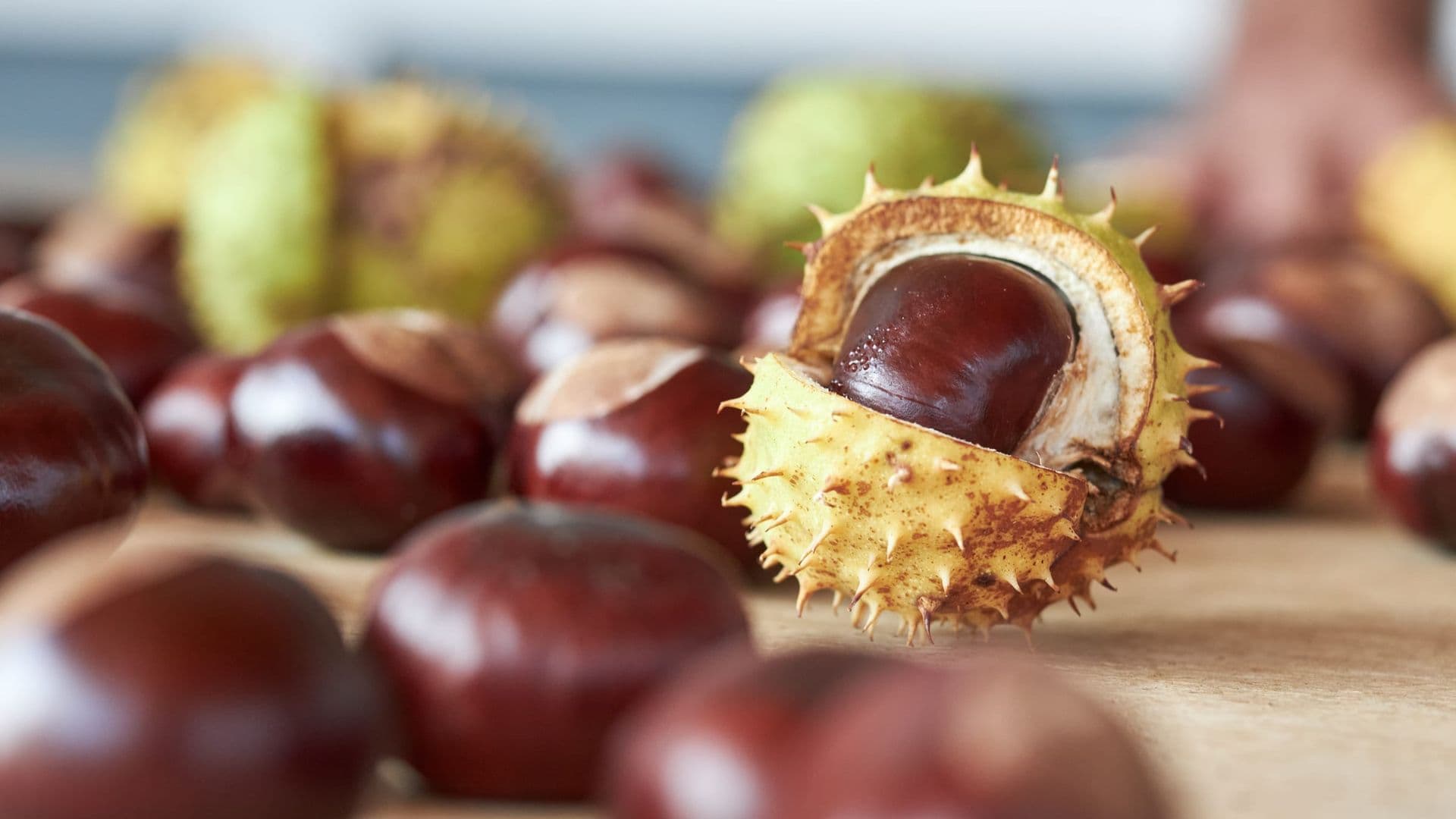
In April and May, the white flowers are grouped in richly flowered inflorescences. They have nectar guides which are yellow initially and turn red after pollination — insects recognise the colour change and avoid the pollinated flowers. Fruits develop only in the lower parts of the inflorescences, as only a few flowers can mature into fruits due to the weight. The seed is enclosed in a green spiny fruit capsule, which opens on impact and releases the shiny brown seed.
Essence of the plant
Uprightness, lightness, self-control, collection, seriousness and merriness, light in darkness
The horse chestnut possesses the power to uplift the person; it brings processes that have lost internal guidance, thereby becoming lost in trivial, unimportant matters and becoming autonomous, back under control. Uncontrolled, circular thoughts and a lack of inner guidance are positively influenced by the essence of the horse chestnut, as is the blood, which due to venous insufficiency can no longer flow unimpeded back to the heart. A weakness of the inner guidance can manifest as superficial cheerfulness (a lack of seriousness) or excessive seriousness.
The essence of the horse chestnut promotes the appropriate balance and the right measure of seriousness and cheerfulness. The Aesculus type is serious and tends to be melancholic. They bear responsibility with great dedication, even to the denial of their own needs.
They lack lightness, cannot deal playfully with situations and facts, and tend towards feelings of guilt. They experience a strong need for control; troubling events occupy them for days, they "chew over" them repeatedly and cannot let them go. They can at times be weighed down by the burden of responsibility, which may lead to lower back pain. Through the influence of the horse chestnut, body and psyche can be restored upright.
The positive energy of the horse chestnut is symbolised by the child who still meets every situation playfully and with enthusiasm, interest, and curiosity. It radiates sparkling, luminous joy. With the same ease, the ripe fruit of the chestnut rolls out shiny, round, and fresh from the burst shell.
Aesculus hippocastanum
Horse Chestnut
From shape to healing power
As early as January, the buds of the horse chestnut begin to swell considerably and become covered with a glossy, sticky layer. Their plump bulge promises a rich substance formation. When they then open wide in spring and release the leaves from their enclosure, these are already too large and heavy, yet still too weak to stand upright. The leaflets hang limply from the slanting upward leaf stalk.
Like the joints of lifeless marionettes, the leaflets collapse inwards, held only at one point at the end of the stalk. Gradually, they are drawn upwards by an uplifting force, as if on strings, until they adopt the correct, horizontal position to face the sunlight. The splendour of the horse chestnut is only fleeting. The leaves are palmately compound with 5 to 7 leaflets.
All parts originate from a central point at the end of the leaf stalk. From here, the entire leaf shape is held together, nourished, and controlled. A rare leaf structure; usually, the leaflets branch off laterally from an axis running through the middle of the leaf composition. Once the leaves have spread out in the plane, flowering is already well advanced.
Like floral candlelights, the white flower clusters adorn the crowns of the chestnut trees year after year in spring. Observed up close, we try to understand the flower’s structure and comprehend how the individual corolla and stamen parts fit together. A challenging undertaking! Only with intense mental effort can the order of the horse chestnut flower be grasped. But let us set aside the botany and surrender to the radiance of this flower.
Its radiant white crowns with brightly red and yellow spots in the throat are simply magnificent to behold. Later, in summer, the horse chestnut forms a completely closed tree crown with its dense foliage, which denies any passage of sunbeams to the ground below; a perfect provider of shade. This is why this tree is so popular in garden restaurants. In autumn, children delight in the plump brown seeds, the chestnuts.
Encased in a fleshy and spiny green fruit husk, the seeds mature. Then the fruit husk splits open and lets the seeds fall to the ground. The shine of the freshly “hatched” chestnuts fades after a short time; it seems not intended for the outside world but acts inside the fruit. In summary, we recognise uplifting and centrally controlling forces in the horse chestnut, as well as the permeation of the darkened interior space with luminous white, bright colours, and reflecting shine.
Wild collection
The horse chestnut originally comes from the Balkans (Albania, Greece, North Macedonia) and was introduced throughout Europe in the 16th century as a park and avenue tree. Today, it is omnipresent in Central Europe in parks, avenues, and beer gardens. It prefers deep, fresh, and nutrient-rich soils.
Ceres exclusively uses ripe seeds (chestnuts) from wild collection in Switzerland. The harvest takes place in September and October when the seeds naturally fall out of the spiny husks — a natural indication of optimal ripeness.
Traditional Use
Horse chestnut is a classic remedy for venous disorders. The seeds are used, for example, directly as a tea or in the form of finished medicinal products. The main focus of its use in herbal medicine is chronic venous insufficiency. In homeopathy, Aesculus hippocastanum is also applied for lumbar and sacral pain. The consequences of stagnant blood return in the venous system are extremely diverse. In the leg area, affected individuals usually experience swelling, pain, feelings of heaviness, and itching. Night-time calf cramps are also common. There is also a pronounced tendency towards oedema and varicose vein formation. In severe cases, thrombosis or leg ulcers may occur. Medicinal products derived from horse chestnut can provide relief here due to their vessel-sealing, oedema-protective, venotonic, and anti-inflammatory properties. Portal vein congestion and haemorrhoidal complaints are also part of the venous symptom complex. In sports injuries with local oedema formation and bruising, Aesculus hippocastanum can also be applied externally.
Sources
1. BGA/BfArM (Kommission D). Aesculus hippocastanum (Aesculus). Bundesanzeiger 190 a, (1985).
2. Committee on Herbal Medicinal Products (HMPC). Community Herbal Monograph on Aesculus Hippocastanum L., Semen. (2009).
3. Hänsel, R. & Steinegger, E. Hänsel / Sticher Pharmakognosie Phytopharmazie. (Wissenschaftliche Verlagsgesellschaft GmbH, Stuttgart, Deutschland, 2015).
4. Madaus, G. MADAUS LEHRBUCH DER BIOLOGISCHEN HEILMITTEL BAND 1-11. (mediamed Verlag, Ravensburg, 1990).
5. Kalbermatten R, Kalbermatten H. Pflanzliche Urtinkturen. 7th ed. AT Verlag, Aarau, Schweiz; 2014.
6. Kalbermatten R. Wesen Und Signatur Der Heilpflanzen. 9th ed. AT Verlag, Aarau, Schweiz; 2016.
Overcoming Gravity
R. & H. Kalbermatten — «Psyche des Menschen und Signatur der Heilpflanzen»
Ceres mortar process — gentle, cold and complete.
Freshly harvested, hand-picked, ground at room temperature and aged for years. No heating, no pressure - the plant's full vitality is preserved.