Horsetail
Equisetum arvense
Segmentation, structuring, clarity of thought
Botany
The horsetail (Equisetum arvense L.) is a living fossil. Horsetails have existed for at least 150 million years, closely resembling the present-day species — thus, this genus may be one of the oldest still existing plant genera. It overwinters underground, with its rhizomes extending deeply. In spring, it first produces light brown, fertile spore shoots with almost mineral-like spore carriers. These are followed by the typical green vegetative shoots, which can grow up to 50 cm tall.
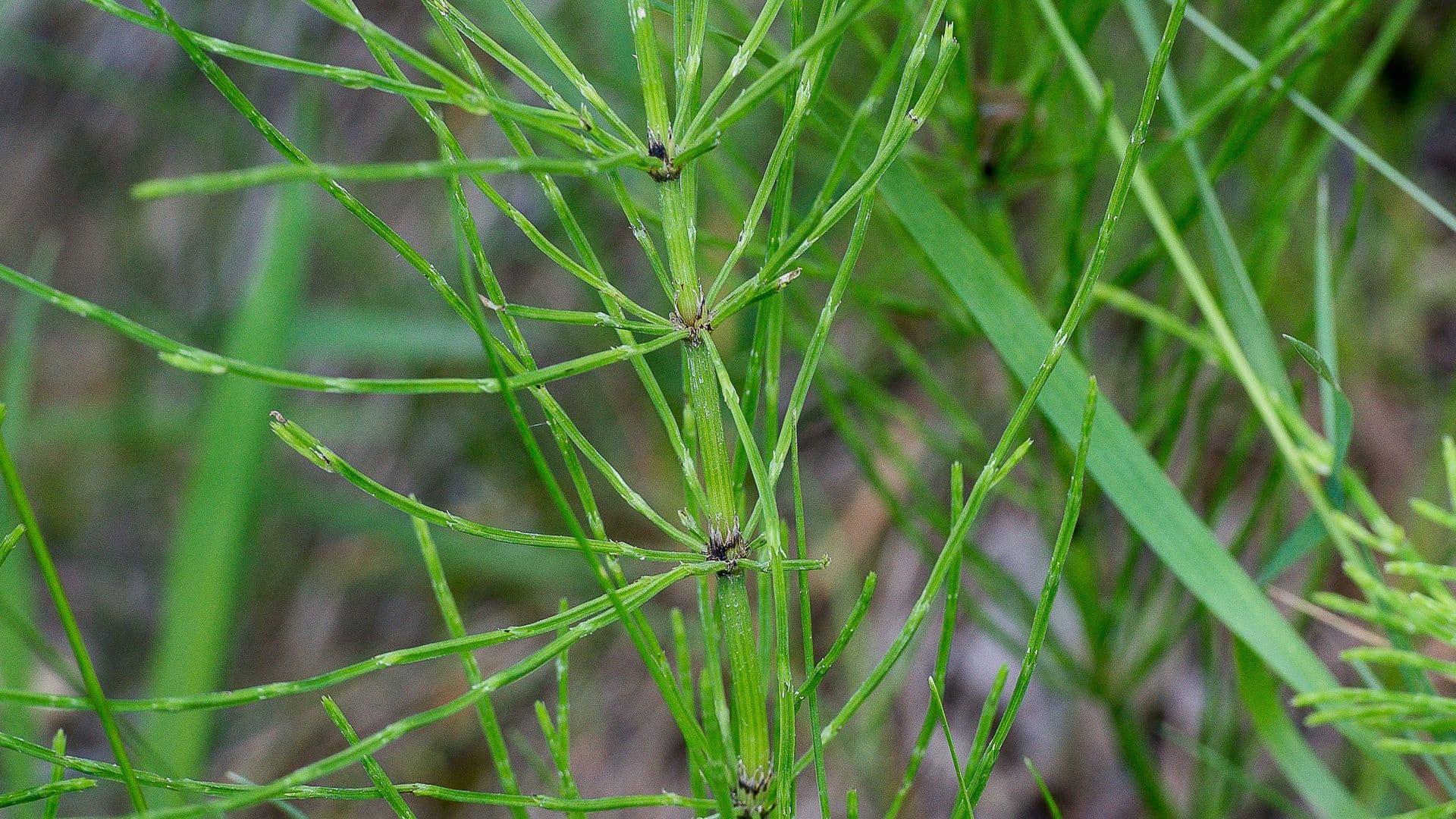
The horsetail lacks the typical plant differentiation into stem, leaf and flower. It appears efficient, clearly segmented, and structured. The leaves are extremely reduced and lie as a sheath directly on the shoot; many side branches emerge whorled from the shoot. The entire shoot is divided into distinct segments that can be pulled apart. When touching the plant, its firmness is surprising — it gains this through deposits of silica, which are particularly abundant in this genus.
Essence of the plant
Segmentation, structuring, clarity of thought
The essence of Equisetum is characterised by its restriction to the absolute essentials, to the framework, to the structure. The plant does not display any forms that move towards abundance. It is very rich in structuring minerals, especially in crystalline silica.
It is, in a way, mineral made into plant. Within Equisetum are embodied those forces necessary for clear organisation and structuring of thought and the processes of form creation. Consequently, Equisetum is indicated in all those conditions where the capacity for structuring or forming is weakened.
This manifests, for example, in unclear thinking or a lack of sense of order and organisational ability. However, the deficiency may also express itself conversely in dependence on rigid structures, norms, and regulations. Also worthy of emphasis is Equisetum’s strengthening effect on connective tissue and the skeleton (particularly the spine), thus on those systems that structure our body.
Equisetum arvense
Horsetail
From shape to healing power
Field horsetail is a pioneer plant that colonises gravel pits, rubble sites and fields. In spring, it produces fertile shoots with the characteristic, cone-shaped spore spikes. In summer, the green, whorled, branched, sterile shoots appear, which persist well into autumn. The horsetail is clearly distinguishable from other plants.
It does not have the usual division of the above-ground parts into stem, leaf and flower. The leaves are reduced to small sheaths encompassing the stem and lateral shoots at the nodes, with triangular-lanceolate teeth. Flowers are completely absent. The plant form is limited to stem and lateral shoots.
No forms extending in abundance or width are found. Everything is limited to the absolute essentials, the framework, the skeleton. This plant skeleton features continuous segmentation and structuring: stem and lateral shoots consist of small sections nested into each other at the nodes (hence the name). It appears as if the segments in the leaf sheaths are interlocked.
The individual stem segments can easily be pulled apart and reconnected. The segments are hollow and display protruding longitudinal ribs on the outside, giving the surface a clear structure. The spore spikes appearing in spring are geometric, almost mineral-like in structure. They show a regular, hexagonal honeycomb pattern.
When chewing horsetail, it crunches between the teeth because silica is incorporated into the basic framework of the cell walls. The plant has a very high silica content (silicon dioxide, quartz). The abrasive effect caused by this was historically used to clean tinware (hence also the name "tinweed"). The silica content is one of the most pronounced features of this plant.
In a sense, the horsetail is a plant-formed crystal. The silica inside is so dense and strongly networked that when burnt, the original plant form remains as a white ash skeleton. The suggested essence of structuring, segmentation and skeleton formation combined with the high silica (silicon) content work together in the connective tissue and lead to support of bone formation.
Connective tissue not only holds organs, vessels and muscles together, but bone tissue is also formed from connective tissue. Silicon is essential for bone formation. Silicon deficiency leads to delayed growth and deformed bone formation. Silicon accumulates in areas of new bone formation within the connective tissue.
Further relationships to connective tissue can be found: the form-building force of horsetail, limited to the essential and skeletal, is expressed at the organic level in its anti-oedematous effect. Horsetail restricts the swollen body part affected by oedema back to its original dimension. Connective tissue has a central function in the transport of substances and information from blood capillaries and lymph vessels or nerve endings to the cells and back.
Substances and information are not transported directly from the circulatory or nervous system into the cells; instead, the exchange takes place via the connections located in the connective tissue. This is also the site where toxins taken in excessively or generated by metabolism are deposited. Deposits of toxins lead to obstruction of the transport functions and information transmission of the connective tissue. Consequently, regulation is impaired and further functional disorders occur.
In holistic therapy, cleansing the connective tissue is therefore a central concern. Horsetail offers itself here. The parallel between the use of silicon in technology for information transmission systems in electronic data processing and its biological significance in connective tissue is also of interest. Although so far only the function of silicon in bone formation is known, it can be assumed that this element also plays a crucial role in information transmission in connective tissue.
Wild collection
Field horsetail is widespread in Europe, Asia, and North America and grows on moist, clayey, and sandy soils in fields, roadside verges, floodplains, and along stream banks. It can be regarded as an indicator plant for compacted, moist soils.
Ceres uses field horsetail harvested wild in Switzerland. The sterile green shoots are collected in early summer after the spore-bearing shoots have died back.
Traditional Use
Horsetail, Equisetum arvense L., has a very long tradition of use in herbal medicine. The herbalist Father Sebastian Kneipp already praised the versatile effects of this medicinal herb. While in the past teas and external applications such as sitz baths were common, today oral forms of administration are more prevalent: fresh plant pressed juice, liquid and dry extracts, and tinctures. The main area of application lies within various therapeutic approaches for kidney and urinary tract conditions. The diuretic properties of medicinal preparations from Equisetum arvense L. can be useful for the supportive treatment of uncomplicated urinary tract infections, in cases of oedema, and for the prevention of kidney gravel (lithiasis). Furthermore, joint and skin complaints are also mentioned as areas of application in the literature.
Sources
1. Wichtl, M. et al. Teedrogen und Phytopharmaka. (Wissenschaftliche Verlagsgesellschaft GmbH, Stuttgart, Deutschland, 1997).
2. BGA/BfArM (Kommission E). Monographie: Equiseti berba (Schachtelhalmkraut). Bundesanzeiger 173, (1986).
3. Madaus, G. MADAUS LEHRBUCH DER BIOLOGISCHEN HEILMITTEL BAND 1-11. (mediamed Verlag, Ravensburg, 1990).
4. Committee on Herbal Medicinal Products (HMPC). Assessment report on Equisetum arvense L., herba. EMA/HMPC/278089/2015 (2016).
5. BGA/BfArM (Kommission D). Equisetum arvense. Bundesanzeiger 109 a, (1987).
6. Dragos, D. et al. Phytomedicine in joint disorders. Nutrients 9, (2017).
7. Gilca, M., Tiplica, G. S. & Salavastru, C. M. Traditional and ethnobotanical dermatology practices in Romania and other Eastern European countries. Clin Dermatol. 36, 338–352 (2018).
8. Kalbermatten, R. & Kalbermatten, H. Pflanzliche Urtinkturen. (AT Verlag, Aarau, Schweiz, 2014).
9. Kalbermatten, R. Wesen und Signatur der Heilpflanzen. (AT Verlag, Aarau, Schweiz, 2016).
Ceres mortar process — gentle, cold and complete.
Freshly harvested, hand-picked, ground at room temperature and aged for years. No heating, no pressure - the plant's full vitality is preserved.