Goldenrod
Solidago virgaurea
Connection, love, solace, ability to form relationships, flow of feelings
Botany
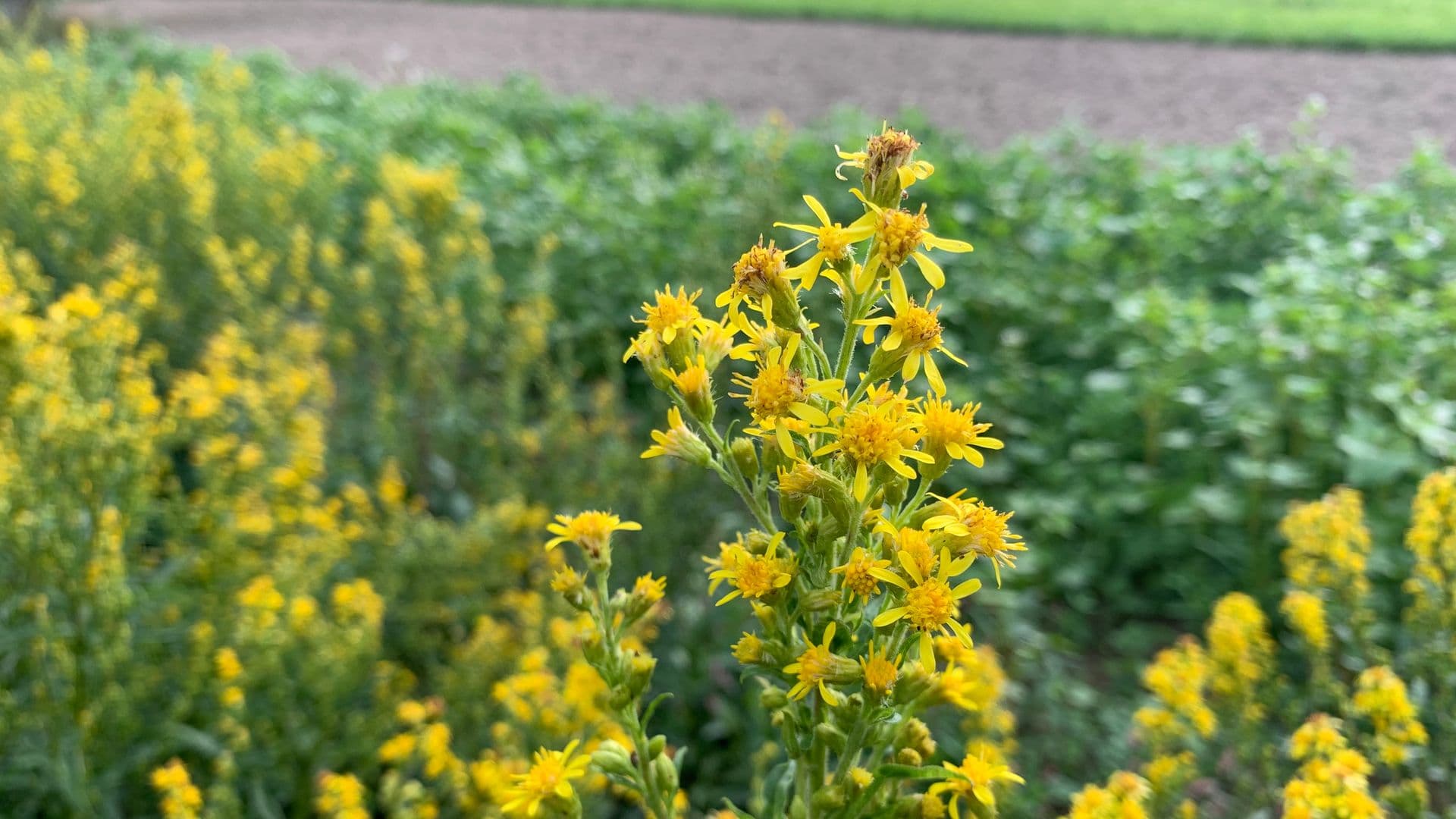
The Common Goldenrod (Solidago virgaurea L.) is a perennial herbaceous plant from the Asteraceae family. In the first year, it usually forms only a rosette of elongated to ovate leaves. From the second year onwards, it produces round, alternately arranged, and very sturdy stems that grow up to 100 cm tall. These stems branch; the lower side branches often grow longer than the upper ones, so the tips with the flowers lie almost at the same level.
From July through to autumn, the Goldenrod blooms with radiant golden-yellow flowers arranged in harmoniously appearing panicles.
Essence of the plant
Connection, love, solace, ability to form relationships, flow of feelings
Through its essence, which symbolises an intimate friendly relationship, Solidago unites what is separate and incomplete into a whole. Friendship and love connect people and activate the energies that enable healthy kidney function.
When the harmonious flow of connecting feelings dries up, when disappointments, frustrations and feelings of guilt block relationships, psychological energy is weakened and the kidneys suffer. Goldenrod is the most specific medicinal product for kidney function. It is particularly indicated for kidney disorders associated with painful experiences in relationships and partnerships and with loss of relationships.
Solidago virgaurea
Goldenrod
From shape to healing power
In Central Europe, three species of the genus Solidago can be found: the native Solidago virgaurea L., the True or Common Goldenrod, which provides the mother tincture, and the two large-growing species introduced from North America, S. canadensis and S. gigantea, that have become naturalised. The most striking feature of the True Goldenrod is its radiant golden-yellow flowers. Numerous small flower heads form dense, terminal panicles. The entirety of the flowers conveys a harmonious, complete impression.
However, when you look closely at a single flower head, you discover a very rare imperfection among the Asteraceae: the marginal ray florets do not form a complete ring or a seamless floral corolla as usual (for example, in the sunflower). There are many gaps so that the individual flower heads are incomplete. However, due to the dense clustering of the inflorescences, the ray florets of one flower head extend into the gaps of another and thus complement each other.
It is precisely the incompleteness of the individual flowers that leads, through connection and mutual complementation, to a harmoniously interlinked whole. The True Goldenrod grows in dry, open forests, on forest edges and embankments. It occurs only sporadically or in loose stands and thus differs from the North American species, which spread rapidly and displace the native flora with their dense stands. In late summer and autumn, their yellow inflorescences shine visibly from afar and adorn their locations – gardens, railway embankments, riverbanks and wastelands.
The True Goldenrod, on the other hand, is extraordinarily selective with regard to the harmony of its habitats. These usually have a special charm and invite one to linger and recharge due to their beauty and atmosphere. While the introduced Goldenrod species demonstrate great vitality through their spreading, dense stands, the True Goldenrod expresses its equivalent vitality in a different way; it possesses an unusual radiance with a strong emotional attraction. Together with Arnica and St John’s Wort, the True Goldenrod is probably one of the medicinal plants with the strongest radiance.
A sensitive observer will not fail to notice how the plant changes conspicuously shortly after harvest. Even before the natural wilting process begins, the flowers and leaves become dull and lose their beautiful sheen. One senses how the Goldenrod suffers from dryness and longs for water.
For a plant that grows in dry locations and naturally manages with little water, the extent of this reaction is unusual. Every plant needs water; beyond this biological requirement, however, the Goldenrod has an essential need for connection with water. The plant retains its radiance and beauty only in constant connection with the flowing element. Cut off and left on its own, it becomes dull and expressionless, estranged from its nature.
Its smell and taste are pleasantly refreshing, lightly and unobtrusively aromatic, and reminiscent of honey, a hint of the plant’s connecting, friendly nature. The signature of the True Goldenrod clearly expresses its nature oriented towards connection, complementation, harmony, vitality and flow. It possesses all the characteristics of a harmonious relationship in mutual emotional complementation. On the psychological level, the Goldenrod embodies the realm of partnership, love and the capacity for relationships.
Corresponding to this area on the physical level is the kidney function. Just as the Goldenrod represents a specific kidney therapeutic, its nature also represents the specific forces required for a harmonious emotional relationship, for genuine friendship. Frequently, kidney function disorders are the physical expression of impaired relational ability, a disturbance in the interaction between emotional giving and receiving. In such cases, the essential forces of Goldenrod can on the one hand lead to perception and awareness of one’s own issues, while on the other hand stimulating kidney function.
Goldenrod connects what has been separated. It heals wounds both physically and emotionally on the psychological level. In previous centuries, the plant was one of the most trusted wound-healing herbs and was originally called "pagan wound herb". Its Latin name Solidago (from solidum agere = to firmly reunite that which has been separated by wounding) also expresses this connecting nature.
Organic cultivation and wild collection
Common goldenrod is widespread in Europe and Western Asia and grows on poor meadows, roadside verges, in light forests, and on heathlands. It prefers fresh to dry, acidic to neutral soils. In Switzerland, it is common in the Central Plateau and the pre-Alps.
Ceres obtains goldenrod from organic cultivation or wild collection in Switzerland. The fresh flower heads are harvested by hand in midsummer at peak bloom.
Traditional Use
Goldenrod, Solidago virgaurea L., is one of the most important organ-specific kidney remedies in phytotherapy. With its diuretic, spasmolytic, anti-inflammatory, and antimicrobial effects, it serves as a central foundational remedy in the treatment of many diseases of the urogenital tract. Medicinal preparations from goldenrod range from the classical tea therapy, through phytopharmaceutical extracts, to alcoholic tinctures. Numerous clinical observations and studies attest to its efficacy. Herbal medicine recognises the following indication for medicinal preparations from Solidago virgaurea L.: to increase urine output and thereby flush out inflammation in the kidney or bladder area. Inflammatory and bacterial diseases of the lower urinary tract and the preventive treatment of urinary stones and kidney gravel are typical areas of application for goldenrod. Its mode of action is described as diuretic, mildly spasmolytic, and anti-inflammatory. Homeopathy also cites its use for kidney weakness. Goldenrod can also serve as an adjunct therapy in uric acid diathesis. This often manifests, favoured by poor dietary habits, in the form of rheumatic and gout-like complaints. The rheumatic spectrum, as well as its use as a blood purifier in chronic eczema, are also applications of goldenrod in traditional folk medicine.
Sources
1. Hänsel, R. & Steinegger, E. Hänsel / Sticher Pharmakognosie Phytopharmazie. (Wissensch. Verlagsgesellschaft GmbH, Stuttgart, Deutschland, 2015).
2. BGA/BfArM (Kommission E). Solidago (Goldrute). Bundesanzeiger 193, (1987)
3. Madaus, G. MADAUS LEHRBUCH DER BIOLOGISCHEN HEILMITTEL BAND 1-11. (mediamed Verlag, Ravensburg, 1990).
4. BGA/BfArM (Kommission D). Solidago virgaurea. Bundesanzeiger 29a, (1986)
5. Committee on Herbal Medicinal Products (HMPC). Community herbal monograph on Solidago Virgaurea.
6. Hänsel, R., Keller, K., Rimpler, H. & Schneider, G. Hagers Handbuch der Pharmazeutischen Praxis Band 5 Drogen P-Z. (Springer Verlag Berlin Heidelberg, 1994).
7. Kalbermatten, R. & Kalbermatten, H. Pflanzliche Urtinkturen. (AT Verlag, Aarau, Schweiz, 2014).
8. Kalbermatten, R. Wesen und Signatur der Heilpflanzen. (AT Verlag, Aarau, Schweiz, 2016).
Permanent Renewal
R. & H. Kalbermatten — «Psyche des Menschen und Signatur der Heilpflanzen»
Ceres mortar process — gentle, cold and complete.
Freshly harvested, hand-picked, ground at room temperature and aged for years. No heating, no pressure - the plant's full vitality is preserved.