Lady's Mantle
Alchemilla vulgaris
Enveloping, guarding, bringing forth
Botany
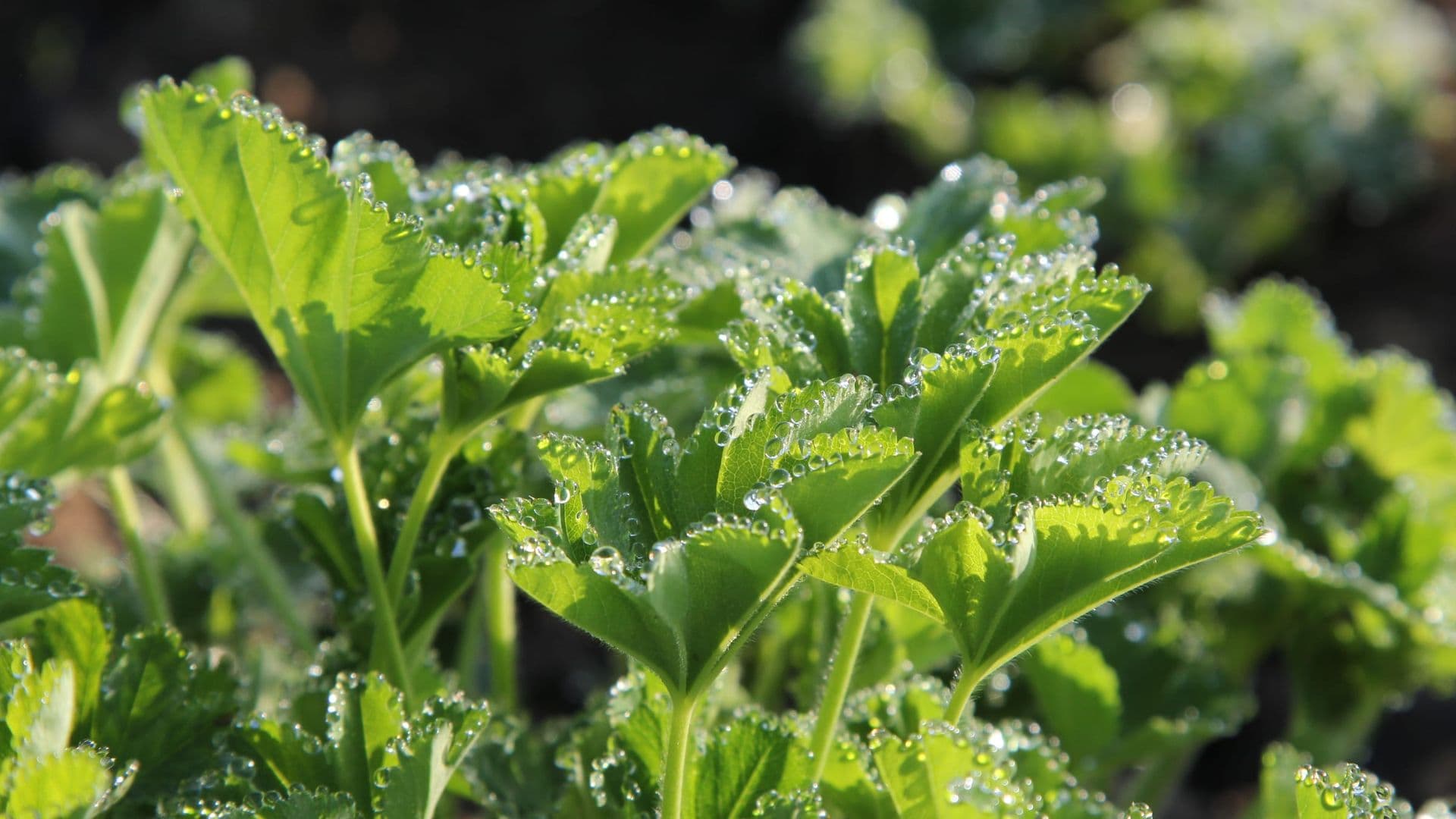
Alchemilla vulgaris aggr., common lady’s mantle, is a very hardy plant that grows up to 30 cm tall. In spring, Alchemilla begins to form its large, characteristic, rounded kidney-shaped leaves. These are initially folded like a fan, later mostly funnel-shaped. The leaf surface is divided into triangular-trapezoidal lobes; the leaf margin is serrated. Like a string of pearls, water droplets often line the edge between the teeth — water actively secreted by the plant, which can gather into a large pearl at the leaf base.
From May to September, the plant blooms with a great many inconspicuous flowers. They are only 2 to 4 mm large and yellow-green in colour — it is hard to imagine that lady’s mantle belongs to the rose family, famous for its perfect flowers. Another special feature: at the moment the flower unfolds, it is already fertilised and carries the embryo within — Alchemilla is not dependent on cross-pollination.
Essence of the plant
Enveloping, guarding, bringing forth
Which other plant could embody the essence of the birthing female womb, the uterus, better than Lady's Mantle? In the sheltered base of its mantle-like enveloping, upwards-facing, soft leaf, the “alchemist” (Alchemilla!) among plants brings forth a silver dewdrop in rhythmic birth. Alchemilla stands for the affirmation of female rhythms and femininity. Lady's Mantle supports women who rely too heavily on their fertility for their identity, or women who find it difficult to integrate this aspect of their femininity, by providing some distance.
Lady's Mantle has a cooling effect, meaning that it balances excessive physical and emotional warmth processes. Its tissue-strengthening effect is also well known. On the emotional level, it strengthens the courage to embrace genuine femininity: a too strong or too weak emphasis on being female is balanced.
Alchemilla vulgaris
Lady's Mantle
From shape to healing power
Let the image of the lady's mantle speak to you! Are many more words really necessary about the signature of this plant? The vessel-forming folding of the leaf speaks for itself and has surely repeatedly given reason to cite the lady's mantle as a convincing example of the signature doctrine. In this respect, the lady's mantle is an exception, as the signatures of most plants require a much more differentiated consideration.
The liquid secreted by the fine hairs on the leaf edge, which gathers into a silver drop at the leaf base, also speaks a clear language. Alchemilla owes its name to the high regard in which it was held by earlier alchemists. The dewdrop from its leaf base was collected by them and used as a starting substance for making elixirs. In a way, it is the alchemist among plants.
Some further botanical characteristics also express the essence of the plant. The fruit is enclosed by a soft, smooth calyx cup, but unlike other genera and species in the Rosaceae family, it is not fused with it. Thus, the fruit develops protected, as though in a womb.
Most of the numerous species of the genus Alchemilla are apomictic, meaning they develop fruits without fertilisation. They do not develop normal pollen, and the anthers do not burst, so the pollen is not released. The lady's mantles are very species-rich and often differ only by hard-to-recognise characteristics. The exact identification of a plant is usually very time-consuming – even for experienced botanists – often even confusing, and generally only possible once the plant has already formed fruits.
At first glance, one might think that the Alchemilla species are not clearly defined and subject to strong variability, meaning their traits slightly change over generations. However, the opposite is true. According to the specialist book «Flora der Schweiz» by Hess, Landolt, Hirzel: “Of all specialists of the genus Alchemilla, the constancy of the small species differences over large geographical areas is described as a unique example among flowering plants.” The Alchemilla species are therefore – despite their difficult-to-discern diversity – extraordinarily stable in their form; they are self-contained. The life-preserving essence is also reflected in the fact that the plant contains strongly antioxidant substances.
Organic and Demeter cultivation
Common lady's mantle (Alchemilla vulgaris) is widespread throughout Europe and prefers moist, nutrient-rich meadows and waysides in hilly and mountainous regions. In Switzerland, it is particularly common in the Jura arc and the Pre-Alps.
Ceres sources lady's mantle from organic and Demeter cultivation in Switzerland. The flowering herb is harvested by hand, preferably in the morning, during its flowering period in early summer.
Traditional Use
Alchemilla is an important medicinal plant in holistic women's healthcare. It is therefore not surprising that Lady's Mantle was already highly valued in the times of the Germanic peoples and was dedicated to Frigga, the goddess of nature and fertility. With increasing Christianisation, the traditional uses and meanings of Alchemilla were transferred from Frigga to the Virgin Mary. The Swiss herbal pastor Johann Künzle writes in his book: "Lady's Mantle remarkably strengthens the muscles of women…". The literature shows a very wide range of applications for Alchemilla in women's healthcare. Among others, leucorrhoea, menorrhagia, pelvic inflammations and pain, irregular menstruation, relaxation of the lower abdomen, as well as preparation for and recovery from childbirth are typical areas of application. From the phytotherapy perspective, the high tannin content indicates an astringent, anti-inflammatory, and antioxidant effect. Therefore, Lady's Mantle is also gladly used in herbal medicine for diarrhoeal diseases. According to the homeopathic medicinal product profile, Lady's Mantle is also used for diarrhoea and leucorrhoea.
Sources
1. Hänsel, R. & Steinegger, E. Hänsel / Sticher Pharmakognosie Phytopharmazie. (Wissenschaftliche Verlagsgesellschaft GmbH, Stuttgart, Deutschland, 2015).
2. BGA/BfArM (Kommission E). Alchemillae herba ( Frauenmantelkraut ). Bundesanzeiger 173, (1986).
3. Madaus, G. MADAUS LEHRBUCH DER BIOLOGISCHEN HEILMITTEL BAND 1-11. (mediamed Verlag, Ravensburg, 1990).
4. BGA/BfArM (Kommission D). Alchemilla vulgaris. Bundesanzeiger 22a, (1988).
5. Kalbermatten, R. & Kalbermatten, H. Pflanzliche Urtinkturen. (AT Verlag, Aarau, Schweiz, 2014).
6. Kalbermatten, R. Wesen und Signatur der Heilpflanzen. (AT Verlag, Aarau, Schweiz, 2016).
The Formation of Life’s Envelope
R. & H. Kalbermatten — «Psyche des Menschen und Signatur der Heilpflanzen»
Ceres mortar process — gentle, cold and complete.
Freshly harvested, hand-picked, ground at room temperature and aged for years. No heating, no pressure - the plant's full vitality is preserved.