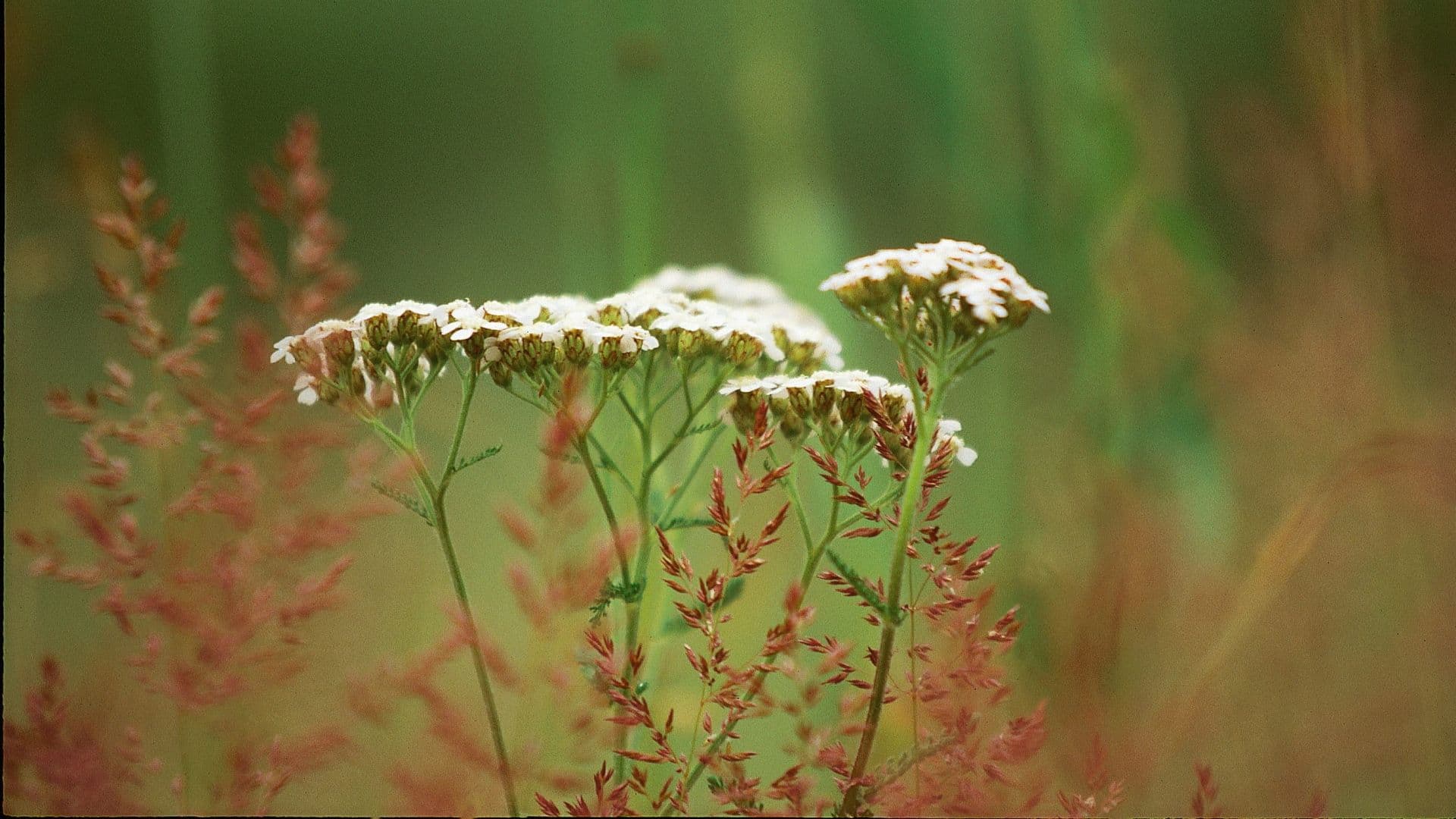
Yarrow
Achillea millefolium
Ability to discriminate, realisation of the essence
Botany
Achillea millefolium L., the Common Yarrow, is a perennial, aromatic-scented plant. Initially, it forms rosette-arranged leaves, later developing sturdy stems. The leaves of yarrow are deeply pinnately divided and highly differentiated — hence the name millefolium, meaning «thousand-leaved». The leaves are very fine and soft, in stark contrast to the almost woody stem.
The plant blooms from June. Mostly white, occasionally pink flowers stand high up in umbrella-shaped inflorescences. At first glance, yarrow could be mistaken for a member of the umbellifers. Upon closer inspection, however, it is revealed to belong to the Asteraceae family. This family groups individual flowers into flower heads, as seen in Echinacea or dandelion. Yarrow further groups these flower heads into umbrella-shaped inflorescences — thus creating an additional structural level.
Essence of the plant
Ability to discriminate, realisation of the essence
Yarrow symbolises the ability to distinguish the essential from the non-essential. This requires not only recognising the opposing aspects of a matter but also seeing their connection. Only when the common core is recognised within the contradictions of facts, experiences, and tasks, connecting the diversity into a whole, can priorities be set correctly.
Without this ability, there is a tendency to polarise and to swing from one extreme to the other. Yarrow represents the capacity to gain the right insight from the polar aspects of life, leading to the integration of opposites. In this way, it sharpens discernment in decision-making processes and can thus act as a clarifying and supportive aid in the personal, correct choice of the next step.
The plant supports both people with weak discernment and those who quickly and decisively form a certain opinion (prejudice) or swiftly express harsh criticism. Both are signs that the inner capacity for insight lacks the necessary light that transcends the contradictions of polarity. On a physical level, this deficiency may manifest itself, among other ways, in certain complaints having no clear triggers: for example, one particular food may cause a stomach crisis at one time but be tolerated without issue on another occasion.
Achillea millefolium
Yarrow
From shape to healing power
Yarrow often provokes bewilderment among medicinal plant experts because it cannot be clearly defined. For example, yarrow can both stop and cause nosebleeds, or it can both relieve and cause cramps. Especially in the Western cultural sphere, where people often struggle with the polarity of all existence and seek clear-cut conditions, it is not easy to grasp the true magnitude of yarrow. The polarization is clearly visible in yarrow’s signature.
To understand this, we need to explore the structural principle of the Asteraceae family to which yarrow belongs. As the name suggests, the Asteraceae have complex flower heads arranged into heads. The sunflower, for instance, is not a single flower but an inflorescence composed of hundreds of flowers. Each yellow ray on the periphery or each sunflower seed inside the flower head originates from a different flower.
The flower head is held together externally by a common receptacle and a covering of mostly green bracts. At a superficial glance, yarrow might be mistaken for a member of the Apiaceae family. The individual “flowers” form an umbel-shaped flower head. For the Asteraceae, it is unique that the already complex flower heads – the small heads – are combined again into an overall umbel-like complex.
Unlike the Apiaceae, the flower head of yarrow is not umbrella-shaped but quite flattened, so that the plant looks like a large T when viewed from the side. It can be observed that the flower heads (small heads) are completely withdrawn from the area of stem and leaf, raised instead to a plane at the top of the plant. Therefore, we do not find the harmonious integration of the flower heads typical of the plant family into the whole plant, but rather a separation, a polarization between the stem and leaf region on one hand and the flower area on the other. This separation is further emphasised by the fact that the flower head forms a plane appearing to be mounted on the stem.
The flower colour is mostly white, but there are always specimens in nature with pink flowers. This does not indicate a different species but shows that yarrow is not fixed on a specific colour. Moving further to examine the stem and leaves, we find that both visually appear mismatched. The light green stems are coarse and woody – if dried stem pieces are dropped on a table, they make a clicking sound (in the Chinese I Ching, yarrow stems are used) – while the leaves are very soft, blue-green and extremely finely twice pinnate.
Yarrow does not exhibit the usual harmonious interplay between stem and leaves, where the leaves gradually arise from the stem. The leaves seem appended and foreign to the stem. Taking a closer look at the leaves, which give the species its name, “millefolium” means a thousand leaves and refers to the multiple divisions of individual leaves. Although there are not literally a thousand leaf segments, the degree of differentiation of a yarrow leaf is extraordinary.
This differentiation always goes hand in hand with distinguishing opposites. The more opposed aspects of a thing we consciously perceive, the more differentiated and true is our understanding. In this sense, polarization and differentiation are cyclically recurring stages in the process of knowledge. Both are found in yarrow.
We can also perceive two opposing components in its scent and aroma. Yarrow tastes bitter on the one hand, thus acting astringently and concretely, and on the other hand it has a typical – not too strong – aroma that I would most describe as floating. Whenever I test yarrow, I have the impression that part of the aroma wants to lead away to distant worlds, while the other part is very focused on the here and now. The tubular florets are white like the ligulate florets.
One of the most essential features of yarrow is its special radiance. When I observe flowering yarrow at a shady forest edge, I believe I perceive a gentle glow from its flowers. As the flowers physically emit no light, this is an intuitive perception of an ethereal light. It is, in a sense, a light of nature to recognise polarities.
There is a clear sign of this inner glow in its external form. In yarrow flowers, unlike other Asteraceae, the inner tubular florets are also white, like the outer ligulate florets. Since the small heads, as mentioned above, stand very close together, the flower head appears like a continuous white (or pink) surface. Thus, the flower head appears much brighter, reflecting more light than would be the case with a ‘normal’ flower colouration. The yarrow flowers are “drawn up” to a plane at the top of the plant.
Demeter cultivation
Yarrow is native to all of Europe, northern Asia, and North America, colonising meadows, pastures, roadside verges, and open forest edges from lowlands to mountainous regions. It prefers sunny to semi-shaded locations on nutrient-rich, not too moist soils.
For the Ceres mother tincture, the fresh, flowering herb is harvested by hand. The harvest takes place at full bloom between mid-June and early July, when the active ingredient content is at its highest. The fresh plant parts are transferred to the production process on the same day as the harvest.
Traditional Use
Yarrow, Achillea millefolium L., is already included in the medicinal treasure of Saint Hildegard of Bingen, who used it internally and externally for wounds, as well as for eye complaints and tertian fevers. The areas of application are numerous and overlapping in both traditional and more recent literature across various therapeutic approaches. A focus in herbal medicine lies in the field of gastrointestinal complaints, where Achillea millefolium L. can help due to its spasmolytic and choleretic effects. Interestingly, professional literature notes that yarrow can be used as a substitute for chamomile, since the areas of application of both medicinal plants show great overlap. Homeopathy uses yarrow among other things for wounds and bleeding. Overall, yarrow can be regarded as a haemostatic agent, with its use particularly in cases of bright red bleeding of the lungs, intestines, uterus, bladder, and nose. Another area of application for yarrow is in gynaecology: cramp-like menstrual complaints and other typical symptoms can be treated supportively.
Sources
1. Hänsel, R. & Steinegger, E. Hänsel / Sticher Pharmakognosie Phytopharmazie. (Wissenschaftliche Verlagsgesellschaft GmbH, Stuttgart, Deutschland, 2015).
2. Wichtl, M. et al. Teedrogen und Phytopharmaka. (Wissenschaftliche Verlagsgesellschaft GmbH, Stuttgart, Deutschland, 1997).
3. BGA/BfArM (Kommission E). Achillea millefolium (Schafgarbe). Bundesanzeiger 22a, (1990).
4. Madaus, G. MADAUS LEHRBUCH DER BIOLOGISCHEN HEILMITTEL BAND 1-11. (mediamed Verlag, Ravensburg, 1990).
5. BGA/BfArM (Kommission D). Achillea millefolium. Bundesanzeiger 29 a, (1986).
6. Committee on Herbal Medicinal Products (HMPC). Community herbal monograph on Achillea millefolium L., flos. EMA/HMPC/143949/2010 (2011).
7. Riha, O. Hildegard von Bingen - Werke- Band V- Heilsame Schöpfung - Die natürliche Wirkkraft der Dinge - Physica - Vollständig neu übersetzt und ein geleitet. (Beuroner Kunstverlag (Abtei St. Hildegard, Rüdesheim/Eibingen), 2016).
8. Kalbermatten R, Kalbermatten H. Pflanzliche Urtinkturen. 7th ed. AT Verlag, Aarau, Schweiz; 2014.
9. Kalbermatten R. Wesen Und Signatur Der Heilpflanzen. 9th ed. AT Verlag, Aarau, Schweiz; 2016.
Differentiating and Connecting
R. & H. Kalbermatten — «Psyche des Menschen und Signatur der Heilpflanzen»
Ceres mortar process — gentle, cold and complete.
Freshly harvested, hand-picked, ground at room temperature and aged for years. No heating, no pressure - the plant's full vitality is preserved.