Thyme
Thymus vulgaris
Ardour, affection, purification
Botany
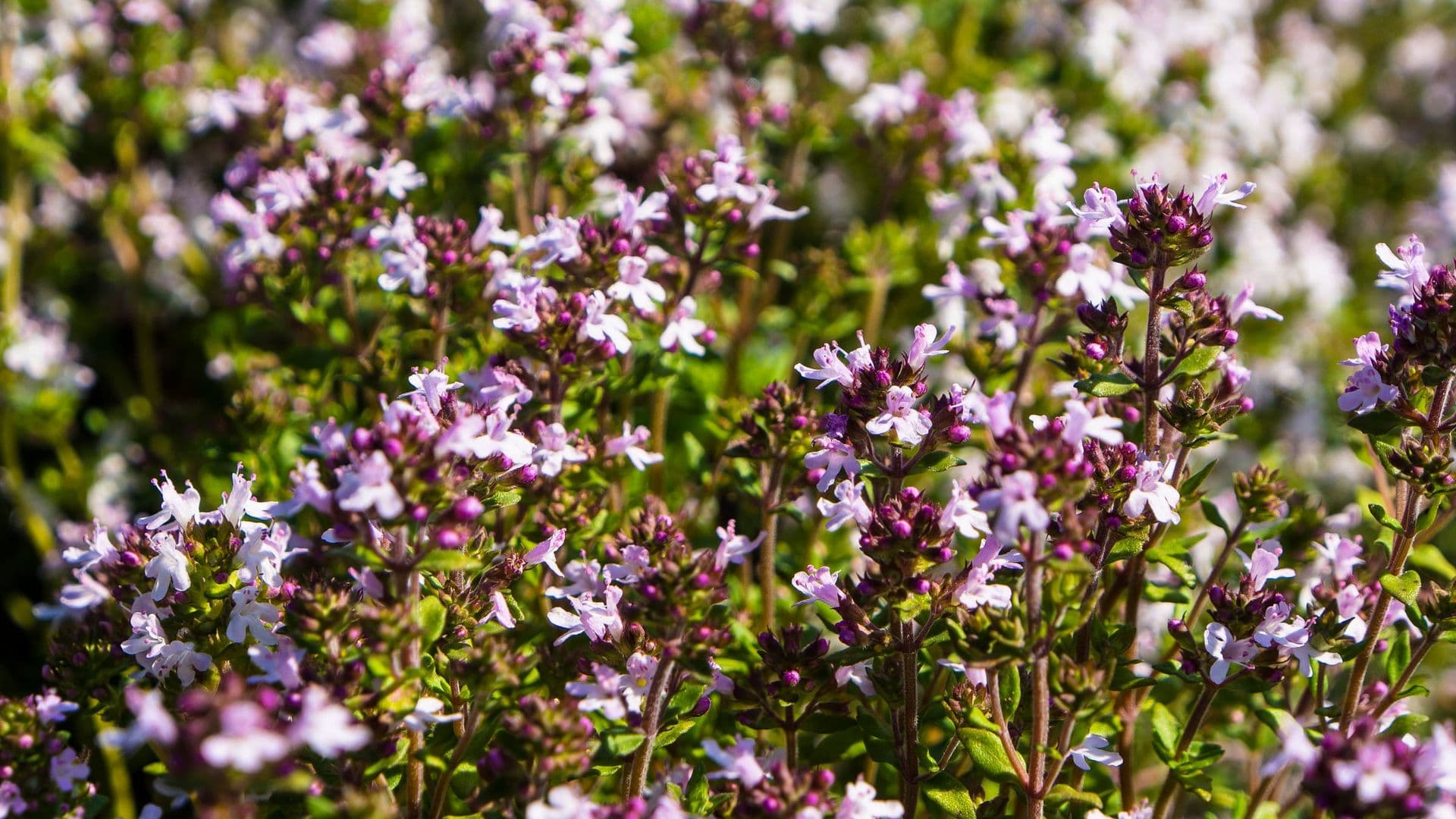
Thymus vulgaris L., thyme, is a perennial, strongly aromatic subshrub from the family Lamiaceae (mint family). Its intense aroma is caused by its essential oil, which has a strong warming character. Thyme is native to southern Europe but has meanwhile become partially naturalised in our region as well. It favours poor but warm locations. The plant remains small, one could say concentrated, in growth and grows to a maximum height of 40 cm. Thyme tends to become woody in its lower parts. When pruning in autumn, one must not cut into this wood as it would be detrimental to the plant. On its upright stems sit small, grey-green leaves shaped elongate and elliptic. These are densely covered with glands, and their leaf edges are rolled downwards. From May to October, thyme forms a true carpet of blossoms with its mostly whitish flowers, which are visited intensively and gladly by bees.
Essence
Essence of the plant
Ardour, affection, purification
On the psychological level, this warmth corresponds to care, attention and recognition. A lack of emotional warmth and attention or physical coldness can lead to vulnerability of the respiratory organs to infectious diseases.
The main symptom is then the formation of viscous, often foul-smelling mucus that cannot be coughed up; but also dry, spasmodic cough (including croup) in children who may have received too little attention, recognition and warmth, is included. Thyme imparts the necessary warmth to penetrate and liquefy the viscous mucus, combat the pathogens and purify unpleasant odours, or to relieve cold-induced spasms.
Thymus vulgaris
Thyme
From shape to healing power
Thyme belongs to the aromatic Lamiaceae, whose essence is conveyed through their aroma. The essential thyme oil has a radiant, warming character. When placed on the tongue, a mild yet long-lasting burning sensation spreads. It is not fiery and intense, dissipating quickly, but rather a steady and sustained heat that can warmly penetrate both lungs and stomach.
It is an intense warmth, like that emanating from glowing embers. Thyme has a radiating character, warming its entire surroundings from the centre of the breastbone. It is no coincidence that thyme and the gland beneath the breastbone share the same Latin name. The plant’s energetic centre of effect is the thymus gland, from which it radiates in a circular manner. The shape of thyme displays the typical pattern associated with the yang character of all plants possessing a high warmth quality: narrow, firm leaves and woody stems.
There is nothing soft or receptive about the plant; instead, we find contraction and concentration of forces that must precede radiating and warming. Regarding its narrow leaves and woody stem, thyme can certainly be compared to rosemary, but the latter is much more fiery, even explosive—something clearly visible in the small flames of rosemary leaves. Thyme does not spread its warmth eruptively; its leaves are not as straight and needle-like as rosemary’s but slightly curved. This means thyme releases its warmth less intensely but consistently over a longer period.
Organic and Demeter cultivation
Thyme originally comes from the western Mediterranean region and is now cultivated worldwide. It prefers dry, sunny, calcareous, and well-drained soils. As a cultivated plant, it is widespread in Switzerland; in mild locations, it overwinters outdoors.
Ceres uses thyme from organic or Demeter cultivation. The flowering herb is harvested in early summer at full bloom, when the plant’s typical aroma is optimally developed.
Traditional Use
As a culinary herb from the Mediterranean region, thyme, Thymus vulgaris L., holds a fixed place in Mediterranean cuisine. In addition, various medicinal preparations and applications have become established over the centuries. Thyme is a very popular herbal tea drug in the indication group of cough and cold. It is used both individually and in combination with other expectorant medicinal plants. The areas of application of thyme-containing cough medicinal products are based on their bronchospasmolytic, expectorant, and antibacterial effects. Specific indications for thyme therefore include: bronchitis, whooping cough, and catarrh of the upper respiratory tract.
Sources
1. Hänsel, R. & Steinegger, E. Hänsel / Sticher Pharmakognosie Phytopharmazie. (Wissenschaftliche Verlagsgesellschaft GmbH, Stuttgart, Deutschland, 2015).
2. BGA/BfArM (Kommission E). Thymi herba ( Thymiankraut ). Bundesanzeiger 228, (1984).
3. Madaus, G. MADAUS LEHRBUCH DER BIOLOGISCHEN HEILMITTEL BAND 1-11. (mediamed Verlag, Ravensburg, 1990).
4. Committee on Herbal Medicinal Products (HMPC). Community Herbal Monograph on Thymus Vulgaris L. and Thymus Zygis L., Herba. EMA/ HMPC/342332/2013 (2013).
5. Kalbermatten, R. & Kalbermatten, H. Pflanzliche Urtinkturen. (AT Verlag, Aarau, Schweiz, 2014).
6. Kalbermatten, R. Wesen und Signatur der Heilpflanzen. (AT Verlag, Aarau, Schweiz, 2016).
Ceres mortar process — gentle, cold and complete.
Freshly harvested, hand-picked, ground at room temperature and aged for years. No heating, no pressure - the plant's full vitality is preserved.