Arnica
Arnica montana
Botany
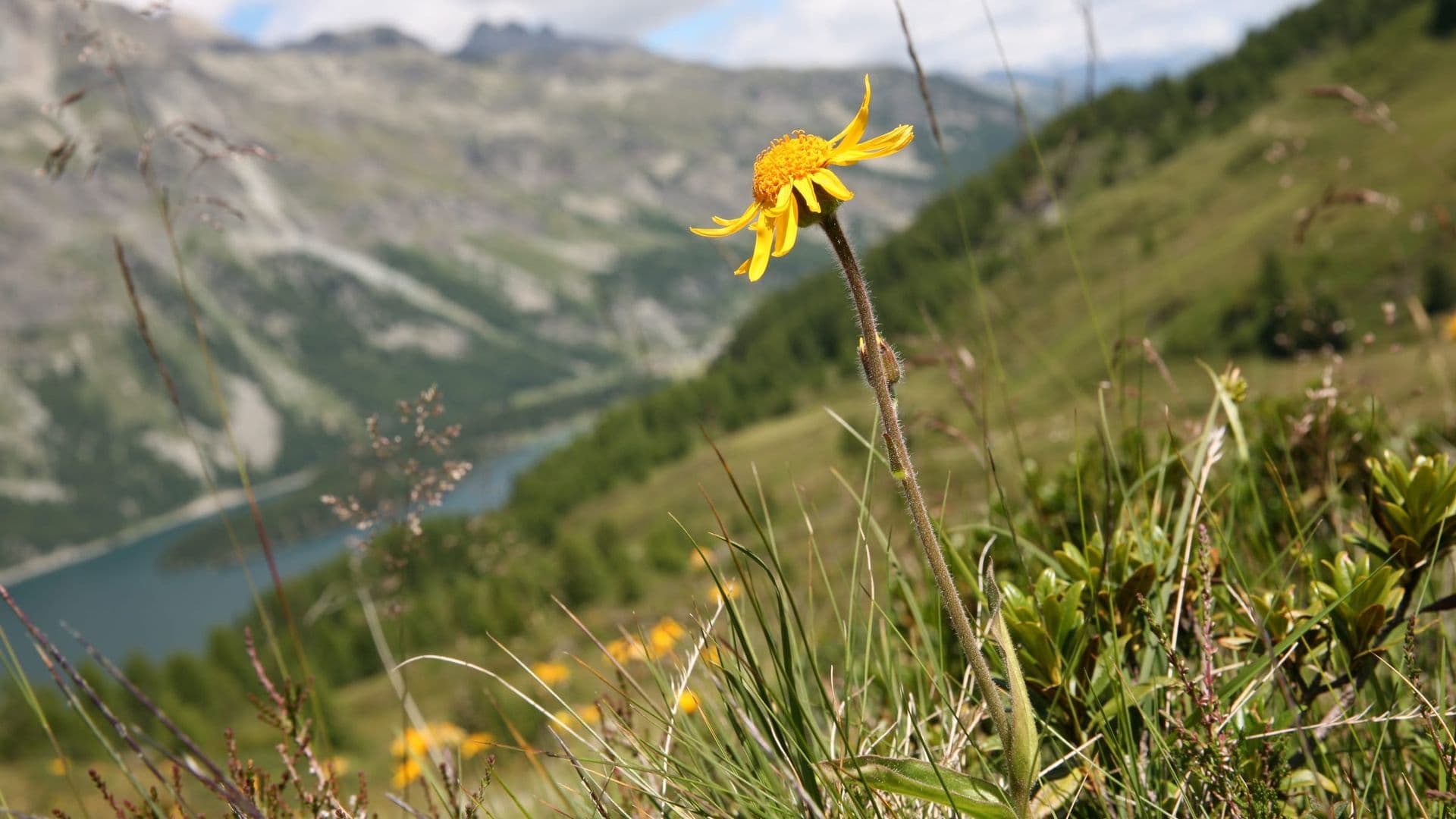
Arnica, Arnica montana L., is a perennial semi-rosette plant belonging to the family of Asteraceae (daisy family). The species name “montana” already indicates that it mainly occurs in mountainous regions. It can be found at altitudes up to 2,500 m. Arnica primarily inhabits sheltered locations; it is found on pastures, in meadows, and also on marshy soils. Its arching rhizome, which can grow up to about 10 cm long and around 0.5 cm thick, is reddish-brown in colour. This has a biting-aromatic, sharply bitter taste. Many fragile roots emerge from its underside. In the first year, a basal rosette initially develops, spreading flat on the ground. It consists of four to six entire-edged and ovate to obovate leaves. In the second year, a robust herbaceous stem up to 60 cm tall forms, which is glandular hairy. On this stem are one to three pairs of opposite lanceolate leaves. From June to July, the flower heads develop terminally on the plant. They measure 6 to 8 cm in diameter, are golden yellow, and have a very pleasant fragrance. They bloom from outside to inside. The outer ligulate florets open first, individually one after another, giving the flower its characteristic “untidy” appearance.
Arnica montana
Arnica
Wild collection
Arnica is native to the mountainous regions of Europe. In Switzerland, it can be found on alpine meadows and pastures, preferably on acidic, nutrient-poor soils. The plant is sourced through wild collection at its natural mountain habitat.
Traditional Use
The wound-healing properties of Arnica were already known in the Middle Ages. Bruises, injuries, rheumatic and cardiovascular complaints were among the traditional uses that have remained relevant to this day. Phytotherapeutically, the flowers are primarily used. Today, preparations made from Arnica flowers are only used externally to treat bruises, blunt injuries, and inflammations. The mode of action and clinical efficacy of externally applied Arnica flowers are well documented scientifically. Arnica is also a well-known remedy in homeopathy for bleeding, muscle pain after exertion, and circulatory system disorders.
Sources
1. Hänsel, R. & Steinegger, E. Hänsel / Sticher Pharmakognosie Phytopharmazie. (Wissenschaftliche Verlagsgesellschaft GmbH, Stuttgart, Deutschland, 2015).
2. Madaus, G. MADAUS LEHRBUCH DER BIOLOGISCHEN HEILMITTEL BAND 1-11. (mediamed Verlag, Ravensburg, 1990).
3. BGA/BfArM (Kommission E). Arnicae flos (Arnikablüten). Bundesanzeiger 228, (1984).
4. BGA/BfArM (Kommission C). Arnica montana. Bundesanzeiger 47, (1990).
5. Committee on Herbal Medicinal Products (HMPC). Assessment report on Arnica montana L., flos. EMA/HMPC/198794/2012 (2014).
Ceres mortar process — gentle, cold and complete.
Freshly harvested, hand-picked, ground at room temperature and aged for years. No heating, no pressure - the plant's full vitality is preserved.