Daisy
Bellis perennis
Untouched quality, innocence, intactness, childlike nature
Botany
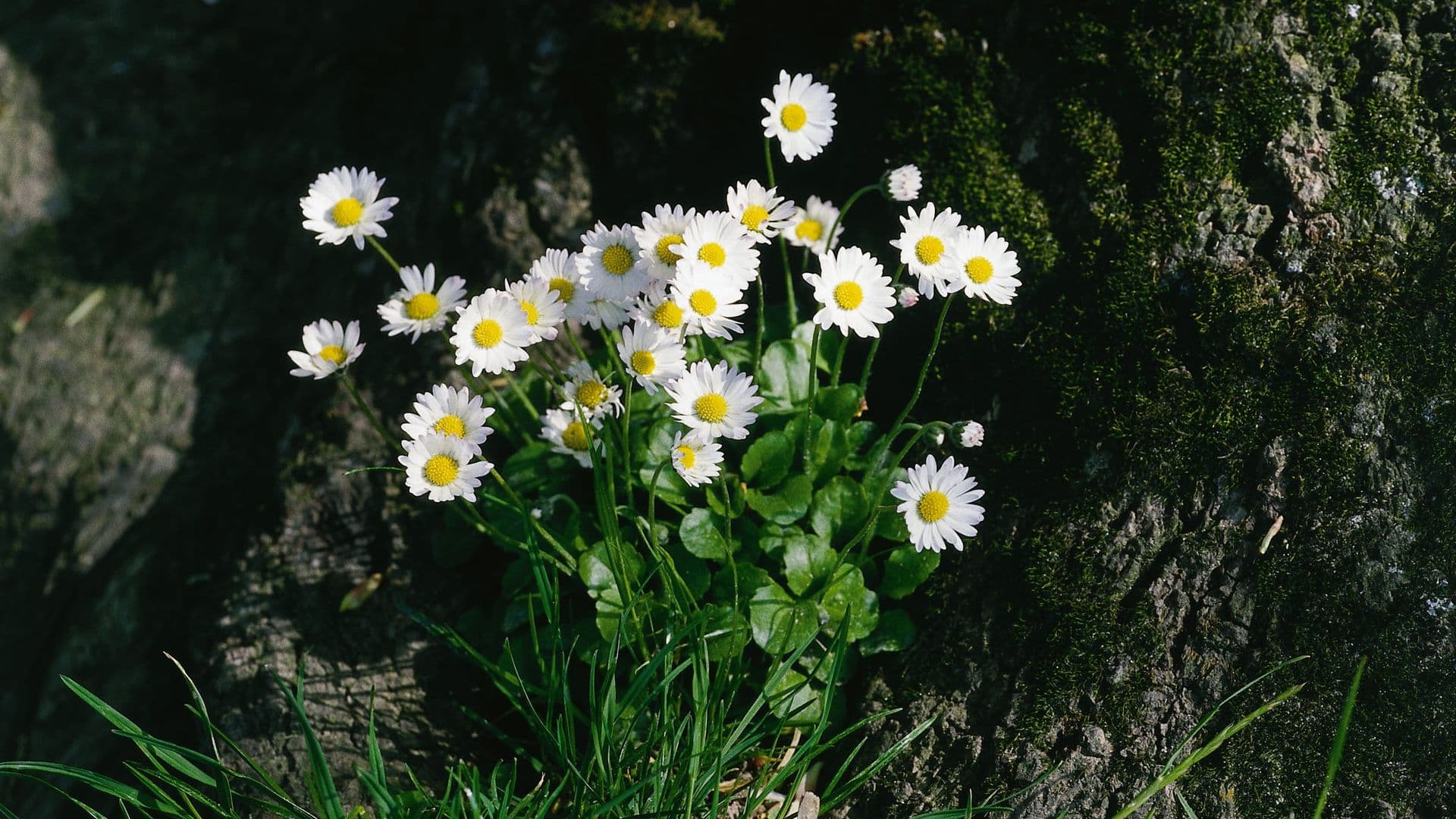
The daisy (Bellis perennis L.) belongs to the family of Asteraceae (the daisy family). It is a perennial plant that can grow 5 to 15 cm tall and remains visible throughout the entire year with its vital basal leaf rosette. From the slightly fleshy, obovate leaves arise the leafless flower stalks, which bear flowers 10 to 30 mm in size at their tips. The centre of the flowers consists of yellow tubular florets, while the white ligulate florets are arranged at the edge, often tinged with pink. The plant delights us with its flowers almost the whole year (January to November), although its main flowering period is clearly in spring. If the flowers are cut or grazed off, new flowers immediately sprout again from the vital rosette. Frequent mowing even promotes the plant, which is why it readily spreads in closely cut lawns.
Essence
Essence of the plant
Untouched quality, innocence, intactness, childlike nature
The essence of Daisy is directed towards preserving childlike innocence and purity. It seeks to protect itself from taint through culpable entanglements, as are part of growing older. Since this is ultimately impossible, it fears the adult world.
As shy and vulnerable as it may be, it can nonetheless release great forces to heal the consequences of assaults on its mental and physical integrity. The other name of this plant, Massliebchen, expresses that it measures love—it regulates the passion of desire, moderating excessive potency. Daisy is a wonderful aid for all mental and physical injuries caused by reckless use of force, especially through sexual aggression.
Bellis perennis
Daisy
From shape to healing power
Who hasn’t picked daisies as a child and made a small bouquet for their mother? Doesn’t a pure, bright tone sound in our hearts when we watch small children picking daisies and adorning each other’s hair with them? Children feel an inner closeness to this small, modest flower, which is often overlooked and trodden upon, yet preserves its integrity. The daisy is a lawn and meadow flower.
It belongs to the diverse family of Asteraceae. One can regard the simple, clear structure of the flower head as a prototype of a childlike flower. The ray florets, pink when blooming, later turn pure white; the flower disc is a simple yellow circle. When the lawn is mown for the first time in spring and the flower heads are cut off, it is not long before the plant produces new flowers, though now with shorter stems.
If the lawn is cut even shorter, this little plant immediately adapts again. It seems indestructible, knowing only one thing: to raise its flower head upwards and keep it pure. Where does this strength, this courage come from, that nothing can harm? The plant has an unusually resilient leaf rosette, from which it continually mobilises new strength. Even after fading, the daisy remains beautiful.
The numerous leaves are all ground-hugging and form a dense rosette. Upon close inspection of the leaf structure, we perceive seemingly incompatible characteristics: tough, fleshy leaves that nonetheless exude a strong gloss. Here we recognise an expression of robustness and vitality. When fading, plants generally undergo a clearly visible transformation: the brilliance of colour and splendour of form fade, wilting petals remind us of the transience of all life.
But have you ever seen a faded daisy? Naturally, they make no exception — they too fade like all life. Yet they are gifted to fade so discreetly — the white ray florets fall off quickly without much discolouration and the yellow of the flower disc adopts the green of the lawn — that the faded plants blend almost invisibly into the grass. The daisy seems to want to be nothing but its flower and to escape the consequences of the reproductive process (wilting and ripening).
Demeter cultivation
The daisy is native throughout Europe and Western Asia and can be found on meadows, lawns, roadside verges, and common pastures from the lowlands up to mountainous regions. As an exceptionally robust plant, it also colonises heavily used soils.
Ceres sources daisies from Demeter cultivation. The entire fresh plant is harvested during the flowering period in spring. Harvesting is done by hand, in dry, sunny weather.
Traditional Use
The daisy has been an established component of natural medicine and wild herb cuisine for centuries. It is a medicinal plant that is non-toxic to humans and animals. Bellis belongs to the family of Asteraceae, which also includes many other “wound-healing herbs” such as Arnica and Calendula. It is therefore not surprising that the phytotherapeutic and homeopathic applications of Bellis perennis L. share many similarities with the therapeutic profile of Arnica: injuries, swellings, bruises, dislocations, sprains, and contusions. A typical sensation is one of soreness and a beaten feeling in the muscles. The symptoms characteristic of Bellis are usually the result of overexertion and overwork. A popular form of preparation for internal use is alcoholic tinctures and homeopathic dilutions up to D12. External application to muscles and joints is also very common. In natural medicine literature, Bellis perennis L. is also recommended for the treatment of skin diseases, especially in children. In traditional women’s medicine, positive experiences have been noted in cases of uterine bleeding and the aftermath of surgical interventions.
Sources
1. Hänsel, R., Keller, K., Rimpler, H. & Schneider, G. Hagers Handbuch der Pharmazeutischen Praxis Band 4 Drogen A-D. (Springer-Verlag, 1992).
2. Madaus, G. MADAUS LEHRBUCH DER BIOLOGISCHEN HEILMITTEL BAND 1-11. (mediamed Verlag, Ravensburg, 1990).
3. BGA/BfArM (Kommission D). Bellis perennis. Bundesanzeiger 190 a, (1985).
4. Vonarburg, B. Homöothanik - Arzneipflanzen der Homöopathie. (Haug Verlag, 2009).
5. Committee for veterinary medicinal products. Bellis perennis Summary Report. EMEA/MRL/663/99-FINAL (1999).
6. Kalbermatten, R. & Kalbermatten, H. Pflanzliche Urtinkturen. (AT Verlag, Aarau, Schweiz, 2014).
7. Kalbermatten, R. Wesen und Signatur der Heilpflanzen. (AT Verlag, Aarau, Schweiz, 2016).
The Restoration of Lost Innocence
R. & H. Kalbermatten — «Psyche des Menschen und Signatur der Heilpflanzen»
Ceres mortar process — gentle, cold and complete.
Freshly harvested, hand-picked, ground at room temperature and aged for years. No heating, no pressure - the plant's full vitality is preserved.