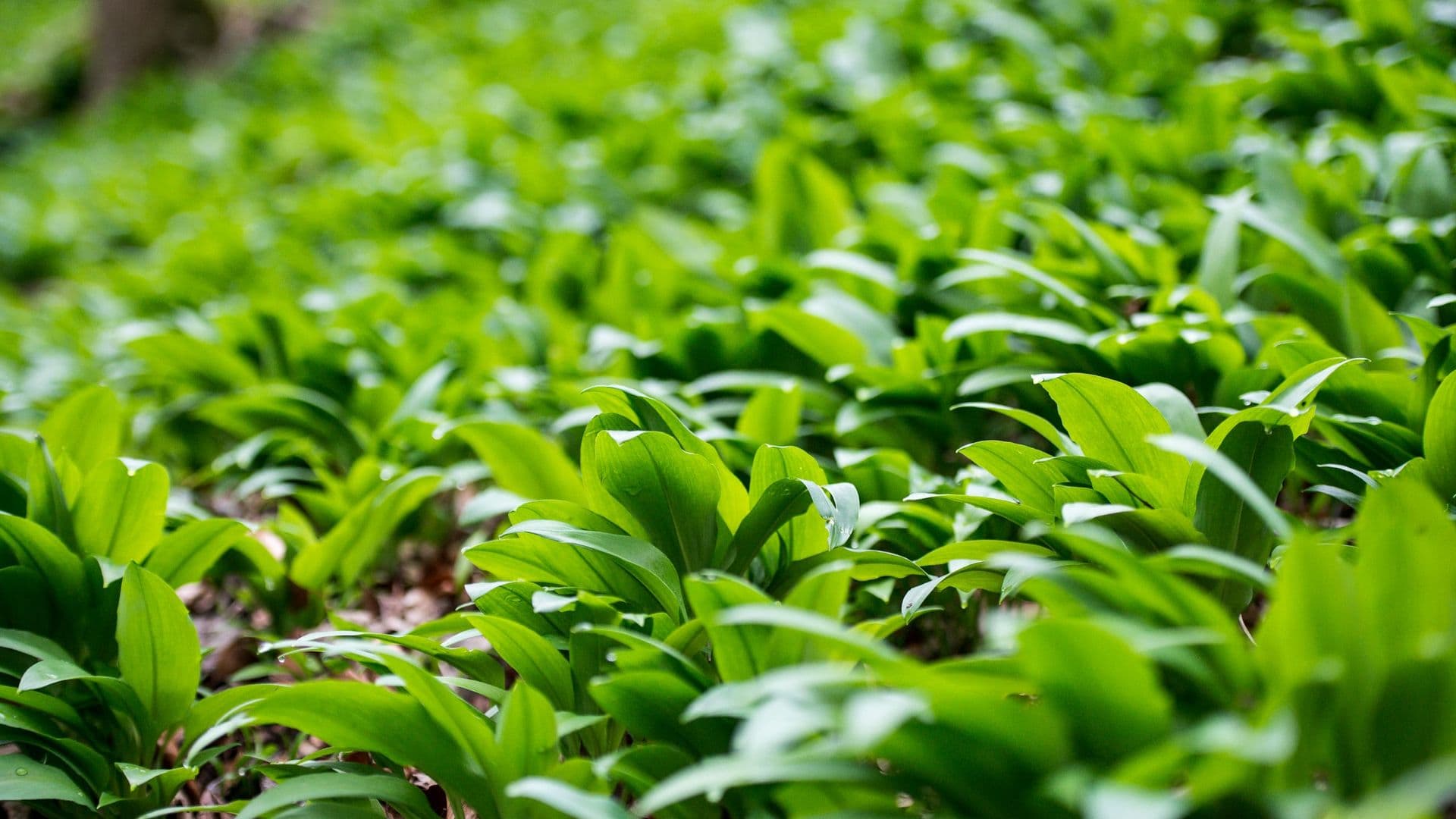
Wild garlic
Allium ursinum
Expansive force, dynamics, power, simplicity
Botany
In spring, wild garlic spreads powerfully through the forests with its intense scent. There, it appears extensively and in large groups. In spring, it produces 2 to 3 elliptic-lanceolate leaves from a bulb. These can grow up to 20 cm long. The leaves have a strong and intense garlic aroma, so a stand of wild garlic in the forest can be smelled from a distance. Wild garlic shows us something special with its leaves: what we see as the upper side of the leaf is actually the underside and vice versa. The leaves of wild garlic are therefore inverted! From late April to May, a leafless stalk emerges from the bulb, at the tip of which white, star-shaped flowers appear. After the flowering phase, the above-ground parts of the plant quickly die back and only sprout again from the bulb the following spring.
The broad, simple leaves contrast with the highly differentiated structure of many other plants — a sign of the subordination of structuring thinking to the vital force. The white flowers in spherical umbels radiate a powerful, undifferentiated expansive energy.
Essence of the plant
Expansive force, dynamics, power, simplicity
Sulphur: Willpower
Wild garlic is an extremely powerful, penetrating harbinger of spring. It possesses an undivided expansive force. Wild garlic dissolves sclerotic tendencies, supplies the blood circulation with new energy, and overcomes the stagnation and hardening tendencies in body and soul symbolised by winter and cold.
Allium ursinum
Wild garlic
From shape to healing power
This video is provided by YouTube and requires your consent.
“Wild garlic has a great capacity to spread and always occurs in large quantities. Where it settles, other plants have difficulty establishing themselves. Another characteristic is the sharp, garlic-like taste, which is due to the presence of sulphur-containing compounds.”
“The most striking feature, however, is the reversal of the upper and lower sides of the leaves. This reversal occurs as follows: Wild garlic has a bulb in the middle of which the flower with its stem emerges. The leaves emerge, as is usual in all plants, on either side of the plant axis. A leaf therefore first emerges on one side of the bulb, but before it is fully grown, it turns over. This can happen in two different ways; either the whole leaf arches over the middle and forms a bow over the bulb, thus apparently emerging on the side opposite its origin, or the leaf stalk turns 180°.”
“In both cases, the leaf turns its underside upwards, towards the light. This is unique among plants. In all other plants, the side of the leaf visible is the upper side. Only in wild garlic do you see the underside from above.”
“The significance of this striking signature is the reversal of polarity between top and bottom, and this ultimately leads us to its property of breaking open hardenings and bringing life back into flow.”
Wild collection
Wild garlic grows naturally in moist deciduous forests of Europe and North Asia. In Switzerland, it is mainly found in floodplain forests and in shady areas along streams.
In Switzerland, the plant is obtained by wild collection.
Traditional Use of Wild Garlic
Wild garlic is one of the oldest used medicinal plants in Central Europe. Archaeological finds document its use since the Neolithic era. The name derives from the observation that bears consumed large quantities of it after hibernation — thereby showing strengthening and health-boosting effects. In Germanic folk medicine, it was regarded as the «power of spring».
Traditionally, wild garlic was used as a draining and blood-purifying agent, especially as a spring cure to support the liver, gallbladder and intestines. It was considered beneficial for the intestinal flora, lowering blood pressure and blood fats, and was recommended for arteriosclerosis and general circulatory support. Externally, it was used for skin inflammations and eczema.
In the Ceres tradition, wild garlic stands for the sprouting, cleansing power of spring. The explosive energy with which it bursts from the ground after winter — bright green, intensely fragrant, in large quantities — embodies the essence of spring: the elimination of the old, the arrival of the new.
Ceres mortar process — gentle, cold and complete.
Freshly harvested, hand-picked, ground at room temperature and aged for years. No heating, no pressure - the plant's full vitality is preserved.