Centaury
Centaurium erythraea
Ideality and reality
Botany
Centaurium erythraea RAFN, the common centaury, belongs to the gentian family (Gentianaceae). This species is rather rare and mainly occurs at forest edges, sunny clearings, and poor meadows. Unlike its relatives, it does not climb into the mountains. The herbaceous plant grows to a maximum height of 50 cm. From a pale taproot develops an upright, four-angled, extremely tough stem, which branches towards the top. At the base, a rosette of inverted egg-shaped leaves forms, which is often already withered at flowering time. The stem leaves are arranged opposite-crosswise and are rather elongated egg-shaped.
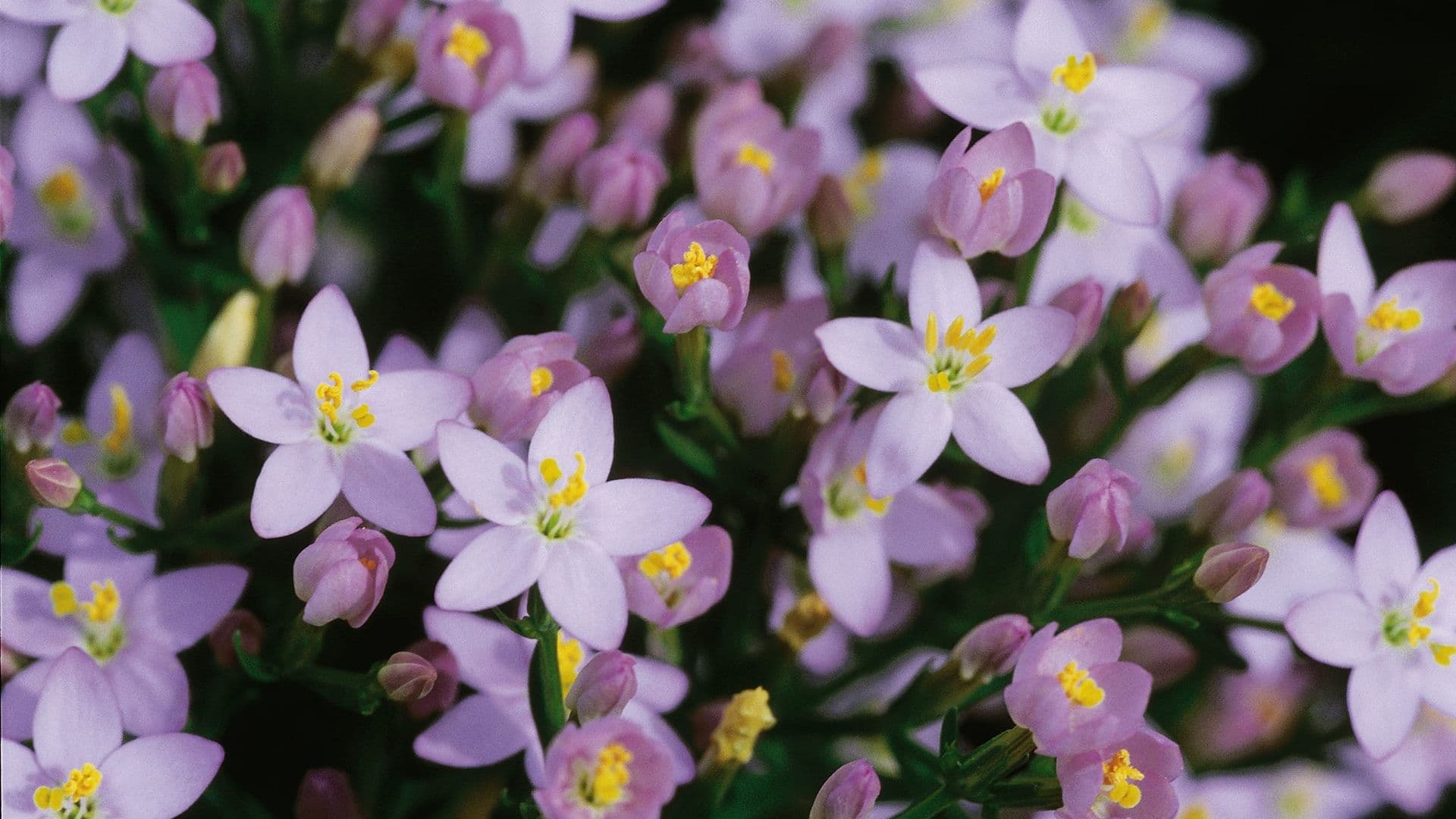
From July to September, the flowers unfold like small, intensely pink, five-pointed stars. The simply structured flowers with clear form are arranged in loose compound umbels; the corolla is fused — if one pulls on a petal, the entire corolla comes away. The flowers open only in warm, sunny weather. The moment of tasting the herb is unforgettable: it tastes intensely gallbitter — which one would not expect from this radiant plant.
Essence of the plant
Ideality and reality
The scientific name of Centaurium could hardly be more fitting. The essence of this highly esteemed medicinal plant is wonderfully expressed in the centaur – the dual being between horse and human from Greek mythology. The centaur symbolises the duality of human existence: on one hand, a physical form with instincts and needs manifests itself, which, like that of animals, is subject to all the laws of gravity.
On the other hand, the human body contains a soul life – and thereby elevates humans above animals – which expresses itself in the striving for culture, for blossoms of simple clarity and strong radiance. Beauty and harmony are expressed in the longing for higher values. It is a nature that is not unified within itself, for the upward striving towards light and purity and the difficult-to-tame natural being cannot come together.
They can neither be united, nor can one part be negated, suppressed or sublimated permanently — they can only exist side by side in mutual respect. This split between ideality and reality within the human nature causes great suffering for many people. Faced with their ideals, they struggle to accept the body, whose natural demands and needs must be met and fulfilled. These are people who project their ideals onto the body and then seek recognition and love through it – the widespread obsession today with youthfulness and slenderness is an expression of this.
This leads some, often young, people to a constant pendulum of feelings between "ecstatic joy" and "deep sorrow." Centaurium, owing to its essential nature affirming this duality, is helpful in psychosomatic disorders of the digestive organs that can arise from such suffering. These include especially illnesses with a lack of grounding in the physical, such as anorexia nervosa, for which Centaurium is the plant remedy of choice in its complex therapy.
Centaurium erythraea
Centaury
From shape to healing power
Tansy-leaf milfoil is a medicinal plant whose essence can only be understood when viewed in connection with its natural habitat. Tansy-leaf milfoil belongs to the gentian family, whose members are mostly mountain plants, dwelling in the "lofty realms" of higher regions. Most gentian species strike us as simple and beautiful. In their natural habitat, on mountain pastures, they come into their own wonderfully.
Tansy-leaf milfoil is now a gentian that has left its ancestral family home and settled in the lowlands. Its locations are clearings, path edges, grassy slopes, and reed meadows. As the plant blooms in mid-summer and only reaches about 10 to 40 cm in height, during flowering it is surrounded or even overgrown by grasses and thorny shrubs. In contrast to the family members that have remained in the mountains, it therefore stands out much less in its surroundings.
The stem has fully adapted to this environment. It is angular, wiry, and tough. Anyone who has harvested tansy-leaf milfoil will be surprised by the sturdy stem, which does not seem to match the delicate flowers.
Now let us allow the image of the blossoms to wash over us! Can one imagine a more perfect synthesis of simple clarity with noble radiance? The nobility, the aura of these flowers, is not created by complex structures but by simplicity and clarity of form, as well as by the shine and delicacy of the pink hue of the petals and the brightness of the yellow stamens. The bloom of tansy-leaf milfoil is of moving beauty.
There is a great contrast between the site and stem of the plant on the one hand, and its radiance on the other. Finding tansy-leaf milfoil in its natural environment among the undergrowth (the plant is rare) is for me always a joyful discovery. The feeling is akin to finding a gem. In the essence of this simple plant lies the hidden power to forge a bridge between the clarity of the mind and the exuberant urge to live.
Demeter cultivation
Tansy is widespread in Europe, West Asia and North Africa. It prefers sunny, dry to moderately moist, calcareous locations: poor meadows, pathsides, stony areas and open woodlands. In Switzerland, it can be found in the Central Plateau and in the warmer valleys.
Ceres sources Tansy from Demeter cultivation. The flowering herb is harvested in summer at the main flowering stage.
Traditional use
Centaurium erythraea has been used as a medicinal product for millennia by renowned herbalists such as Hippocrates and Paracelsus. This bitter plant is traditionally employed as a folk remedy, in herbal medicine, and also homeopathically, typically for stomach complaints. The intake of bitter remedies leads to an increase in gastric juice and saliva secretion. This explains the use of Centaurium erythraea RAFN for loss of appetite and dyspeptic complaints. Recent studies have shown that the effect of bitter remedies extends far beyond the so-called reflexive effect triggered by the perception of bitterness. In particular, the use of plants containing bitter substances is of great importance for depressive moods and as a general tonic to strengthen body and mind. The dried plant is often used for medicinal preparations (e.g. for infusions). In homeopathy, the fresh plant serves as the starting material.
Sources
1. Hänsel, R. & Steinegger, E. Hänsel / Sticher Pharmakognosie Phytopharmazie. (Wissenschaftliche Verlagsgesellschaft GmbH, Stuttgart, Deutschland, 2015).
2. Saller, R., Melzer, J., Uehleke, B. & Rostock, M. Phytotherapeutische bittermittel. Schweizerische Zeitschrift fur GanzheitsMedizin 21, 200–205 (2009).
3. Madaus, G. MADAUS LEHRBUCH DER BIOLOGISCHEN HEILMITTEL BAND 1-11. (mediamed Verlag, Ravensburg, 1990).
4. Committee on Herbal Medicinal Products (HMPC). European Union herbal monograph on Centaurium erythraea Rafn. s.l., herba. EMA/ HMPC/277493/2015 (2015).
5. BGA/BfArM (Kommission D). Centaurium erythraea. Bundesanzeiger 44, (1990).
6. Kalbermatten, R. & Kalbermatten, H. Pflanzliche Urtinkturen. (AT Verlag, Aarau, Schweiz, 2014).
7. Kalbermatten, R. Wesen und Signatur der Heilpflanzen. (AT Verlag, Aarau, Schweiz, 2016).
Ceres mortar process — gentle, cold and complete.
Freshly harvested, hand-picked, ground at room temperature and aged for years. No heating, no pressure - the plant's full vitality is preserved.