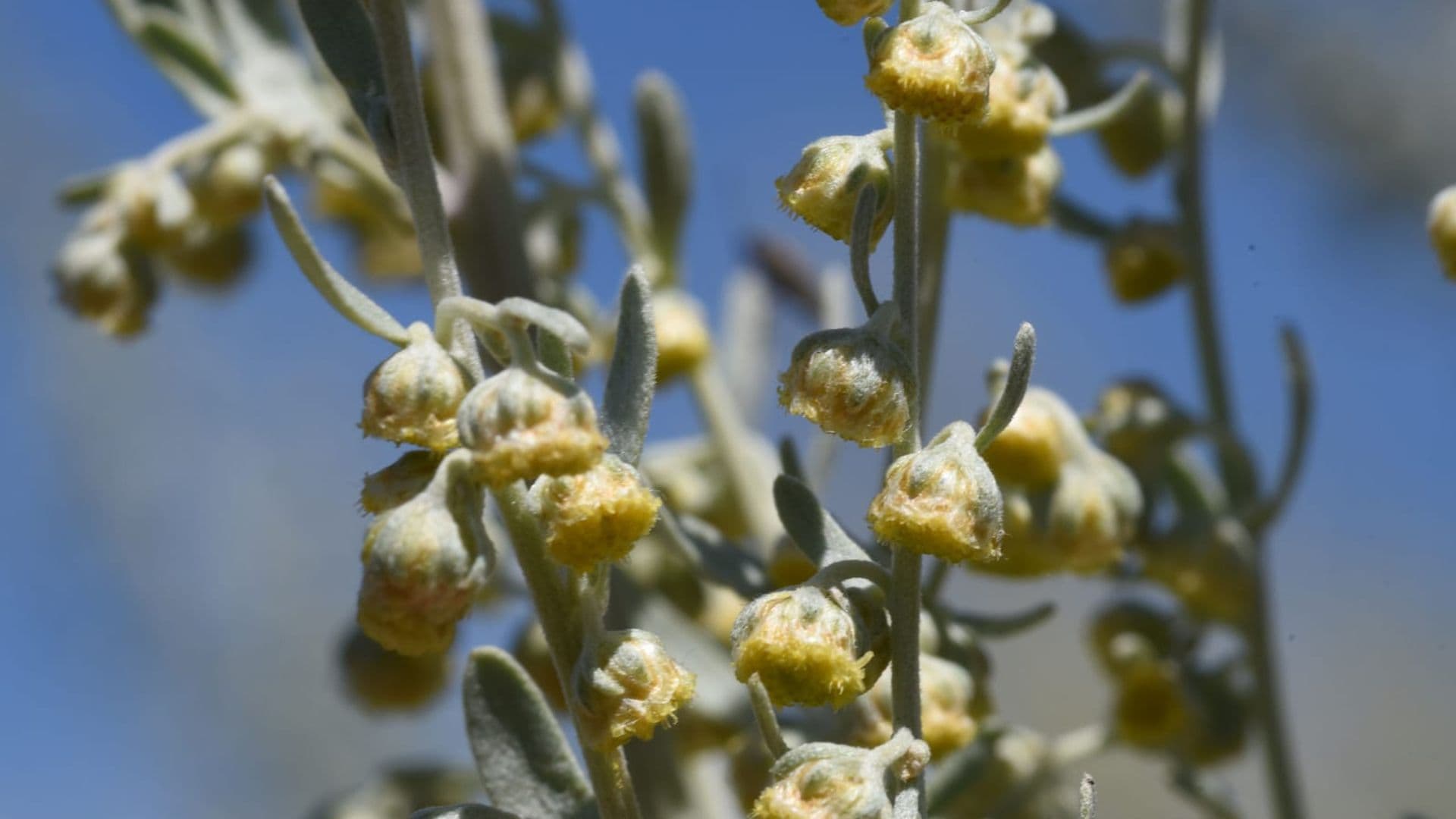
Wormwood
Artemisia absinthium
Compassion, presence, alertness, infusing with energy of metabolic functions
Botany
Wormwood (Artemisia absinthium L.) belongs to the family of the Asteraceae (daisy family). It is a perennial plant of warm and dry locations that can grow up to 1.5 m tall. Stems and leaves are covered with grey-felted hairs. The further one’s gaze travels up the upright, woody stems, the more divided the leaves become, until only narrow, lanceolate leaflets remain in the inflorescence.
From July to September, wormwood flowers with small, inconspicuous yellow flowers that face towards the ground. Unlike other members of the daisy family, wormwood is wind-pollinated; most other daisies attract animals with their magnificent and large flowers. Overall, despite its size, the entire plant appears almost unremarkable—until you taste its aroma.
Essence of the plant
Compassion, presence, alertness, infusing with energy of metabolic functions
The bitterness and aroma of wormwood are so pronounced and penetrating that this plant has become a symbol for the bitter aspects of life. No one who takes a preparation of wormwood remains indifferent; it urges alertness and presence. The bitter taste and the tart aroma of wormwood seem to "bloom within." Their strongly astringent, inwardly directed character leads to a psychologically polar opposite reaction.
Those under the influence of the wormwood essence step outward and participate with active interest in life, fellow human beings, and the world. Wormwood awakens interest in life and activity and promotes the stimulation of metabolic functions. People who lack interest, who at times appear indifferent, are often unable to energetically penetrate metabolic functions and become atonic.
Their digestive organs become weakened, which can lead to general states of exhaustion up to depression. In such situations, wormwood is a potent energising agent for both psyche and body. By warming and toning the weakened stomach, it promotes digestive functions.
Those prone to daydreaming are brought back to reality by wormwood. Daydreams indicate a tendency to escape. Through regular intake of Absinthium, it becomes possible to face life’s tasks with willpower and firmly grasp the thread of life.
Artemisia absinthium
Wormwood
From shape to healing power
Wormwood belongs to the daisy family. It thrives in the valleys of the Central Alps in sunny locations. This stately, perennial plant can grow over two metres tall. The thrice pinnate leaves are grey-felted on both sides and feel very soft.
The also felted stem is strongly branched and traversed by longitudinal grooves. Wormwood’s form hardly reveals any segmentation; it creates no clear contours or boundaries. It appears continuous from outside to inside, from top to bottom; the air element (outer leaf) gently transitions into the water element (inner leaf). Members of the daisy family are characterised by radiant, mostly relatively large flower heads that turn towards the sun.
The sunflower, dandelion, and daisy are typical representatives of this diverse plant family. When we observe the flowers of wormwood with this knowledge in mind, the small blooms that all face downwards, towards the earth, seem strange. Even when wormwood is in full bloom, one must look closely to recognise this in the pollen. There is no splendid unfolding of flowers in bright colours and expansive gestures; they remain as if closed, withdrawn into themselves, seeming to bloom "inside".
The wormwood flower does not strive to emanate forms, colours, and scents; there is no exchange with light and air, as is inherent to the floral being itself. The form reveals an inward-directed signature. Wormwood unites extreme bitterness with an intense, penetrating aroma. We know that scents and aromas immediately place us into a certain mood.
Through fragrances, our emotional state is influenced and moved directly, without detour via thoughts. Each aroma corresponds to a particular quality on the vibrational scale of emotional energies. Bitter substances stimulate bile flow and gastric juice production. They thus influence the autonomic processes, events that elude our conscious control. The union of these two outstanding characteristics (aroma and bitterness) is rare.
Most bitter medicinal plants have a rather weak, flat aroma so that the bitterness predominates undisputedly. In wormwood, however, both properties are strongly pronounced. The various levels of the human being penetrate and promote each other. Thus, the emotional energy, the strength of our feelings and desires, forms the most important source of the vitality of metabolism and therefore of our health.
The life processes of our cells are guided and nourished by the emotional energy potential. It is therefore understandable that every illness has a psychological cause. For a vital metabolism, it is crucial that emotional energies serve the life processes. However, it often happens that feelings take on a life of their own.
We observe this when a person surrenders so completely to their feelings and desires that they see self-purpose in the "feeling of well-being". Then hardly any interest is shown in the world and other people. The energy is lacking because the emotional energy is no longer converted into life energy. The feelings (the air element) are closed off, held captive within themselves, and can no longer penetrate and kindle the life processes (the water element).
Demeter cultivation and wild collection
Wormwood is native to southern Europe, western Asia, and North Africa, and occurs in central Europe as a cultural refugee. It prefers dry, sunny, and nutrient-poor locations: roadside verges, rubble sites, rocky steppes, and south-facing slopes. In Switzerland, it is found particularly in Valais and the Rhine Valley.
Ceres sources wormwood from Demeter cultivation and wild collection. The plant is hand-harvested in summer at the beginning of flowering, when its aroma is most intense.
Traditional Use
As one of the great medicinal plants, Artemisia absinthium L. boasts a centuries-old tradition. Tabernaemontanus alone devotes more than thirteen pages to the use of wormwood, and the holy Hildegard of Bingen already described wormwood as a suitable remedy for weak stomachs. The content of bitter substances and essential oil makes Artemisia absinthium L. a classic bitter remedy or Amarum aromaticum, which reflexively stimulates gastric juice and bile secretion, and therefore digestion. From this derive the medicinal uses of wormwood: it is mainly employed for dyspeptic complaints such as loss of appetite, a feeling of fullness, and flatulence, as well as dysfunction of the bile ducts. Furthermore, wormwood is used in cases of parasite infestation, and it is said that wormwood “lifts… energy and creates joy of life and willingness to work.”
Sources
1. BGA/BfArM (Kommission D). Artemisia absinthium (Wormwood). Bundesanzeiger 142/161, (1994).
2. BGA/BfArM (Kommission E). Absinthii herba (Wermutkraut). Bundesanzeiger 228, (1984).
3. Committee on Herbal Medicinal Products (HMPC). Assessment report on Artemisia absinthium L., herba. (2017).
4. Hänsel, R. & Steinegger, E. Hänsel / Sticher Pharmakognosie Phytopharmazie. (Wissenschaftliche Verlagsgesellschaft GmbH, Stuttgart, Deutschland, 2015).
5. Madaus, G. MADAUS LEHRBUCH DER BIOLOGISCHEN HEILMITTEL BAND 1-11. (mediamed Verlag, Ravensburg, 1990).
6. Kalbermatten R, Kalbermatten H. Pflanzliche Urtinkturen. 7th ed. AT Verlag, Aarau, Schweiz; 2014.
7. Kalbermatten R. Wesen Und Signatur Der Heilpflanzen. 9th ed. AT Verlag, Aarau, Schweiz; 2016.
Compassion for Life
R. & H. Kalbermatten — «Psyche des Menschen und Signatur der Heilpflanzen»
Ceres mortar process — gentle, cold and complete.
Freshly harvested, hand-picked, ground at room temperature and aged for years. No heating, no pressure - the plant's full vitality is preserved.