Artichoke
Cynara scolymus
Self-limitation and excess
Botany
Cynara scolymus L., the artichoke, is a thistle-like perennial up to 2 m high from the family of Asteraceae (daisy family). From the leaf rosette, the plant produces long, often unbranched stems, at the end of which cone-like inflorescences are formed during the summer. The massive, once- to twice-pinnate leaves grow up to 80 cm long and 40 cm wide, light green on top and whitish hairy in the juvenile stage. The petiole is very fleshy and almost watery.
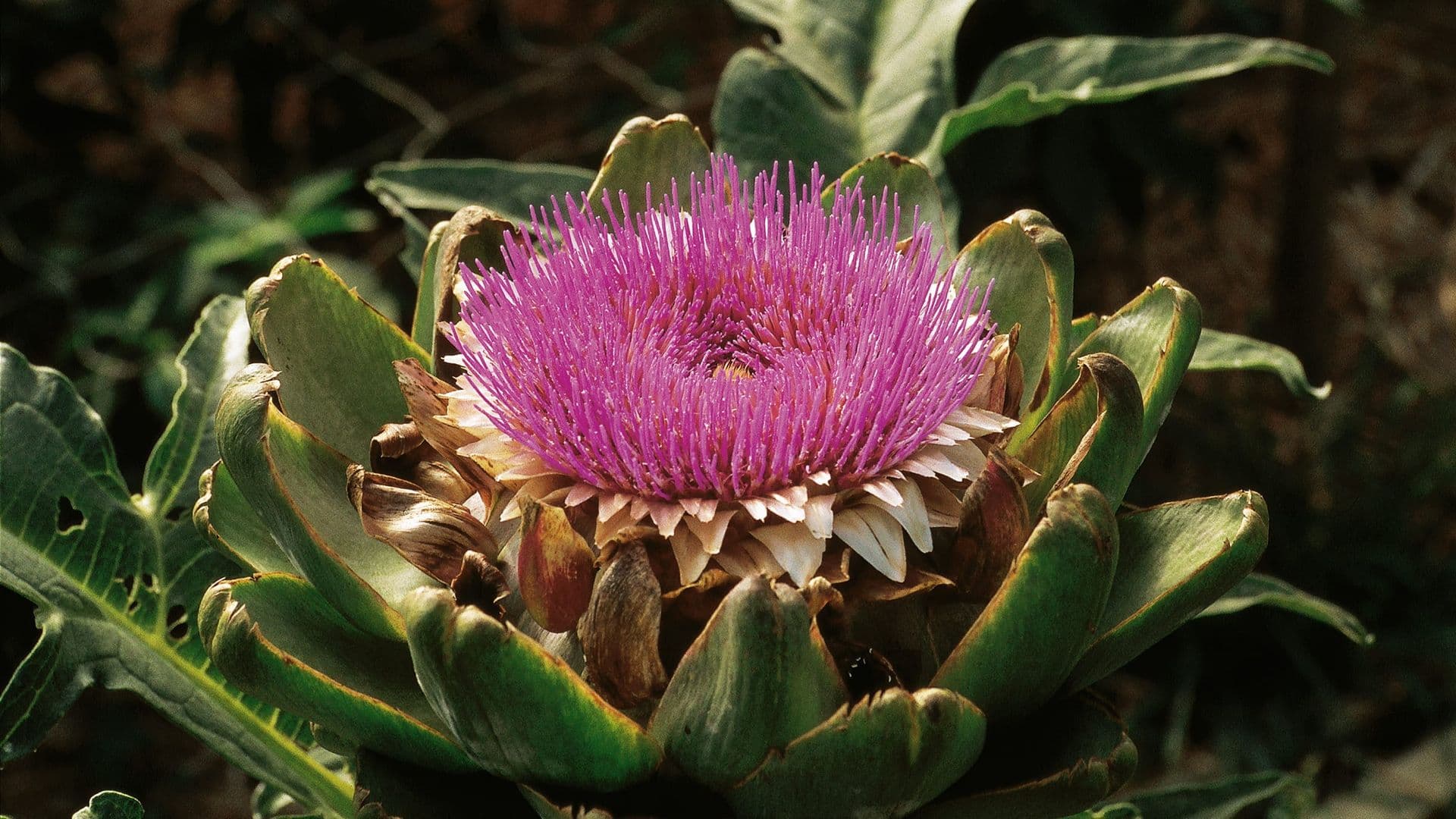
The artichoke blooms in June and July with the typical flower heads up to 15 cm in size. What we know from the vegetable department is not the flower itself, but the unopened inflorescence with a fleshy receptacle, surrounded by a strongly developed, egg-shaped involucre with tile-like arranged involucral bracts, which are fleshy at the base. The tubular, mostly blue florets appear at the head of the inflorescence. The plant has a waxy scent.
Essence of the plant
Self-limitation and excess
The essence of the artichoke expresses itself in completely opposing tendencies. On the one hand, the plant brings about luxuriance and abundance; on the other hand, it contains a principle that counteracts this luxuriance. In the artichoke, the balance between indulgence and self-restraint is reflected.
The essence of this plant supports people in their endeavour to find a balance between excess and renunciation. In approaching this balance, thoughts can lose some of their heaviness and earthbound nature and be directed towards higher things. Through its bitter substances, Cynara scolymus strengthens the digestive processes and particularly stimulates the effective processing of fats.
Cynara scolymus
Artichoke
From shape to healing power
The artichoke plant develops a substantial form. Its leaves spread widely, are twice pinnately divided, with clear gaps between the individual segments. The richly enlarged flower head becomes extraordinarily heavy, and the numerous involucral bracts provide firm external support. They are fleshy inside and, when harvested shortly before flowering, serve as valuable vegetables.
In every respect, the plant goes into fullness and brims with juice. The leaf is watery and of low firmness. A piece of leaf can easily be crushed between the fingers; it has no internal structure that might resist dissolution. When the leaves are handled vigorously during harvest or processing, the hands become coated with a waxy, astringent substance.
These are the bitter-tasting sesquiterpene lactones, which are produced by glandular hairs on the surface of the artichoke plant – a Mediterranean cultivated plant. During rain, the bitter substances can be easily washed off, as they are only localised on the outer side of the leaf. These substances have an astringent effect and thus stand in polarity to the plant's striking exuberance.
The waxy bitter substances seem to encase and structure the plant from outside like a shell. The artichoke expresses overflowing life forces, which are dampened and structured from outside. This limiting principle, which acts from outside on the watery interior of the plant, is especially evident in the flowers. We recognise immoderation in the very large and heavy artichoke flower, which is limited by the mantle of tough involucral bracts. In the bud stage, the artichoke is completely enclosed by the bracts, and in the flowering stage the mantle forms only a small opening as space for the fine violet flower hairs.
The essence of the plant, which has a structuring and form-giving force, has not penetrated deeply into the interior in the artichoke. It consolidates and limits the body especially from outside, as is the case in the animal kingdom for example with a snail. In this sense, the artichoke is the snail among plants.
Since the essence of the artichoke has not strongly bound itself to the matter, its contribution as an active constituent is less than in other plants. On the other hand, this rather weakly penetrating essence makes the artichoke an ideal medicinal product for arteriosclerosis. In this disease, we see a loss of youthful life forces, whereby the structuring essences of the human being work crystallisingly and hardeningly deep into the vessels. Preparations made from artichoke leaves – taken regularly – can be counted among the best agents for the prevention of arteriosclerosis and the delay of ageing processes.
Organic and Demeter cultivation
The artichoke originates from northern Africa and the western Mediterranean region; it is a cultivated form of the wild artichoke (Cynara cardunculus). Today, it is cultivated in Mediterranean countries and in warmer regions of Switzerland.
Ceres uses fresh artichoke leaves and flowers from organic and Demeter cultivation. The leaves are harvested at the time of flowering, when the cynarin and flavonoid content is highest.
Traditional Use
The bitter-tasting artichoke is an integral part of Mediterranean cuisine. The juicy bracts and the fleshy flower base are consumed. Another popular form of use is fresh plant press juices. In the pharmaceutical field, dry extracts and tinctures have been used for decades to treat digestive disorders, chronic liver-gallbladder disorders, and lipid metabolism disorders. Due to its bitter taste, artichoke preparations have a stimulating effect on the production and flow of bile (choleresis) into the digestive tract. This particularly benefits fat digestion and reduces dyspeptic complaints such as a feeling of fullness and flatulence. In addition, medicinal preparations of Cynara scolymus L. are among the most important herbal remedies for lipid metabolism disorders, such as hyperlipidaemia. Together with its antioxidant properties, this also explains the use of artichoke in the preventive treatment of arteriosclerosis.
Sources
1. Hänsel, R. & Steinegger, E. Hänsel / Sticher Pharmakognosie Phytopharmazie. (Wissenschaftliche Verlagsgesellschaft GmbH, Stuttgart, Deutschland, 2015).
2. Committee on Herbal Medicinal Products (HMPC). European Union herbal monograph on Cynara cardunculus L. (syn. Cynara scolymus L.), folium. EMA/HMPC/194014/2017 (2018).
3. Committee on Herbal Medicinal Products (HMPC). Assessment report on Cynara cardunculus L. (syn. Cynara scolymus L.), folium. EMA/ HMPC/194013/2017 (2018).
4. BGA/BfArM (Kommission E). Cynarae folium (Artischockenblätter). Bundesanzeiger 122, (1988).
5. BGA/BfArM (Kommission D). Cynara Scolymus. Bundesanzeiger 109 a, (1987).
6. Kalbermatten, R. & Kalbermatten, H. Pflanzliche Urtinkturen. (AT Verlag, Aarau, Schweiz, 2014).
7. Kalbermatten, R. Wesen und Signatur der Heilpflanzen. (AT Verlag, Aarau, Schweiz, 2016).
Excessiveness and Self-Restraint
R. & H. Kalbermatten — «Psyche des Menschen und Signatur der Heilpflanzen»
Ceres mortar process — gentle, cold and complete.
Freshly harvested, hand-picked, ground at room temperature and aged for years. No heating, no pressure - the plant's full vitality is preserved.