Chicory
Cichorium intybus
The power of now, ‘yes’ to the present, fidelity
Botany
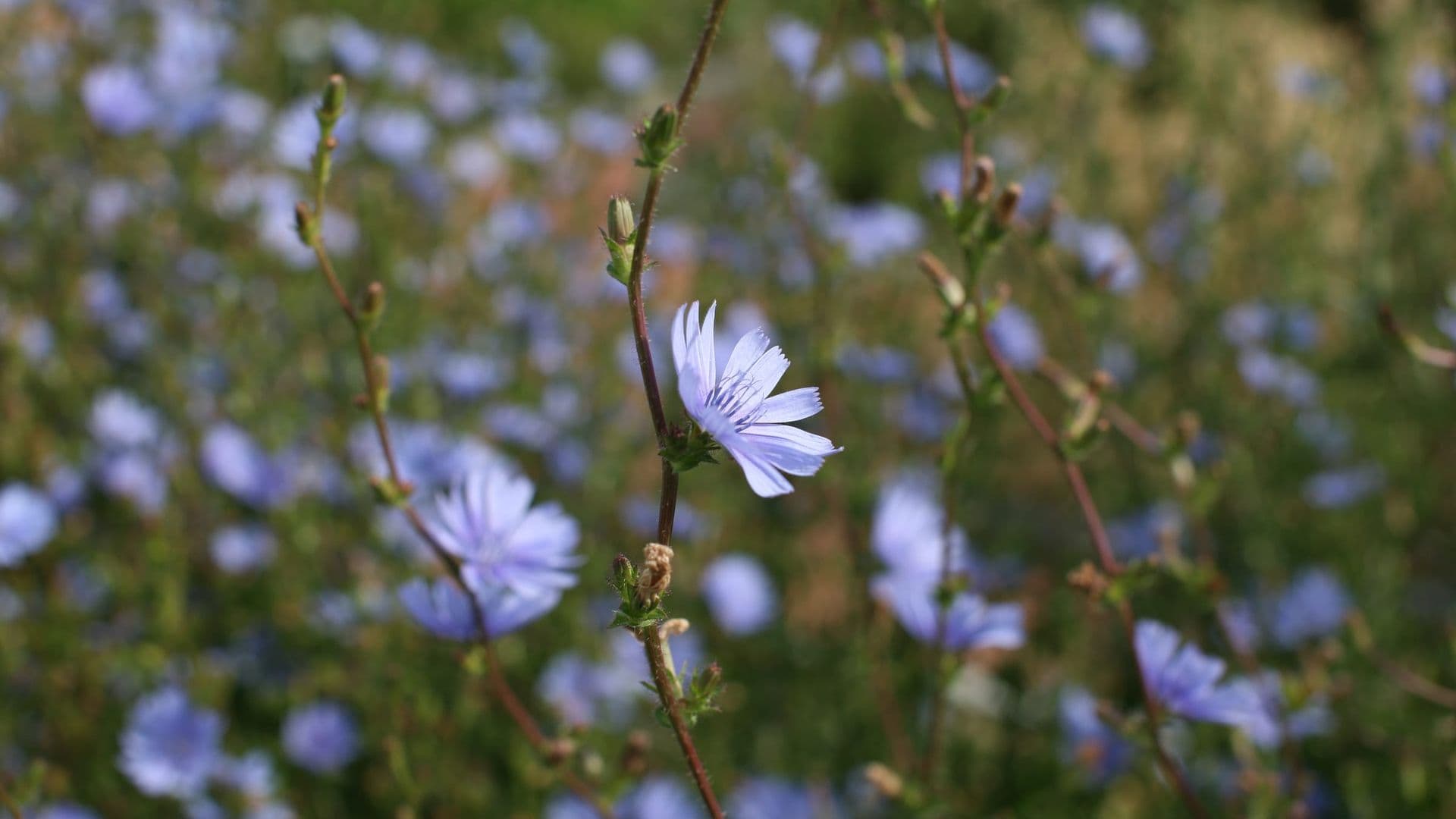
The chicory (Cichorium intybus L.) is a biennial or perennial plant from the family of Asteraceae and commonly grows at paths and field edges. Its root extends deep into the soil, and the plant is considered highly regenerative. From its basal rosette, whose leaves resemble those of dandelion, it later produces an upright, quite branched stem — at this stage it is no longer to be confused with dandelion. The stem grows up to 1.50 m high and bears many pale blue, rarely white flower heads from July to September. The 3 to 5 cm large flowers are very short-lived: in hot weather they open only in the morning and wither again by the afternoon. The plant continuously renews wilted flowers.
Essence of the plant
The power of now, ‘yes’ to the present, fidelity
Man walks a path with many forks, and at each junction one must make a decision. Does one truly follow their path, remain faithful to it, or is one led astray by external influences or inner doubts? Is one trapped in the stream of time?
Does one struggle with the past, dream of the future? Or does one move through life with the playful lightness of the moment like the jester? At medieval courts the jester enjoyed immunity.
The flowers wither after just a few hours. He held a mirror up to the ruler, without moral judgement, playfully, foolishly. The lightness of now contains a playful yet deeply serious dimension and renders one invulnerable because it stands in truth. The chicory places the human with both feet in the present moment, awakens from daydreams and connects with the now, the here and the present.
The signature of the now, of today, shows one their location. Not through the past, not through the future, but through the radiant today, the moment in which I live, I am connected with my original mission. Chicory’s sky-blue blossom opens a window anew each day, leading one out of the flow of time into the moment and thereby into the reality of one’s innermost true mission.
In consciously grasping the moment, one perceives their current location without value judgement. They realise that they are guided according to a plan, that their existence is governed by a law. This law is fidelity to oneself, loyalty to one’s own life plan, to the original mission.
Cichorium intybus
Chicory
From shape to healing power
Chicory (Cichorium intybus L.) belongs to the family of Asteraceae or Compositae (daisy family). Medicinally, the roots are used. Striking are the many sky-blue flowers, which bloom for only a single morning and wither in the midday heat. The sky-blue of the flowers is extraordinary, touching the soul.
The process of fading occurs in such a short time that, with some patience, it can be observed, which is possible with only a few plants. The large basal leaves are strongly lobed and in the rosette stage practically indistinguishable from the leaves of dandelion, but the stem leaves are very small, so they hardly appear. Without flowers, that is on hot summer afternoons, the plant appears as a plain, tangling mass of stems growing randomly. Yet every new morning, new, beautiful flowers unfold from the buds, which are numerous in the nodes, until they wither again in the midday heat.
Demeter cultivation
Chicory is native to Europe, Western Asia and North Africa and occurs as a ruderal plant on roadsides, embankments, rubble sites and poor grasslands. In Switzerland, it is common in the Central Plateau.
Ceres uses chicory root from Demeter cultivation. The roots are harvested early in the year. Chicory is usually one of the first fresh plants of the year to be processed.
Traditional Use
Chicory, Cichorium intybus L., has a long history as a medicinal plant, coffee substitute, and fodder crop. The great ancient physician Dioscorides already valued this medicinal plant as a valuable aid for the stomach, and the saintly Hildegard von Bingen also describes chicory as a remedy for hoarseness and constipation. Chicory is also known in homeopathy for use in constipation. Particularly noteworthy is the use of Cichorium preparations for gastric mucus and sluggish digestive activity or constipation. Even today, chicory is traditionally used for feelings of fullness, flatulence, and sluggish bowels. This is partly due to the mildly choleretic and appetite-stimulating effect of the bitter chicory root.
Sources
1. Madaus, G. MADAUS LEHRBUCH DER BIOLOGISCHEN HEILMITTEL BAND 1-11. (mediamed Verlag, Ravensburg, 1990).
2. BGA/BfArM (Kommission E). Cichorium intybus (Wegwarte). Bundesanzeiger 76, (1987).
3. Street, R. A., Sidana, J. & Prinsloo, G. Cichorium intybus: Traditional uses, Phytochemistry, Pharmacology, and Toxicology. Evidence-based Comple ment. Altern. Med. 1–13 (2013). doi:10.1155/2013/579319
4. Committee on Herbal Medicinal Products (HMPC). Community herbal monograph on Cichorium intybus L., radix. EMA/HMPC/121816/2010 (2010).
5. BGA/BfArM (Kommission D). Cichorium intybus (Cichorium). Bundesanzeiger 109 a, (1987).
6. Riha, O. Hildegard von Bingen - Werke- Band V- Heilsame Schöpfung - Die natürliche Wirkkraft der Dinge - Physica. (Beuroner Kunstverlag (Abtei St. Hildegard, Rüdesheim/Eibingen), 2016).
7. Kalbermatten, R. & Kalbermatten, H. Pflanzliche Urtinkturen. (AT Verlag, Aarau, Schweiz, 2014).
8. Kalbermatten, R. & Kalbermatten, H. Psyche des Menschen und Signatur der Heilpflanzen. (AT Verlag, Aarau und München, 2020).
7. Kalbermatten, R. Wesen und Signatur der Heilpflanzen. (AT Verlag, Aarau, Schweiz, 2016).
Life in the Now
R. & H. Kalbermatten — «Psyche des Menschen und Signatur der Heilpflanzen»
Ceres mortar process — gentle, cold and complete.
Freshly harvested, hand-picked, ground at room temperature and aged for years. No heating, no pressure - the plant's full vitality is preserved.