Rosemary
Rosmarinus officinalis
Fire, enthusiasm
Botany
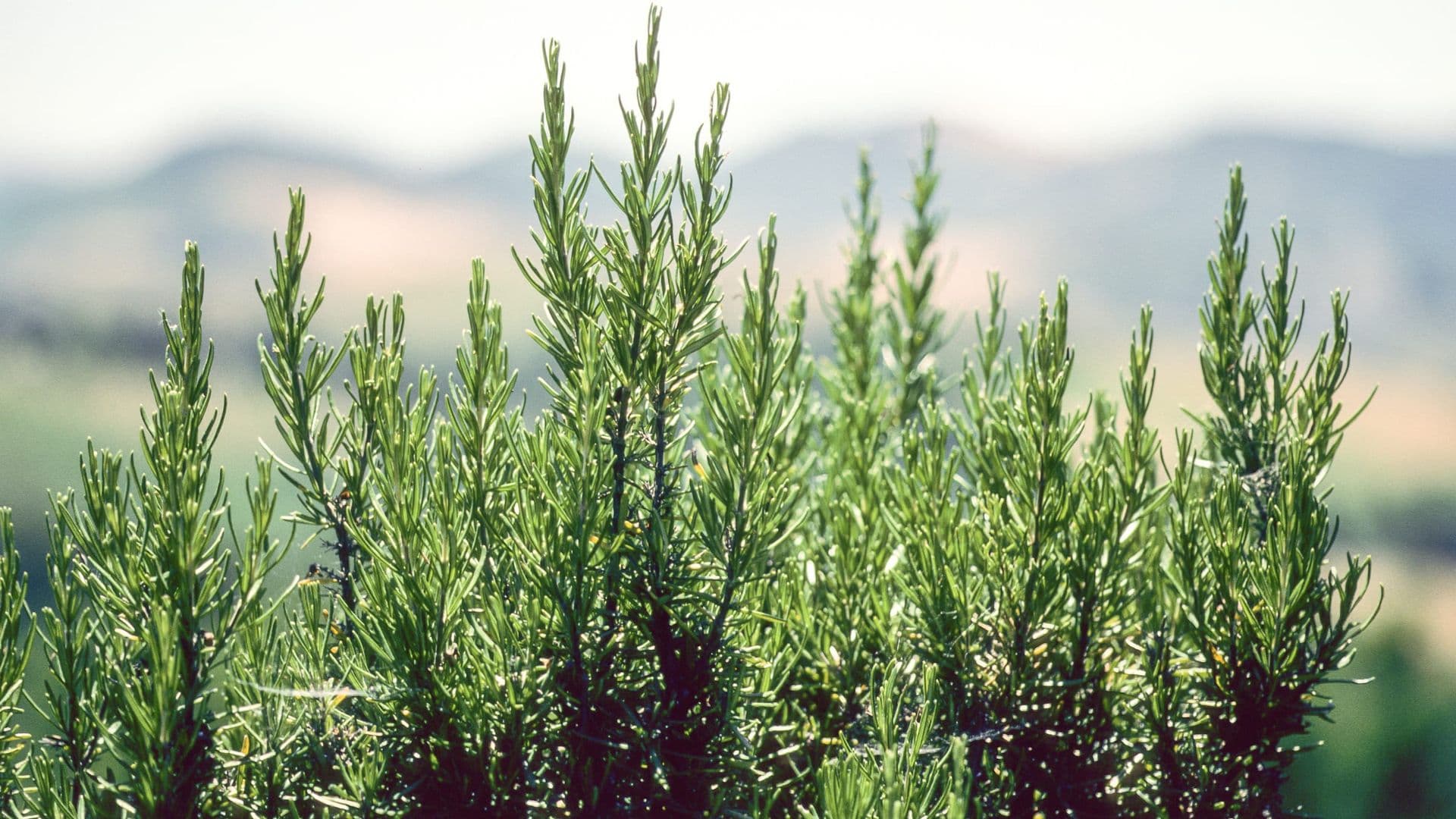
Rosemary (Rosmarinus officinalis L.) is an aromatic-smelling, evergreen subshrub up to 200 cm in height. It belongs to the family of Lamiaceae (mint family) and, like many species in this family, is distinguished by a strong, characteristic aroma — stimulating and fiery, caused by the lightly volatile essential oil. Native to the warmth-loving Mediterranean coastal region, rosemary is now widespread throughout Central Europe, where it overwinters in sheltered locations. The whole plant has a strong tendency to become woody; only the young shoots of the current year are fresh and non-woody. The entire leaf margin is broad and needle-shaped, arranged in many whorls, and densely hairy underneath, which, together with the folded leaf edges, gives them a whitish appearance. The plant flowers very early in the year with pale blue two-lipped flowers.
Essence of the plant
Fire, enthusiasm
The essence of rosemary ignites the spirit, inspires enthusiasm. When one can no longer be enthusiastic about anything, when the "feu sacré" has died out and lethargy sets in, the circulatory system also lacks the dynamising principle. Rosemary kindles energy, stimulates the circulation, warms the blood, and helps prevent anaemia.
For example, people who show great dedication and commitment in social professions usually have a lot of enthusiasm themselves and can infect coworkers and colleagues with their enthusiasm, thereby creating a positive environment and achieving high goals. The great inner warmth causes rosemary to bloom as early as February or March. Often, however, these very people do not think about recharging their own "batteries"; their environment relies too much on them and naturally expects their unrestricted presence.
This leads to burnout syndrome. The same person who previously served others with much love for the cause and sparkling joy is now empty and burnt out. They can no longer warm to anything, no longer find joy in anything, lacking the strength to do so. Rosemary stimulates circulation and warms body and soul with its aromatic, fiery essence.
It strengthens the stomach and pancreas and acts as a tonic. When young women suffer from anaemia, their complexion is pale and their circulation weak, rosemary helps; it counteracts anaemia, stabilises low blood pressure and improves circulation. Rosemary has the power to uplift the person, dispels lethargy and conveys joy in life again.
Rosmarinus officinalis
Rosemary
From shape to healing power
Among therapists, the saying goes: «What rosemary is for the mind, lavender is for the soul.» It is therefore known that rosemary stimulates the mind. In connection with mind and enthusiasm, we also speak of fire, of the «feu sacré». We know that only those who keep a cool head can think clearly. But fire is hot, and a hot-headed person can hardly be brilliant.
Is there not a contradiction here? Fire is not only hot, it also emits light, and its flames are very mobile. The fire of our life-giver, the sun, nourishes the heart and blood circulation with its heat, the head and thoughts with its light and movement energy, and the solar plexus and life processes with its ethereal energy. Of these fiery qualities, rosemary mainly conveys heat and mobility.
When the essential rosemary oil is rubbed onto the skin, an intense warming and reddening occurs due to increased circulation. Taken internally, rosemary unfolds a very dynamic fiery effect on the heart and circulation. This is the basis of its healing power for circulatory complaints and rheumatic diseases. The principle of mobility of flames is recognised in rosemary in the shape of the leaves. Do they not remind us of narrow tongues of flame?
Because the elongated, needle-shaped leaves are tightly directed upwards along the shoot, we mostly perceive only their undersides, which bear a light longitudinal stripe in the middle. This occurs because the green, smooth leaf upper side curls around the densely white-felted underside. Thus, only a narrow light central stripe of the underside remains visible. Due to their colour, the little flames remind us less of a light-emitting fire than of gas flames.
In our inner perception, rosemary appears as a bush with countless flickering little flames moving up and down, which arise explosively like small gas eruptions emerging from the wood and then vanish again. Thus, our intuition presents an image of the enormous mobility and lightness of fire, and thereby an analogy for the mobility and lightness of the mind, the ability to ignite and become enthusiastic in the mind. Incidentally, the real possibility of ignition underscores this intuitive image: Essential rosemary oil has the greatest volatility of all essential oils. On very hot days (in the main cultivation areas of the Mediterranean countries), it can happen that over a large field the concentration of rosemary oil is so high that a spark ignites parts of the field.
Organic cultivation
Rosemary is native to the western Mediterranean region and grows in dry, calcareous, sunny locations. In Switzerland, it is cultivated outdoors in warmer areas (Valais, Ticino).
Ceres uses rosemary leaves from organic cultivation.
Traditional Use
The sun-loving rosemary shrub is cultivated throughout the Mediterranean region to obtain essential oil by means of steam distillation. This oil is used in the perfume industry and also in many medical-cosmetic products such as ointments, massage oils, bath additives, and soaps. Many of these products primarily aim to locally stimulate skin blood circulation through a hyperaemic or warming rub. This effect is suitable for the topical treatment of rheumatic diseases and circulatory complaints. Due to its antioxidant, preservative properties, rosemary leaves are also a popular additive in foods and serve as a favourite culinary spice. Medicinally, Rosmarinus officinalis L. is used as a carminative and stomachic for digestive disorders, as it tones the stomach and intestinal tract. According to Madaus, this medicinal plant is also a good tonic for states of exhaustion, memory weakness, and dizziness (e.g., in low blood pressure). Homeopathy applies rosemary for menstrual disorders. Due to rosemary's toning effect, the main focus of use from a naturopathic perspective is especially in the area of amenorrhoea and oligomenorrhoea.
Sources
1. Hänsel, R. & Steinegger, E. Hänsel / Sticher Pharmakognosie Phytopharmazie. (Wissenschaftliche Verlagsgesellschaft GmbH, Stuttgart, Deutschland, 2015).
2. Wichtl, M. et al. Teedrogen und Phytopharmaka. (Wissenschaftliche Verlagsgesellschaft GmbH, Stuttgart, Deutschland, 1997).
3. Madaus, G. MADAUS LEHRBUCH DER BIOLOGISCHEN HEILMITTEL BAND 1-11. (mediamed Verlag, Ravensburg, 1990).
4. Committee on Herbal Medicinal Products (HMPC). Community herbal monograph on Rosmarinus officinalis L ., folium. EMA/HMPC/13633/2009 (2010).
5. BGA/BfArM (Kommission D). Rosmarinus officinalis. Bundesanzeiger 86, (1994).
6. Hänsel, R., Keller, K., Rimpler, H. & Schneider, G. Hagers Handbuch der Pharmazeutischen Praxis Band 5 Drogen P-Z. (Springer Verlag Berlin Heidelberg, 1994).
7. Kalbermatten, R. & Kalbermatten, H. Pflanzliche Urtinkturen. (AT Verlag, Aarau, Schweiz, 2014).
8. Kalbermatten, R. Wesen und Signatur der Heilpflanzen. (AT Verlag, Aarau, Schweiz, 2016).
Ceres mortar process — gentle, cold and complete.
Freshly harvested, hand-picked, ground at room temperature and aged for years. No heating, no pressure - the plant's full vitality is preserved.