Dandelion
Taraxacum officinale
Transformation, adaptability, flow of life energy, warmth, life force
Botany
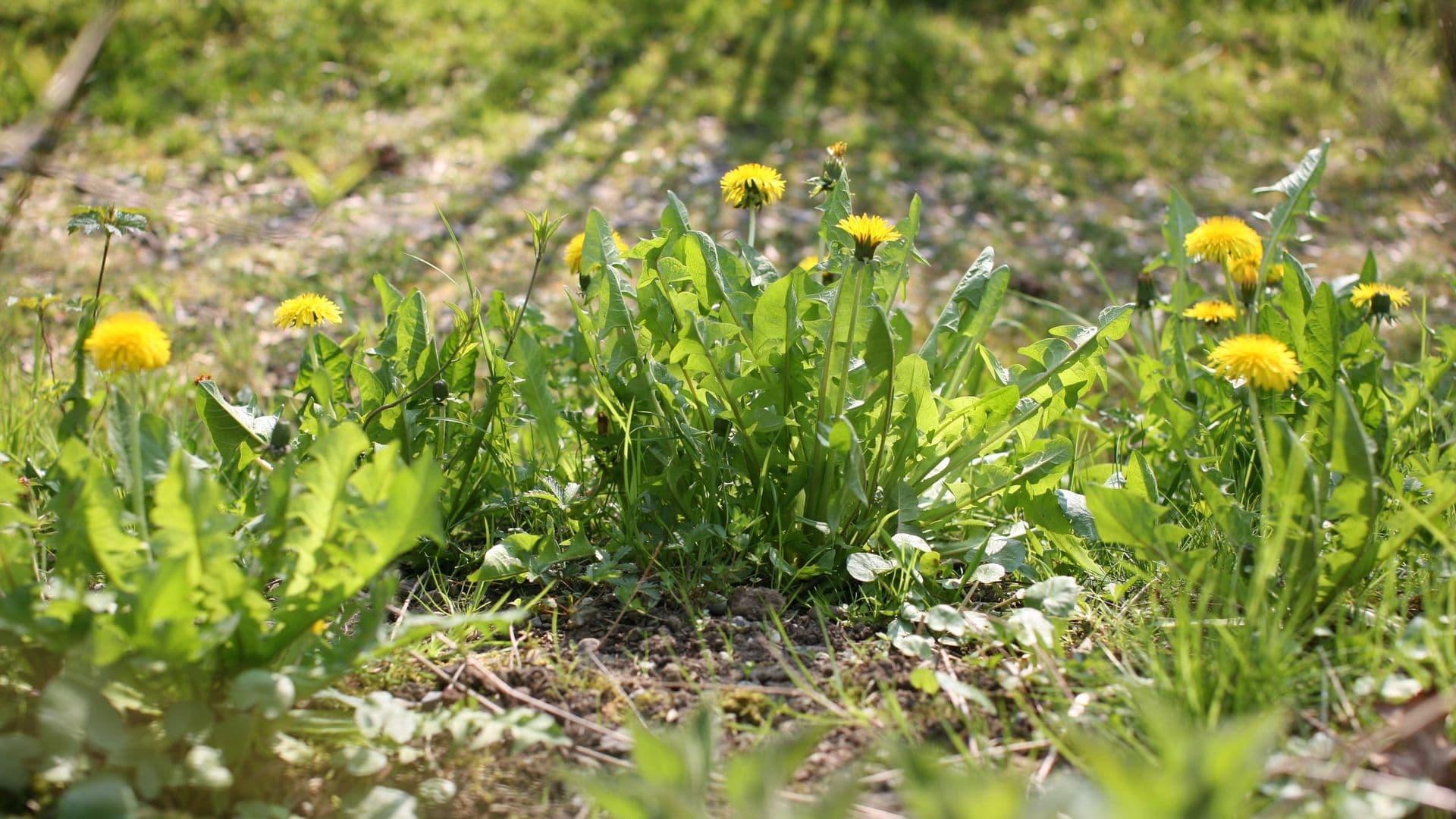
Who does not know dandelion? It belongs to the family of Asteraceae and is found on nutrient-rich meadows, fields and gardens, even venturing into cities. It prefers over-fertilised sites with a high nitrogen content. With its taproot, it penetrates up to 2 m into the soil and grows over 40 cm above ground. The root is very vital and can regenerate from small fragments.
The leaves form a basal rosette. They are obovate to oblanceolate, bright grass-green, extremely varied, and differently pinnately lobed — no two are identical in shape. Flowering begins early in spring, at the latest in April. The large, sun-like yellow flower heads — composed of up to 200 ligulate florets — only open in sunny weather. They stand on hollow, tube-like stems. The development from bud to “blowball” is rapid. Dandelion leaves taste bitter; all parts of the plant are filled with a white, rubbery sap, which after washing leaves typical brown and black stains on clothing.
Essence of the plant
Transformation, adaptability, flow of life energy, warmth, life force
Dandelion is one of the most adaptable and vital plants. The transformation and adaptability conveyed by dandelion relate equally to ideas, values, and perceptions as to the metabolic activity of the liver. Both levels exhibit a close connection: just as the liver performs an active conversion of chemical substances, so the inner perception undergoes continual adjustments, changes, and expansions throughout life.
Concepts must be tested against life experience and adjusted or corrected if necessary. Yet no other process on the emotional and mental level causes as much difficulty as changing once-formed values and perceptions.
Although perception and reality always differ to some extent due to the imperfection of consciousness, when a certain degree of divergence is exceeded, it leads to annoyance or bitterness. This is usually accompanied by a disruption of liver function and bile flow. Dandelion stimulates the processes of transformation and adaptation, dissolves blockages and stagnations in mind and body, and thereby imparts new vitality.
Taraxacum officinale
Dandelion
From shape to healing power
This video is provided by YouTube and requires your consent.
The dandelion heralds spring with great power: the meadows are still cold and wet from winter. In the sky, the sun traces higher paths once again, touching nature with the first warming rays. The new year awakens. Now the dandelion blooms in large numbers, colouring entire meadows yellow with thousands of tiny suns that have fallen upon the earth.
For a time, we can enjoy these harbingers of spring, but soon the sunflowers transform into silver-bright, airy globes of seed heads. When the seeds have matured, the little parachutes are carried far and wide with the first wind. The yellow blossoms are like mirrors of the sun; when it disappears behind the clouds, they close. If it rains, the flowers sometimes close so tightly that it is no longer apparent whether they have already withered.
With its strong taproot, the dandelion is well anchored. The entire plant is soft, the stem hollow and tubular, flowing with abundant white milky sap. All parts of the plant contain this sap, which – when children play with the stems building water pipes – leaves black, permanent stains on clothing. The leaves are variously toothed (hence the name); no two leaves could ever be made to match in shape. The scent is faint, barely perceptible, but the taste of all parts of the plant is bitter.
Within this bitter taste, we find the dandelion’s connection to the liver and gallbladder, as bitter substances stimulate bile flow and liver functions. The dandelion, with its entire essence, stands in complete opposition to any rigidity or fixation on firm shapes and stability. It is wholly oriented towards change. In its transformation of forms, it mirrors the constantly flowing metabolic processes of the liver.
Wild collection
Dandelion is native to Europe, North Africa and Western Asia and is now almost worldwide in distribution. It colonises meadows, pastures, roadside verges, gardens and parks up to mountainous regions and can even be found in our cities.
Ceres uses the fresh whole plant from wild collection in Switzerland. The plants are harvested in spring at the beginning of the flowering period.
Traditional Use
Dandelion is one of the best-known and most widely used medicinal and food plants of the Central European flora. It is traditionally used in spring cures to stimulate metabolism and purify the blood. The range of dosage forms is very broad, spanning fresh plant juices, tea infusions, fluid and dry extracts, to alcoholic mother tinctures. The target organ of preparations from Taraxacum officinale L. in various therapeutic approaches is the liver-gall system. The restoration of liver and gallbladder function is central to this. Disorders of the liver-gall system are often associated with fatigue, weakness, skin conditions, itching, digestive and upper abdominal complaints. Since dandelion particularly stimulates the flow of bile, it has an overall beneficial effect on the entire gastrointestinal tract. Loss of appetite and dyspeptic complaints such as a feeling of fullness and bloating can be treated alongside with dandelion. The areas of application of dandelion extend phytotherapeutically to the urogenital tract. By stimulating diuresis, this medicinal plant can also be used to flush the urinary tract and as an adjunct treatment for mild urinary complaints. Further traditional areas of application of
Sources
1. Hänsel, R. & Steinegger, E. Hänsel / Sticher Pharmakognosie Phytopharmazie. (Wissenschaftliche Verlagsgesellschaft GmbH, Stuttgart, Deutschland, 2015).
2. BGA/BfArM (Kommission E). Taraxaci radix cum herba (Löwenzahnwurzel mit -kraut). Bundesanzeiger 228, (1984).
3. Madaus, G. MADAUS LEHRBUCH DER BIOLOGISCHEN HEILMITTEL BAND 1-11. (mediamed Verlag, Ravensburg, 1990).
4. Committee on Herbal Medicinal Products (HMPC). COMMUNITY HERBAL MONOGRAPH ON TARAXACUM OFFICINALE WEBER ex WIGG., RADIX CUM HERBA. EMA/HMPC/2128895/2008 Corr (2019).
5. BGA/BfArM (Kommission D). Taraxacum officinale (Taraxacum). Bundesanzeiger 66a, (1989).
6. Hänsel, R., Keller, K., Rimpler, H. & Schneider, G. Hagers Handbuch der Pharmazeutischen Praxis Band 5 Drogen P-Z. (Springer Verlag Berlin Heidelberg, 1994).
7. Kalbermatten, R. Wesen und Signatur der Heilpflanzen. (AT Verlag, Aarau, Schweiz, 2016).
8. Kalbermatten, R. & Kalbermatten, H. Pflanzliche Urtinkturen. (AT Verlag, Aarau, Schweiz, 2014).
Adaptability
R. & H. Kalbermatten — «Psyche des Menschen und Signatur der Heilpflanzen»
Ceres mortar process — gentle, cold and complete.
Freshly harvested, hand-picked, ground at room temperature and aged for years. No heating, no pressure - the plant's full vitality is preserved.