Shepherd's purse
Capsella bursa-pastoris
Retaining, restricting, containing life force
Botany
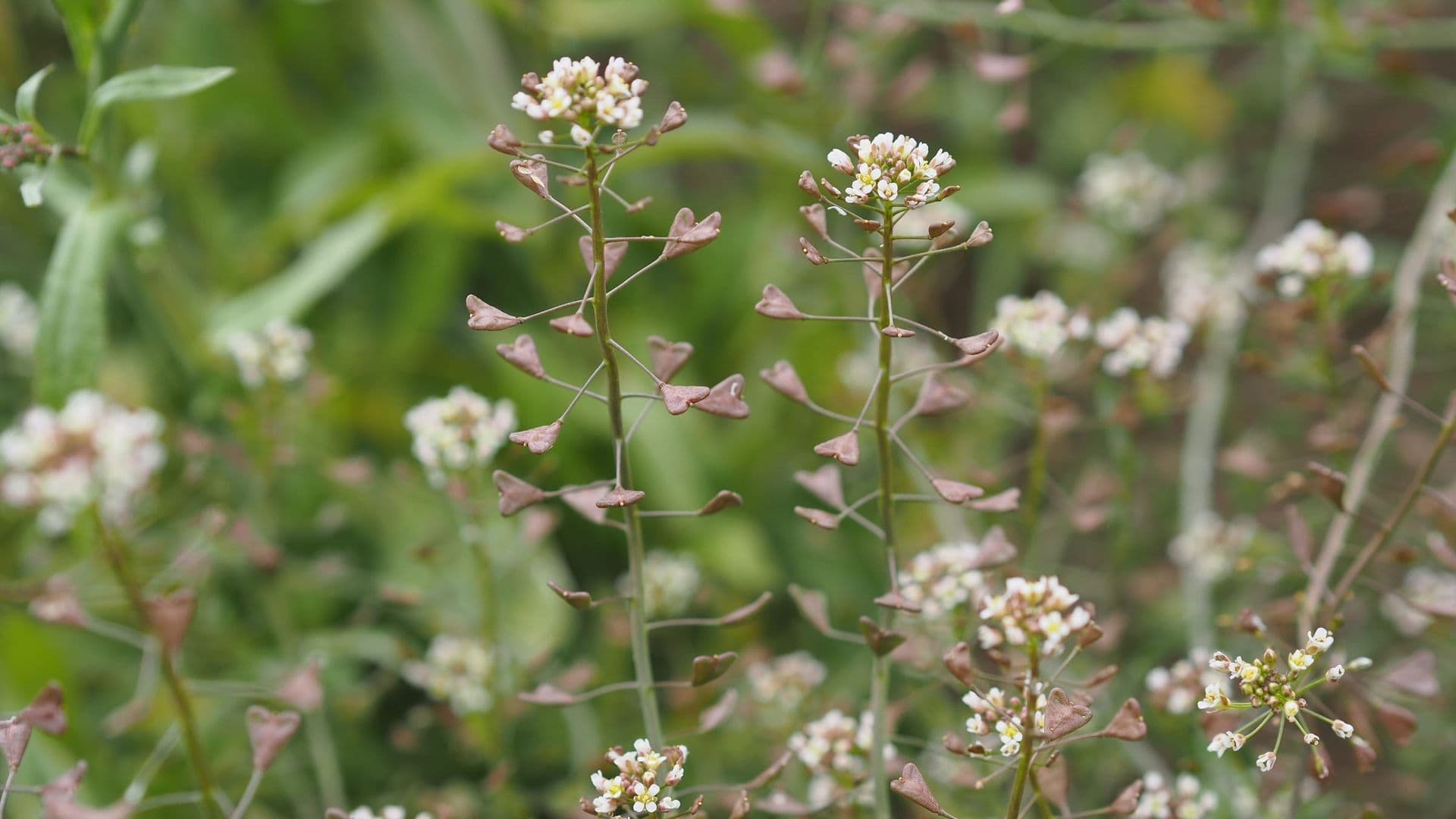
Capsella bursa-pastoris (L.) Medik., shepherd’s purse, is a plant belonging to the mustard family (Brassicaceae) and grows to about 10 to 70 cm tall. Its basal leaves, arranged in a rosette, can vary greatly in size and shape. The stem leaves, however, are significantly smaller and lanceolate-shaped. The plant can flower throughout the year. Its long-stalked white flowers initially grow tightly clustered together as buds and then elongate during flowering and fruiting. The flowers are white and only 2 to 3 mm long, mostly self-pollinating. The distinctive fruits of the plant are inversely heart-shaped, with the tip directed towards the stem. Their typical shape, reminiscent of shepherds' purses, has given the plant its name. Full of vigour, shepherd’s purse can produce up to 4 generations per year. The seeds retain this vigour, remaining viable in the soil for up to 30 years. Shepherd’s purse mainly colonises fields, fallows, and gardens, but can also be found on roadsides.
Essence
Essence of the plant
Retaining, restricting, containing life force
Shepherd's purse is a plant of intensely vibrating inner vitality, which it is unable to express outwardly through either colour or aura. It is in the nature of Shepherd's purse to contain its life forces and hold them firmly within, thereby preventing any loss. The essence of this plant could be described as the opposite of charismatic. It is conservative, thus preserving, and its life expressions never fall outside the bounds.
Shepherd's purse is a plant for people who often overextend themselves by stepping outside their personal boundaries. The resulting loss of life energy can also be compared to a bleeding. Capsella bursa-pastoris (L.) Medik. is therefore a plant that is extremely specific against physical and emotional forms of blood loss.
Capsella bursa-pastoris
Shepherd's purse
From shape to healing power
It took me a very long time to understand the signature and essence of Shepherd's purse. For years, I repeatedly studied it intensively to unravel its secret. The doctrine of signatures is not something schematic, where one can proceed according to fixed rules. There is no catalogue providing the meanings of various plant forms.
The first step is always to establish a soulful connection with a plant by opening oneself to its radiance. But Shepherd's purse completely puzzled me, as it was the only plant from which I could not perceive any radiance at all. I observed the plant for hours and examined it under the microscope in all variations, but could find nothing significant. Until one day I realised: Shepherd's purse has no radiance outwardly, but it radiates inwardly. And then I understood its signature and its essence.
In electrical engineering, we are familiar with antennas. They can receive or emit electromagnetic radiation. This is the same in the living nature. There are also “antennas” here, such as long thorns or hairs, for example.
Vertical and horizontal lines characterise the image of a Shepherd's purse stand. They are able and tasked with absorbing or emitting radiation – in this case, life energy. To graphically express a targeted movement, we draw an arrow. The tip of an arrow always points in the direction of the movement or radiation.
There are also arrows in nature, although much more rarely than antennas. One such example is Shepherd's purse. Let us consider the form of the seed pods. They are arrows pointing inward, towards the plant. Inward-pointing arrows are a very great exception.
These arrows indicate the direction in which the life forces of Shepherd's purse flow. With Shepherd's purse, we do not have an outward radiance as with all other plants, which communicate outwardly with their radiating forces, but rather the flow of forces moves in the opposite direction. This means the deepest essence of this plant consists in avoiding even the slightest loss of life force as much as possible. From this quality of essence, the blood-staunching effect can be best understood, for blood is pure life force.
Demeter cultivation and wild collection
Shepherd's purse, which originally comes from the Mediterranean region and West Asia, can now be found almost worldwide on arable land, roadside verges, waste ground and in gardens within temperate zones. It is one of the most undemanding medicinal plants there is.
Ceres uses Shepherd's purse from Demeter cultivation or wild collection at uncontaminated sites in Switzerland. The flowering plant is harvested in spring.
Traditional Use
Hitherto, Paracelsus was familiar with Shepherd’s Purse and classified it as a "Constrictivum". This term is of Latin origin and loosely translates to a "constricting agent". The haemostatic effect of Capsella bursa-pastoris (L.) Medik. has therefore been known for centuries and is extensively described in relevant natural medicine literature. Traditionally, preparations as herbal tea infusions and the use of alcoholic tinctures have been established. Shepherd’s Purse is regularly used especially in gynaecology. In particular, it is applied for excessive and prolonged menstrual bleeding, which in some cases accompanies uterine myomas. It can also be used after childbirth, following surgical procedures, and in cases of nosebleeds where there is a persistent tendency to bleed. Depending on the location of the bleeding complaints, either internal (oral) or external (topical) application is chosen. Another traditional form of use of medicinal preparations from Shepherd’s Purse concerns kidney complaints, especially when associated with the formation of concretes (sand, grit and stones) in the urogenital tract.
Sources
1. Vonarburg, B. Homöothanik - Arzneipflanzen der Homöopathie. (Haug Verlag, 2009).
2. Madaus, G. MADAUS LEHRBUCH DER BIOLOGISCHEN HEILMITTEL BAND 1-11. (mediamed Verlag, Ravensburg, 1990).
3. Committee on Herbal Medicinal Products (HMPC). Assessment report on Capsella bursa-pastoris ( L .) Medikus , herba (EMA/HMPC/262767/2010). (2011).
4. Kalbermatten, R. & Kalbermatten, H. Pflanzliche Urtinkturen. (AT Verlag, Aarau, Schweiz, 2014).
5. Kalbermatten, R. Wesen und Signatur der Heilpflanzen. (AT Verlag, Aarau, Schweiz, 2016).
Ceres mortar process — gentle, cold and complete.
Freshly harvested, hand-picked, ground at room temperature and aged for years. No heating, no pressure - the plant's full vitality is preserved.